Verdi – Il trovatore
Il Conte di Luna – Boris Pinkhasovich
Leonora – Eleonora Buratto
Azucena – Clémentine Margaine
Manrico – Enea Scala
Ferrando – Alexander Roslavets
Ines – Mariana Poltorak
Ruiz – Colin Aikins
Chor der Hamburgischen Staatsoper, Philharmonisches Staatsorchester Hamburg / Matteo Beltrami.
Stage director – Immo Karaman.
Staatsoper, Hamburg, Germany. Friday, March 20th, 2026.
The Staatsoper Hamburg does not always make photos available of repertoire evenings such as these. If they are subsequently made available, the review will be revised.
Tonight marked my first visit to the Staatsoper Hamburg since Tobias Kratzer took over as Intendant. The title of the 2025 – 26 season is ‘Framing the Repertoire’ and Kratzer and his team have already introduced some very exciting new initiatives. The season aims to place these repertoire performances, such as tonight’s revival of Immo Karaman’s 2024 staging of Il trovatore, into a wider artistic context. There’s a collection of books for visitors to peruse on the second floor, while a group of multilingual ‘Framing guides’, with badges denoting the languages they speak, are available in the lobby for visitors to discuss with, before and after the performance – much as one might find at a vernissage in an art gallery. This really is a terrific initiative as it makes the evening accessible to the audiences, much more so than a pre-performance talk for instance, and allow those who might not be as comfortable in asking questions in a bigger context to engage on a more personal level. The other attraction of this revival was the presence of Eleonora Buratto making her role debut this ru as Leonora, as indeed was Enea Scala as Manrico, while Clémentine Margaine reprised her Azucena, a role in which she was stupendous in Parma back in 2024.
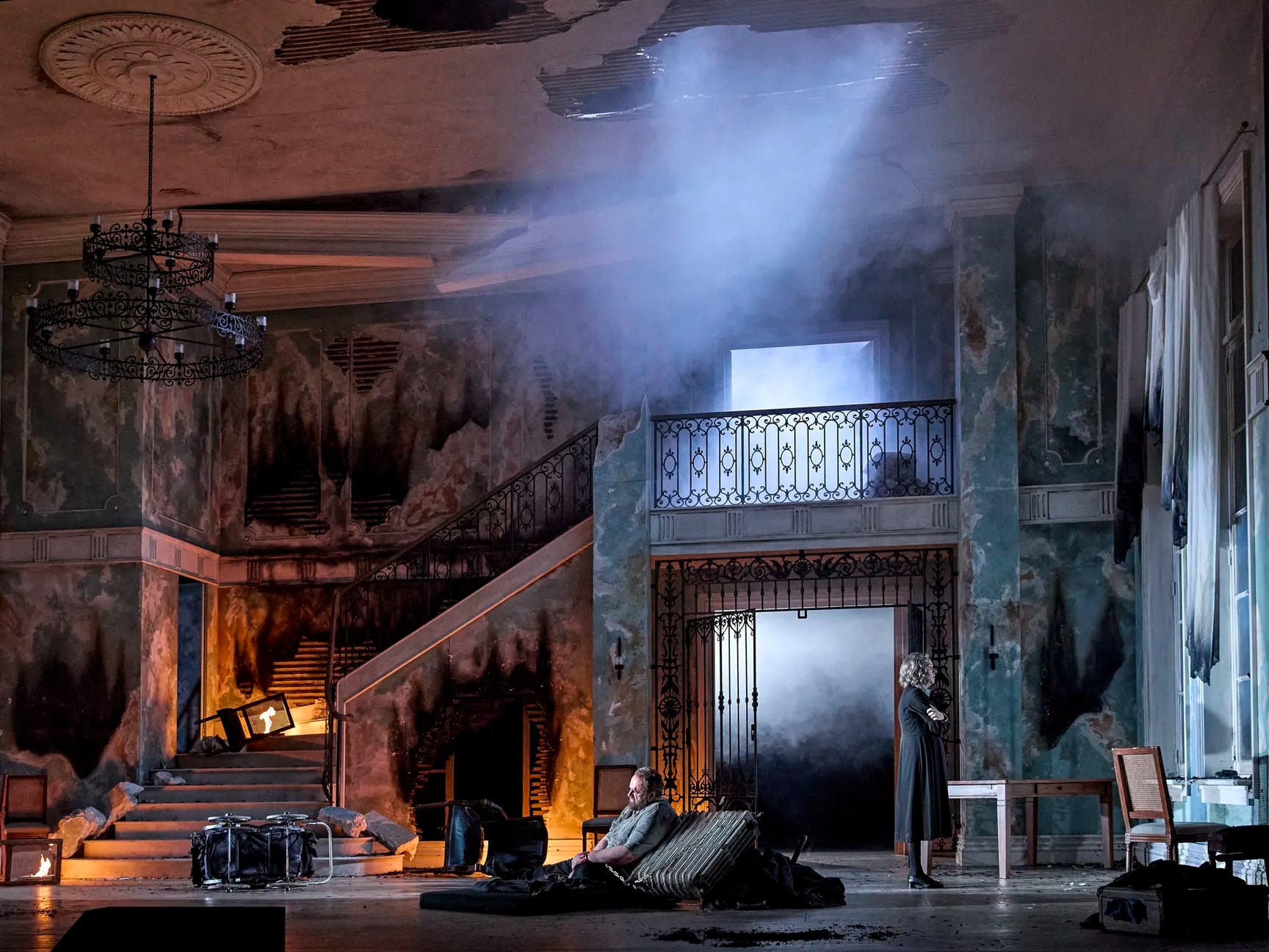
Trovatore is often considered as a work with a somewhat impenetrable plot. Perhaps it was as a result that Karaman chose to take a very visual approach to his storytelling. He sets the action in a single set, by Alex Eales, which in the first act already shows the signs of conflict with two holes in the ceiling. Some captions at the start of the evening inform us that this is a noble home, where Donna Leonora is holding a party, which is the setting for Ferrando to give his narration to the guests, while Azucena turns out to be a servant employed by Leonora. It is rather strange that Ferrando mentions in his narration that he would recognize Azucena immediately, only for him not to recognize her working in the house. During the second half of the evening, the captions announce that Leonora’s house is being held under siege and the set displays damage to the walls, the set itself disintegrating much like the lives of the protagonists.
It’s certainly an intriguing approach and yet Karaman, through revival director Johanna Schulz-Bongert, seems not to trust his principals to drive the action forward, constantly adding visual ‘noise’ through the use of extras. For instance, while Azucena sings ‘stride la vampa’ a ghostly, smoking female figure walks through the chorus. Or, as she sings the subsequent duet with Manrico, a burning baby stroller guides itself on stage and off again. Clearly, Karaman wants to accentuate the narrative, but the principals were doing that perfectly well without the additional visual clutter, especially since diction across the board was excellent. He also had a tendency to bring on extras to move furniture just as the principals were going into the final phrases of their arias, which again only served to distract from their performances. I longed for him to just allow the principals to drive the action forward. I did also wonder what the crowd who seemed to incarnate zombies for the Anvil Chorus represented as they didn’t appear to come back subsequently. Ultimately Karaman’s staging is serviceable and very much aims to clarify and tell a story, and in that respect, I imagine it was appreciated by the audience.
Matteo Beltrami led an interesting traversal of the score. This is a very elegant orchestra founded on a rich and warm bass line. I did find the opening to be rather suave, instead of the punchy vigour one might expect. His tempi, on the whole, kept things moving along, although I would have preferred some crisper articulation from the strings, with less vibrato. It did feel that perhaps Beltrami had drunk an espresso at intermission, since afterwards his tempi certainly picked up, with the closing scene given added urgency. That said, it did feel that Azucena’s final declaration of vengeance was a bit rushed. Beltrami was certainly a very sensitive accompanist to his singers, always allowing them through, while also allowing the brass to ring out. The quality of the orchestral playing was as good as one would expect here. Yes, there were a very few split notes in the brass, but they were very well behaved on the whole, and the winds were nicely forward in the orchestral texture. The chorus, prepared by Christian Günther, offered some particularly lusty singing in the tenors and basses – although they momentarily lost contact with the pit in ‘Squilli, echeggi la tromba guerriera’. The sopranos and mezzos offered some nicely mellifluous and well-blended singing in the nun’s chorus.
Leonora is most definitely a gift of a role for Buratto, one that shows her at her very best. I’ve written so often that in her vocalism one hears the great Italian tradition manifested. Tonight was no exception. Her opening ‘tacea la notte placida’ was sung with such poise and impeccable style, the breath control seemingly endless, spinning lines of great pulchritude in her peaches and cream tone. The following ‘di tale amor che dirsi’ was dispatched with almost nonchalant ease, turning the corners beautifully and with a genuine trill. Buratto rose to a ‘D’amor sull’ali rosee’ of immense beauty, the text always forward, the words so full of meaning, her milky-smooth legato sustained on staggering breath control, the voice taking wing on that cushion of sound. Perhaps there was a sense in the final act that she’s still growing into the role dramatically, though I have no doubt that in a staging with more rehearsal time Buratto will find even more depth to her characterization. Another fabulous assumption from this wonderful singer.
Margaine repeated her sensational Azucena. The voice is so full and round, with fabulous amplitude. She’s a born storyteller and doesn’t hold back in her vocalism and dramatic commitment. Her ‘Condotta ell’era in ceppi’ exemplified that approach. Margaine used the text to colour the tone, bringing out meaning, the horror of her narration vividly brought to life, at times letting the sound rip, at others descending to a generous chestiness while draining the colour from the tone. She was utterly mesmerizing. As Ines, Marian Poltorak sang in an attractive, bright soprano with a poised, elegant line.
Scala’s Manrico most certainly fired on all cylinders from the very start. His off-stage romance was sung with full-throated vigour rather than dreamy charm. Throughout the evening, he was most generous with his vocalism, singing his ‘Ah sì, ben mio’ at an unremitting forte. If one thought that was the limit of his decibels, the subsequent ‘di quella pira’ proved he was capable of even more volume. I longed for Scala to take his foot off the gas, to find a bit more light and shade in his singing. Particularly so, since the need to create volume also meant that the voice was made wider and pitch was saggy. We got both verses of ‘di quella pira’, sadly not ornamented, and he went for the Cs even though he landed short of the destination in both cases. Scala has a voice that is forward in placement and capable of good projection, he could certainly pull back and focus the tone and still be heard. He’s a capable singer and I hope he can, in future performances, just pull back a bit.
Boris Pinkhasovich sang Luna in an elegant line and focused tone. His ‘Il balen del suo sorriso’ was sung in long, easy lines with an impressive legato. Vocally he gave pleasure, although I did find his diction to lack the focus and incisiveness of his colleagues. Still, the security of his singing was gratifying to hear. Alexander Roslavets made so much of Ferrando’s opening monologue, dispatching it with stylistic panache and injecting the text with drama. As Ruiz, Colin Aikins sang with confidence, as did the uncredited Vecchio Zingaro and Messo.
Tonight was definitely ladies’ night at the Staatsoper, with both Buratto and Margaine exemplifying why they are two of the finest Verdi singers before the public today. Indeed, Buratto gave us a singing lesson tonight, demonstrating such an instinctive command of Verdian phraseology and style, while Margaine was utterly gripping. Beltrami’s conducting was efficient and kept the evening moving along. Karaman’s staging was not without visual interest, even if he didn’t seem to fully trust the principals to fully drive the drama forward. The audience responded politely during the course of the evening and at the close gave the principals a generous ovation.
 operatraveller.com