Wagner – Das Rheingold
Wotan – Gábor Bretz
Loge – Nicky Spence
Alberich – Scott Hendricks
Fricka – Marie-Nicole Lemieux
Erda – Nora Gubisch
Mime – Peter Hoare
Fasolt – Ante Jerkunica
Fafner – Wilhelm Schwinghammer
Donner – Andrew Foster-Williams
Froh – Julian Hubbard
Freia – Anett Fritsch
Woglinde – Eleonore Marguerre
Wellgunde – Jelena Kordić
Flosshilde – Christel Loetzsch
Symfonieorkest van de Munt / Alain Altinoglu.
Stage director – Romeo Castellucci.
La Monnaie – De Munt, Brussels, Belgium. Saturday, October 28th, 2023.
And so, it begins. The new Brussels Ring, a co-production with the Gran Teatre del Liceu, opened last week in this new staging by Romeo Castellucci and conducted by house Music Director, Alain Altinogolu. This evening’s was the third performance of the run of eight. For the cycle, the house has invited back many of the familiar faces we have seen here over the years. Of course, seeing Das Rheingold, at the start of a cycle always gives us tantalizing glimpses of where a director will take us over the course of the next chapters, but what is already apparent is that this will be a visually audacious cycle, as well as one of great detail.
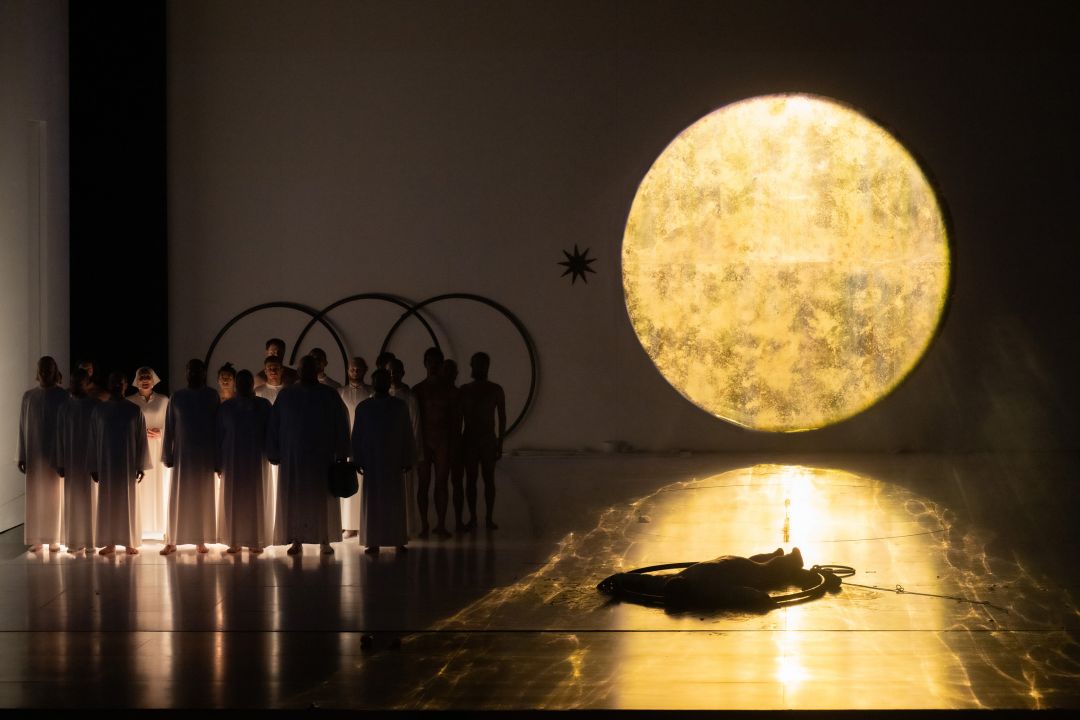
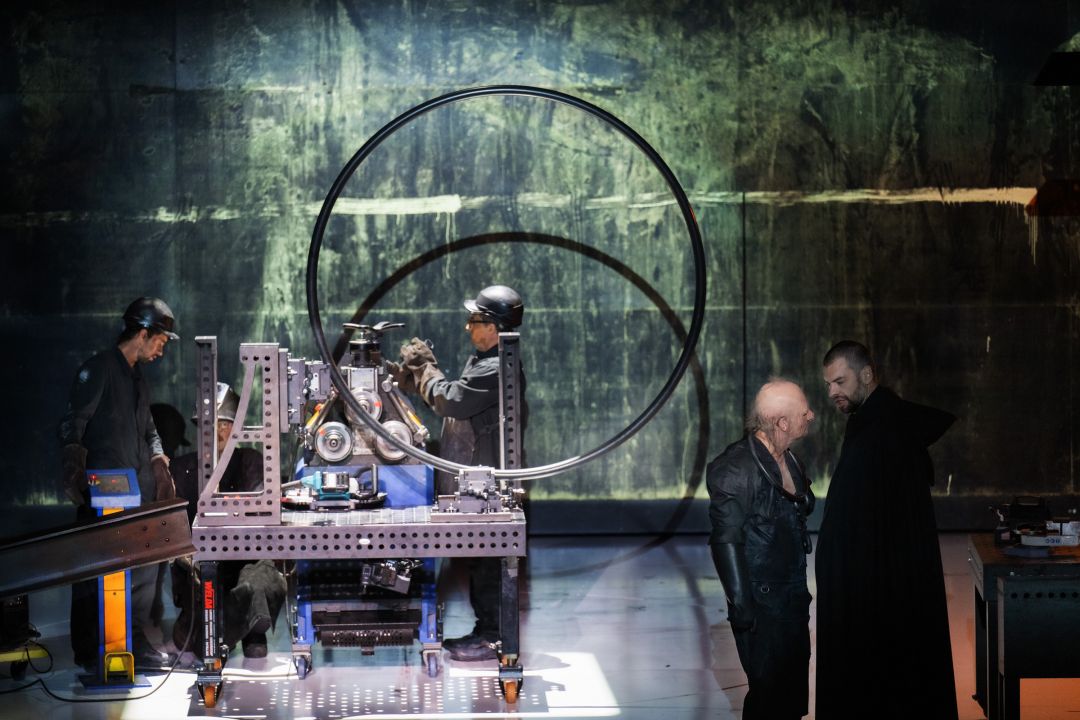
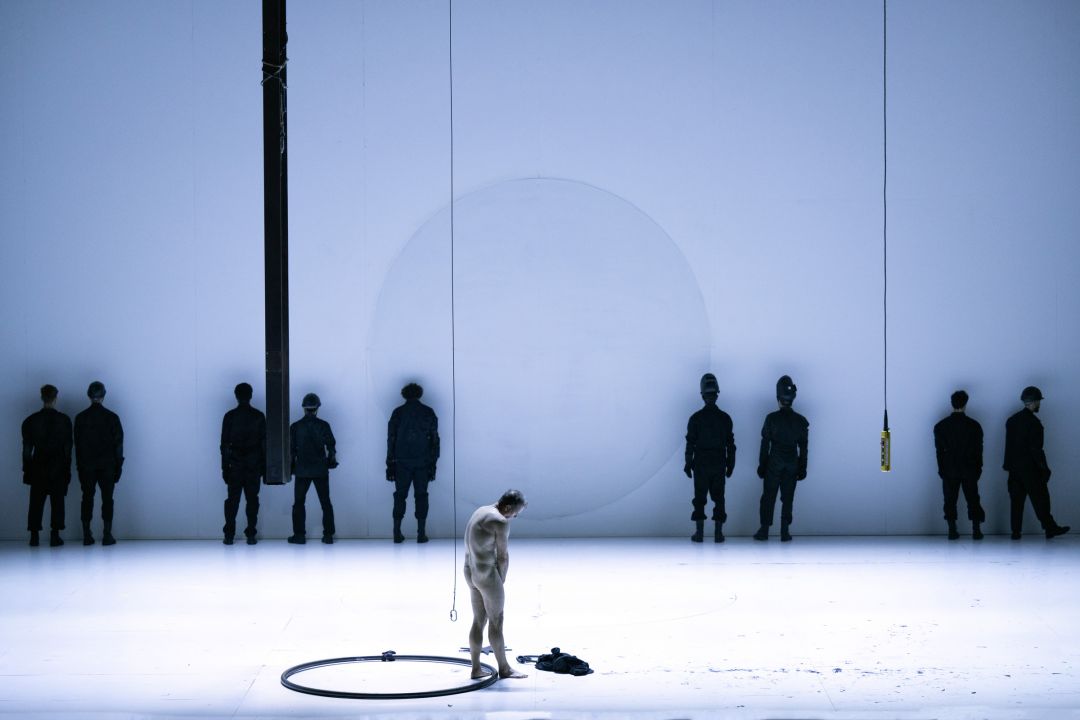
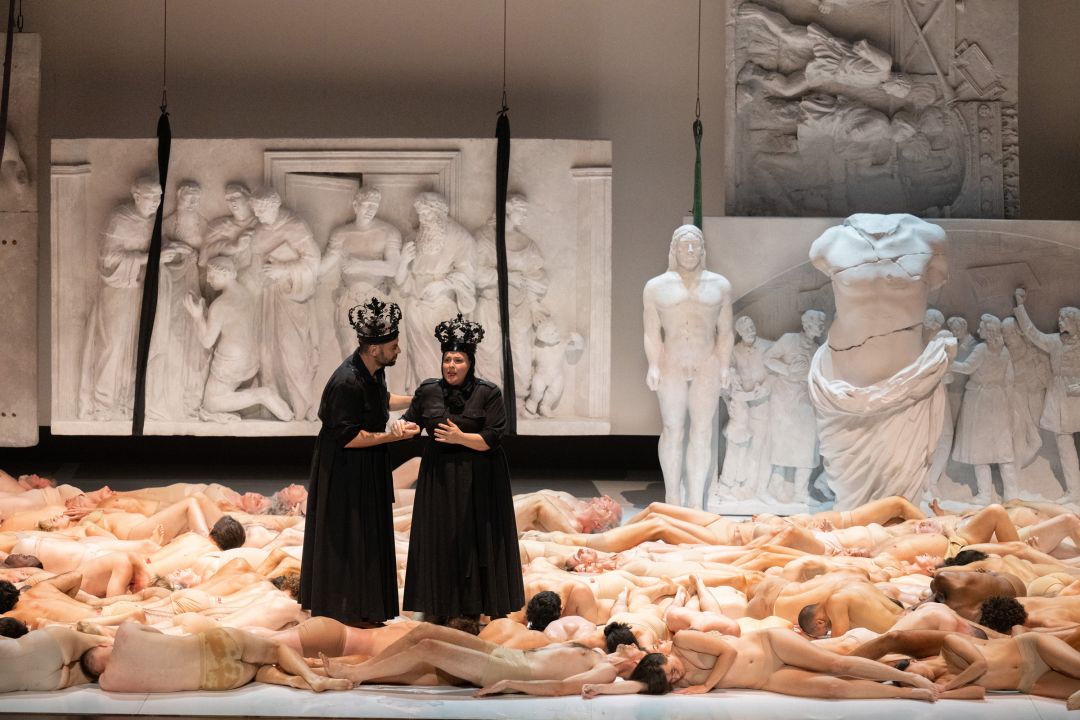
Castellucci’s visual world here is timeless, seemingly combining ancient Greece with sci-fi futurism. In a way, it feels that Castellucci is universalizing the narrative, as if to say that this is a story that has been repeated through history and will continue to be repeated long after we’ve gone. Our first glimpse of Wotan, is hearing the Valhalla motif with him standing in a pristine white room, surrounded by Grecian sculptures, the floor full of naked extras over whom the gods walk. Castellucci seems to be making a deeper point here about the corruption of resources – how power is obtained by those at the top literally stepping over those at the bottom. I found how he illustrated the Rheingold itself as a kind of ephemeral dust, that the Rhinemaidens caught in a bowl yet then morphed into water, was also highly compelling.
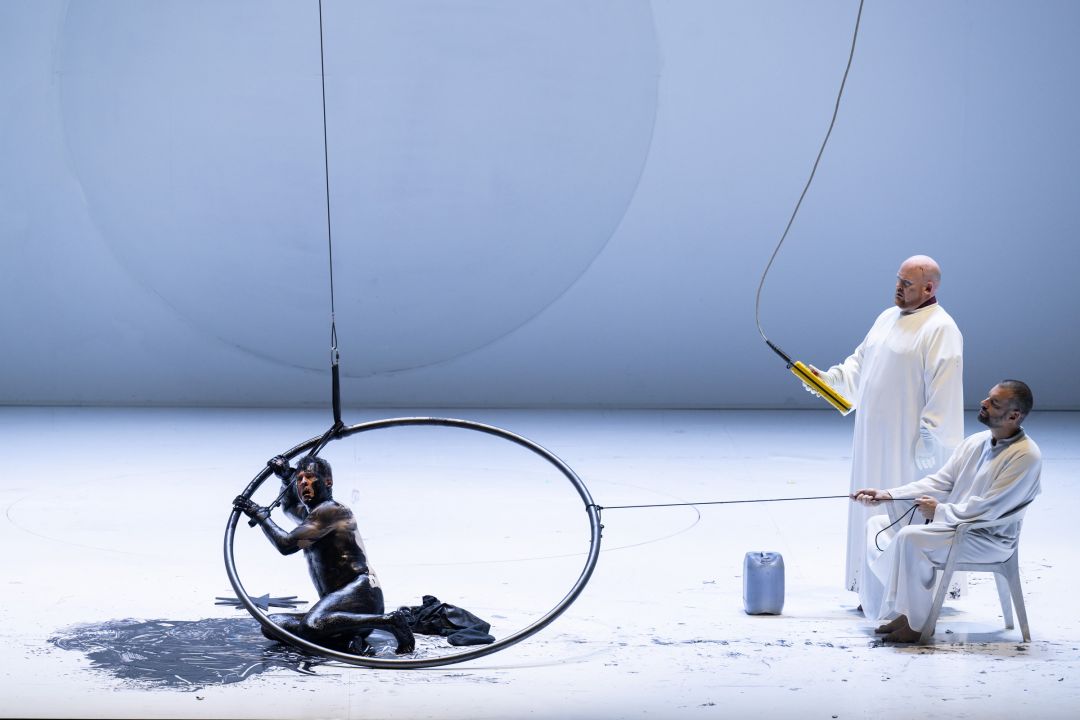
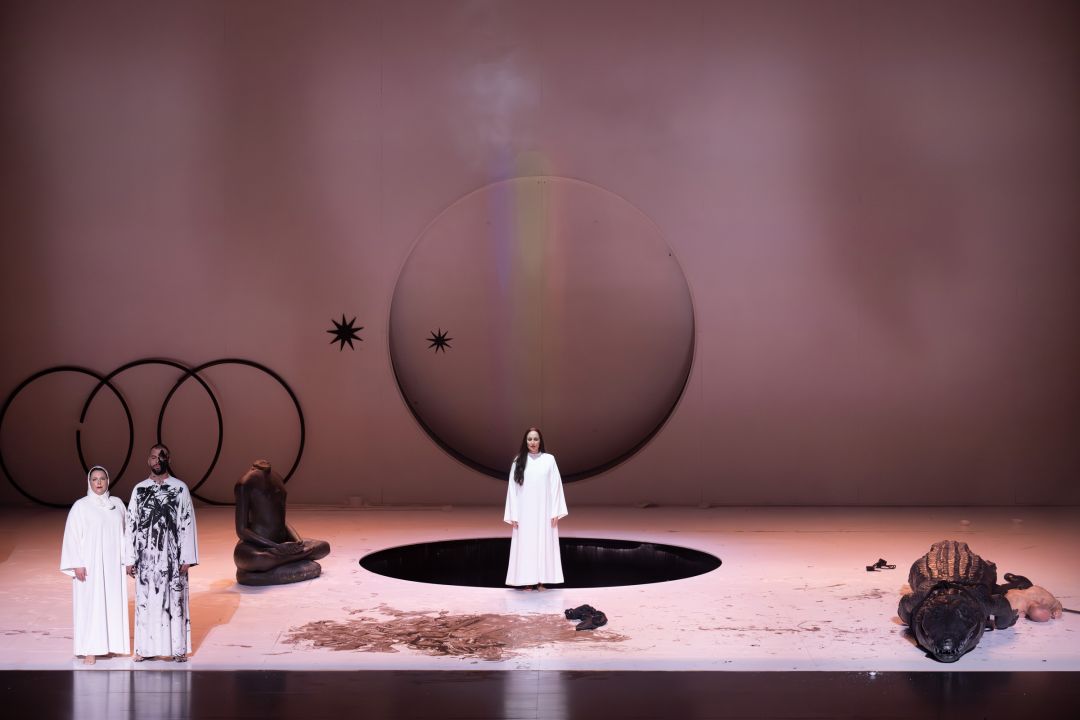
And yet, I can’t help but feel that beyond the visual audaciousness, Castellucci keeps us somewhat at arm’s length from the characters and their motivations. He asks so much of his singers physically and it’s a real credit to them that their vocalism is so secure throughout. Scott Hendricks’ Alberich is suspended in the air by his wrists during his confrontation with Wotan and Loge, completely naked other than some black paint to preserve his modesty. Indeed, I found how he tarred Wotan with the black paint to be particularly striking, as if passing on the curse. Similarly, there was no rainbow bridge here. Rather, the gods fell backwards one by one into a pit in the ground. For a spectator it was terrifying to watch – even if it made for a highly persuasive image of following Wotan’s lead into a place of unseen darkness. The extras, crawling around the floor, dragging one of the marble sculptures on top of them, was also rather harrowing to watch. One can only imagine the sheer number of health and safety discussions the creative team would have had with the stage technicians. That said, what is immediately apparent is that Castellucci not only has that rich theatrical imagination and the technical means to realize it, but he’s also able to bring his cast onboard to push themselves above and beyond to give such physically uninhibited performances.
The performance was greatly helped by the sheer clarity of diction across the cast – every word was clear throughout, while Altinoglu always let his singers through. There may have been nods to sci-fi on stage, but it was the playing from the orchestra that was simply out of this world. To play this score for two and a half hours, without a single split note or ragged entry is a massive achievement. Altinoglu’s reading was relatively swift, yet wasn’t afraid to pull back to bring out those crepuscular half-lights as we heard the Tarnhelm in the brass. He took risks with dynamics, not only to let the singers through, but also to allow the climaxes have even more impact and ring out splendidly in this grateful acoustic. The opening, growing out of nothingness, seemed to take wing in pulchritudinous lyricism, the intertwining lines seemed to sing as much as anything on stage. I also found the winds to be nicely forward in the texture, while the strings played with impressive depth of tone as we descended into Niebelheim. One already knew that this is one of the top three opera orchestras in the world, but tonight they reached another pinnacle. I simply cannot wait to hear them play the rest of the cycle.
Gábor Bretz sang Wotan in his familiar handsome and resonant bass. The voice is one of rare beauty and he coped extremely well with the tessitura, giving his Wotan a masculine warmth that I found especially pleasurable. There were some very small hints of tiredness towards the end of the evening with some graininess entering the tone, but the sheer depth of the sound he produced was most impressive. I very much hope he will look after that fabulous instrument as he looks ahead to the bigger sing that awaits him in Walküre.

Marie-Nicole Lemieux gave us a sensational Fricka. More than any interpreter I have seen of this role until now, Lemieux made her a three-dimensional character, at times strong and determined, at others warmly consoling Wotan. She achieved this through consistent pointing of the text, but also colouring it with a wide range of tone colours – at times steely, at others tenderly encouraging. Anett Fritsch sang Freia in a penetrating yet creamy soprano, the emissions always even. Nora Gubisch sang a hieratic Erda that was rich in tone, her auburn mezzo putting the words nicely forward so that when she warned, we listened.
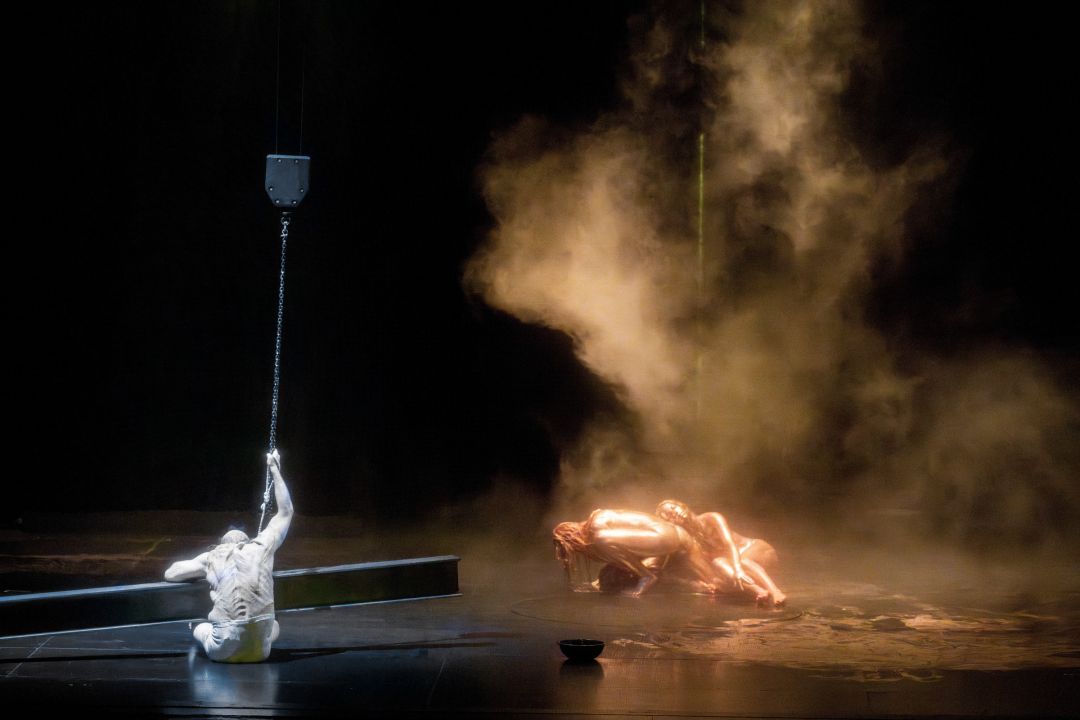
Nicky Spence sang Loge in a well-placed, forward tenor. He sang the role off the text, the hint of a Caledonian accent in his extremely clear German giving his Loge genuine character. Castellucci has Spence interpret the role as an extrovert fop, fully aware of his demigod status, demonstrated through his being dressed in shorts and casual shirt, but also in how he stayed clear of throwing himself into the pit that was Valhalla. Hendricks was fearless as Alberich, vocally and physically. At first, his baritone sounded rather acidic, the emissions rather loose. As the evening progressed, Hendricks found a firmness in the tone, spitting out the text with determination, maintaining that firmness of tone even when suspended in the air from his wrists – seriously impressive.
Julian Hubbard sang Froh with ardent tone and generous lyricism, while Andrew Foster-Williams sang Donner in a focused baritone. Peter Hoare sounded incredibly fresh of voice as a deliciously sardonic Mime. Both Ante Jerkunica and Wilhelm Schwinghammer were massive in voice as Fasolt and Fafner, both pouring out huge columns of sound into the auditorium. For the giants’ initial scene with the gods, Castellucci had the gods incarnated by children who mimed the text, to emphasize the giants’ heights, while the singers sang from the wings. From my seat, this was less than successful as the singers were virtually inaudible. We also had a mellifluous trio of Rhinemaidens, who sang their music robustly.
Tonight’s Rheingold made for an extremely exciting start to this new Ring. Certainly, the quality of the orchestral playing was simply superlative, while the singing across the board gave much satisfaction. I left the theatre with a sense of wanting to see Castellucci’s staging again. I did find that for much of the evening, I spent a lot of time reflecting on what was happening and how it was achieved by the cast, rather than allowing myself to be absorbed by it. For this reason, I do feel that it requires a second viewing to fully appreciate it. The run is completely sold out, but there will be a chance to see it when the production will be streamed on demunt.be from November 20th. This Rheingold is a work of immense theatrical audacity, performed by a cast that is completely committed to Castellucci’s vision of the work, and supported by an orchestra on glorious form. The evening was received with an enormous and generous ovation for the entire cast.
 operatraveller.com
[…] In Brussels, Alain Altingolu led a house orchestra on simply superlative form in Das Rheingold in a staging by Romeo Castellucci. They didn’t put a foot wrong in the entire score, not […]
[…] of the Ring at La Monnaie – De Munt reaches its second instalment, following the success of Rheingold last fall. Expectations were certainly raised by the Vorabend, thanks to the striking visual […]