Strauss – Salome
Herodes – John Daszak
Herodias – Violeta Urmana
Salome – Asmik Grigorian
Jochanaan – Kyle Ketelsen
Narraboth – Oleksiy Palchykov
Ein Page der Herodias – Jana Kurucová
Erster Jude – James Kryshak
Zweiter Jude – Florian Panzieri
Dritter Jude – Daniel Kluge
Vierter Jude – Andrew Dickinson
Fünfter Jude – Hubert Kowalczyk
Erster Nazarener – Alexander Roslavets
Zweiter Nazarener – Nicholas Mogg
Erster Soldat – David Minseok Kang
Zweiter Soldat – Ayk Martirossian
Philharmonisches Staatsorchester Hamburg / Kent Nagano.
Stage director – Dmitri Tcherniakov.
Staatsoper, Hamburg, Germany. Saturday, November 4th, 2023.
This new production of Salome at the Hamburgische Staatsoper, directed by Dmitri Tcherniakov and conducted by house music director Kent Nagano, opened here last week. Of course, this isn’t Tcherniakov’s first Strauss at this house. His Elektra, which I saw in Copenhagen, premiered here two years ago and this Salome is very much a continuation of his staging of the later opera.
Indeed, Tcherniakov sets the action within the same set used for his Elektra, setting the action in a bourgeois apartment – possibly in one of those beautiful old Hamburg apartment buildings. Another common thread is the presence of the great Violeta Urmana, here singing Herodias, who has a much bigger presence in this staging that one usually sees. As one familiar with his work would expect, Tcherniakov doesn’t give us a reading that stays close to the text. Instead, he uses the text as a starting point for an exploration of the dark side of bourgeois life, where horrifying secrets are there for all to see, yet everyone is complicit in perpetuating the darkness. The stage is set around a long dinner table, where Herodes and Herodias hold court. Indeed, before the show even begins, we can see the waiters setting the table for the guests. Salome is first illustrated as surly teenager, one who refuses the embrace of her mother, but rather aggressively hugs her stepfather. Jochanaan is one of the guests, sitting at the head of the table.
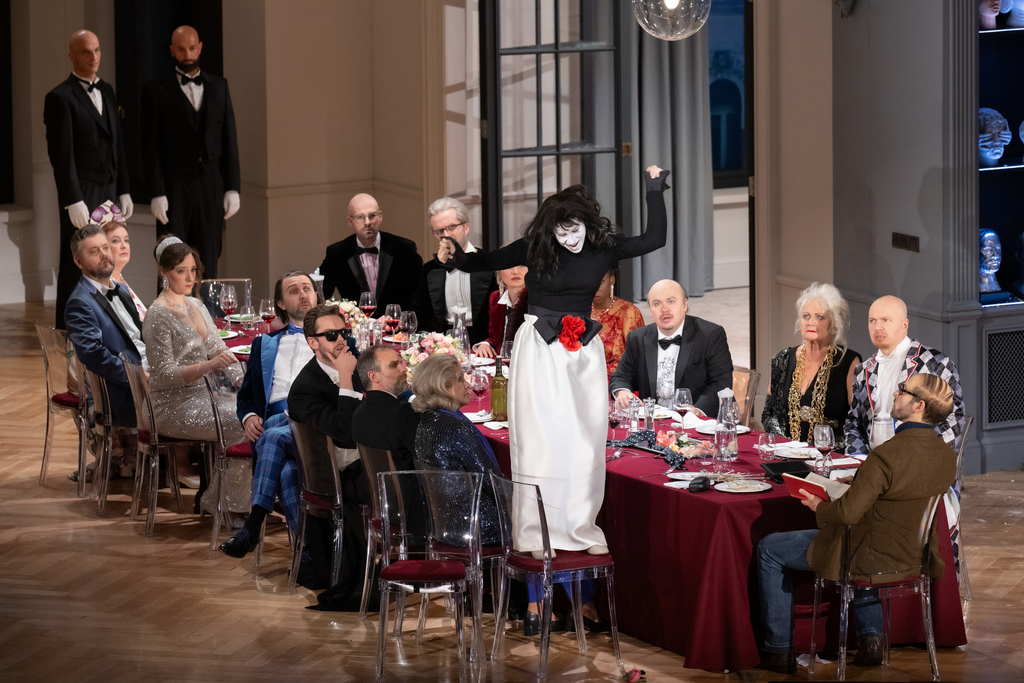
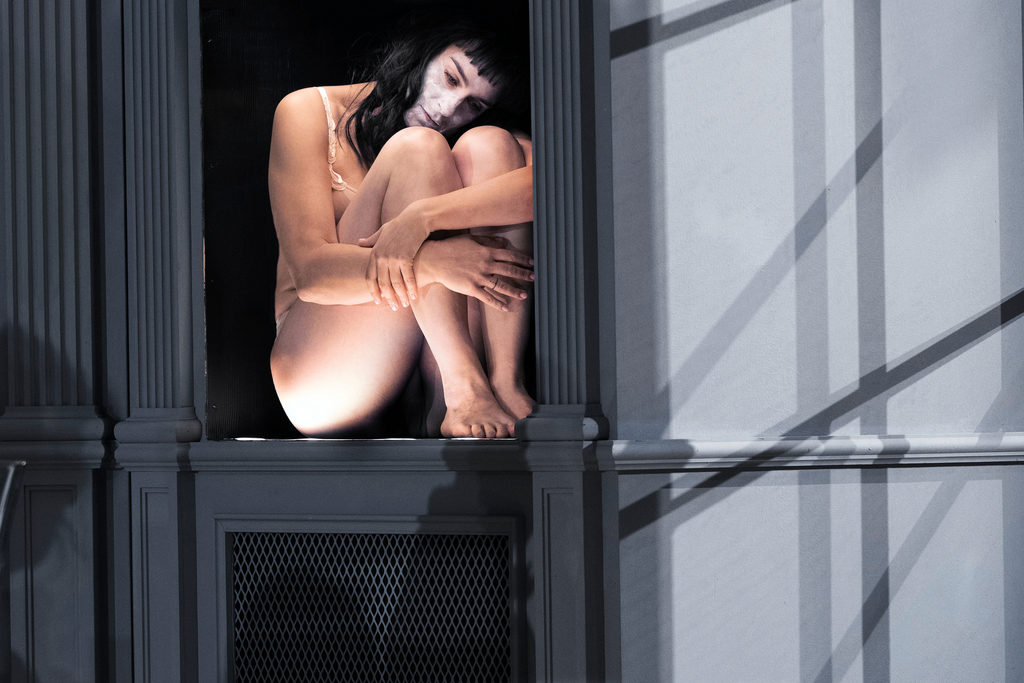
Consequently, this means that there’s no cistern, no head to kiss, and Narraboth gets to live. Yet, within this framework, Tcherniakov gives us something quite disturbing, an evening that repeats the revolutionary aspects of this score, that would have thrilled those earliest audiences over a century ago. There’s a darkness here that I found extraordinarily compelling. The way that Herodias brought two bags of outfits, including teddy bears, for Salome to wear while doing her dance for Herodes was extremely disturbing. It’s clear that this abuse has been going on for a long time and Herodias is completely complicit in it – just like the dinner party guests watching as Herodes puts Salome on the dinner table for all to look at her. In such an environment, the only way for Salome to escape is to fantasize about one of the guests. While Jochanaan is incarnated as a bald philosophy professor with a combover, Salome sings “Dein Haar ist wie Weintrauben, wie Büschel schwarzer Trauben”, projecting onto him an image that lies deep in her escapist fantasies. As the evening progresses, we see Salome further lose her sense of reality, fantasizing about kissing a head that doesn’t even exist. There’s also a nihilism here that was even more disturbing, the fact that this girl seemed so far away from sanity, yet nobody did anything to bring her back. This approach could have felt voyeuristic, but it’s a strength of Tcherniakov’s staging that we cannot helped be both moved and disturbed by the horror that lies behind these closed doors.
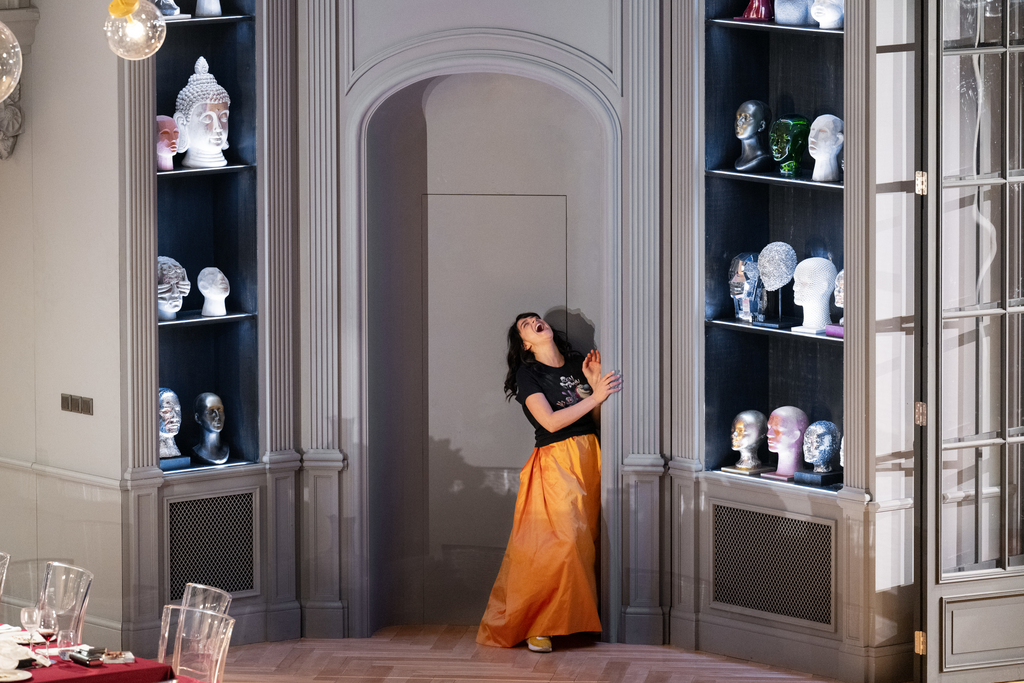
Of course, the performance would not have had the impact it did have, had the musical aspects not been as strong. Asmik Grigorian gives us a staggering assumption of the title role. She has clearly worked hard on enunciating the text and makes every word clear. She did cough a few times during the evening, which made me wonder if she was suffering from an indisposition. It that were indeed the case, this makes her performance this evening even more remarkable. The voice has easy amplitude and reach, soaring over the orchestral tumult with total freedom. She brought a steely determination to her ode to Jochanaan’s body, long lines pealing out, while she also coped admirably with those descents into the vocal cistern, colouring the tone with darkness. Her final scene saw her add some creaminess to the tone, giving it an almost childlike innocence which was immensely disturbing, matching the lunar horror in the orchestra with lunar beauty in her tone. Grigiorian is a consummate actor, tireless and fearless from beginning to end, and always utterly believable in every gesture.
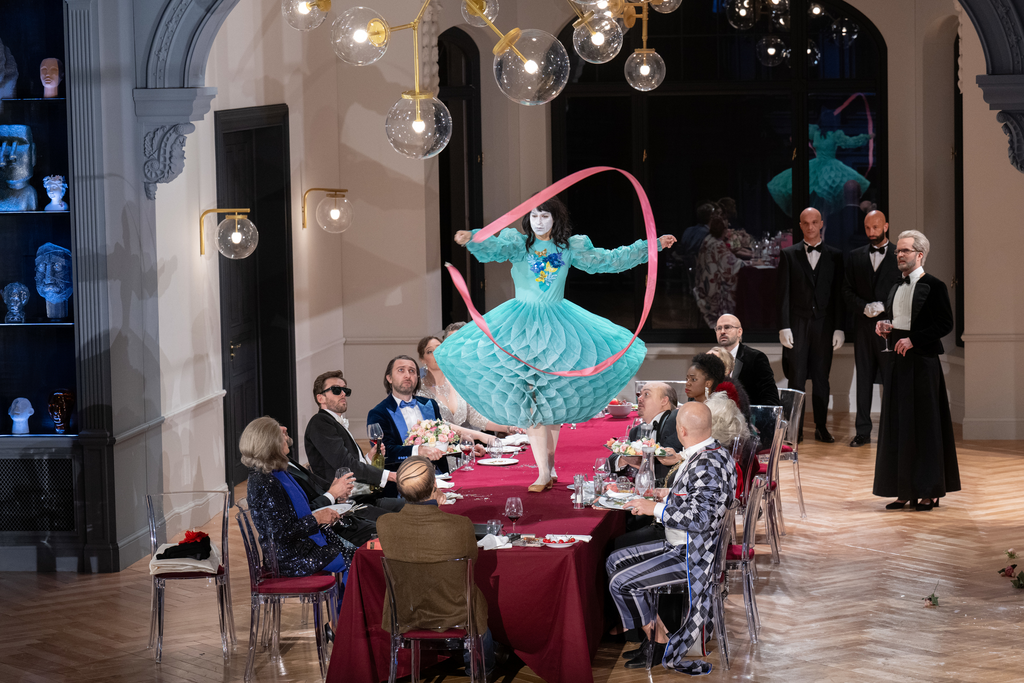
Urmana was also highly compelling. She held the stage, even when not singing, both haughty and determined, and completely aware of her complicity in the horror imposed on her daughter. Vocally, the top is still most definitely there, ringing out with ease, although the registers have now started to part company. Still, the clarity of her diction, the sheer stage presence, and her total assumption of the role and the staging were all superb. John Daszak’s Herodes is a known quantity and his performance here once again demonstrated his secure vocalism, clarity of diction, and extrovert stage presence.
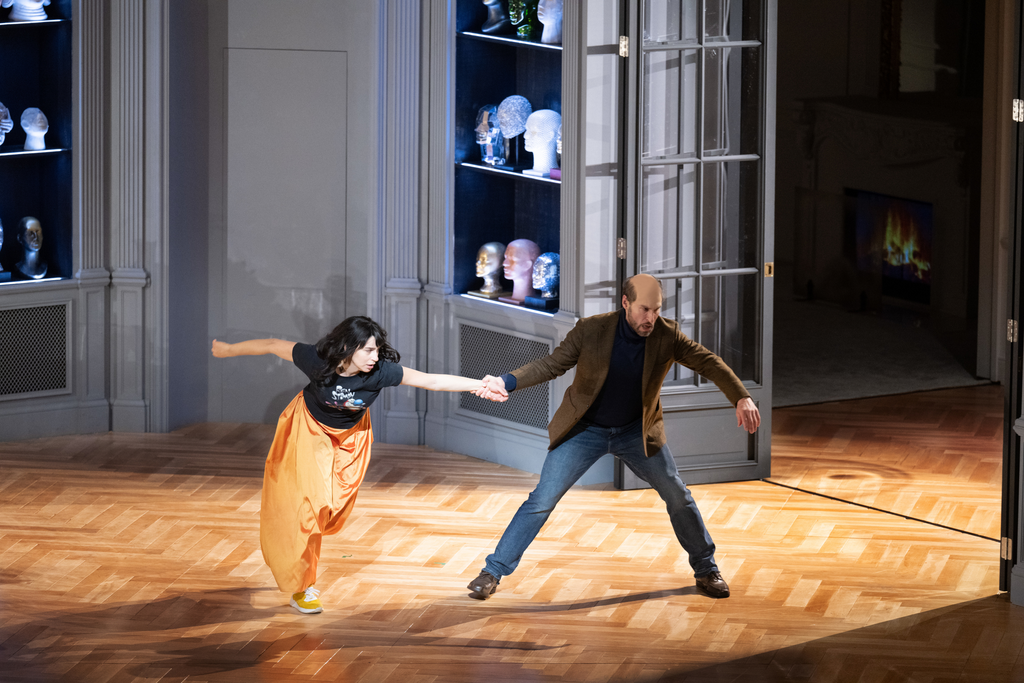
Jochanaan is a new role for Kyle Ketelsen, marking his prise de rôle in this run. Ketelsen is one of the most intelligent singers out there and his Jochanaan reflects his willingness to illustrate and understand the sung text. That said, I did leave with a feeling that he still has to work the role into the voice. His baritone defies gravity, sustaining the higher reaches with ease, but does tend to narrow at the very top. In order to replicate the sound from the cistern while having Ketelsen seated at the table, Tcherniakov has him sing with his back to the audience and, while singing to Salome, Ketelsen aims his voice to the wings. The outcome was that I felt a sense of the voice not quite having the ideal amplitude needed for the role, although Nagano was supportive in letting Ketelsen through. His is certainly an intelligent assumption of the role, as one would expect from him, and I look forward to seeing how he will develop in it with time.
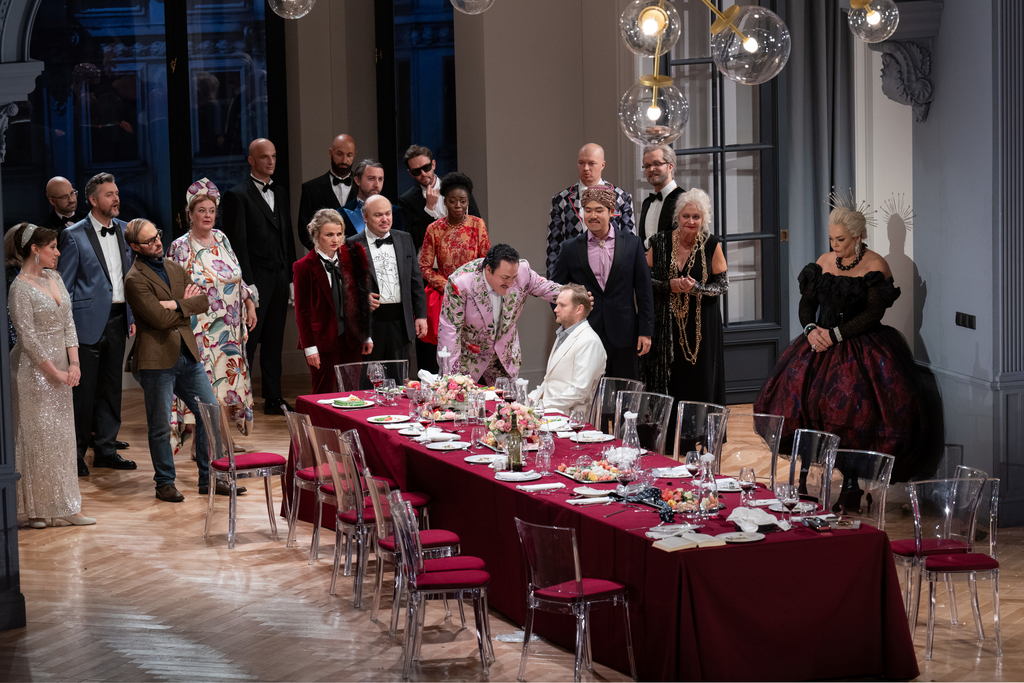
The remainder of the cast reflected the excellent standards one would expect here. Oleksiy Palchykov gave us a mellifluous Narraboth, his forwardly-placed tenor ringing out with easy reach. The role of the Page sits a little low for Jana Kurucová’s optimal comfort, the break between registers rather too apparent, but her sunny mezzo is always a pleasure to hear. The supporting roles were all competently taken.
Nagano led an orchestra on superb form. The quality of the playing across the board was excellent and they made a tremendous noise. I did find his reading perhaps a bit too controlled. I missed a sense of genuine swing in the Schleiertanz, but it did feel as a whole with what we saw on stage. The range of colour that Nagano was able to elicit from his band was striking, at times making the score sound almost Debussy-like in colour and transparency. He was a sensitive accompanist to his singers, giving those who needed it a helping hand, while also allowing the band to ring out and give Grigorian a generous texture on which to take wing.
This was a gripping, if extremely dark, evening in the theatre. Tcherniakov has given us a staging that tells the story of what goes on behind closed doors, that shows how many are complicit in horrific abuse and, together with Grigorian and the entire cast, illustrates the harrowing mental disintegration of a sufferer of abuse. Musically, the evening was performed at the highest level – even though, as always, there were a few reservations along the way. The audience responded with an enormous and unanimously positive ovation for the entire cast – with especially loud cheers for Grigorian.
 operatraveller.com
[…] best opera orchestras in the world currently. Common to both Tcherniakov’s Elektra and his Salome in Hamburg was the set and Violeta Urmana. As both Klytämnestra and Herodias, she was […]
[…] viewed from outside, divided into rooms, similar to the one featured in his stagings of Elektra and Salome, in which the bulk of the action takes place. Underneath, Bruges is portrayed as a blank space, […]