Puccini – Turandot
La Principessa Turandot – Sondra Radvanovsky
L’Imperatore Altoum – Nicola Martinucci
Timur – Alexander Tsymbalyuk
Calaf – Yusif Eyvazov
Liù – Rosa Feola
Ping – Roberto de Candia
Pang – Gregory Bonfatti
Pong – Francesco Pittari
Un Mandarino – Sergio Vitale
Prima ancella – Valeria Attianese
Seconda ancella – Linda Airoldi
Il Principino di Persia – Vasco Maria Vagnoli
Coro di Voci Bianche del Teatro San Carlo, Coro del Teatro San Carlo, Orchestra del Teatro San Carlo / Dan Ettinger.
Stage director – Vasily Barkhatov.
Teatro San Carlo, Naples, Italy. Sunday, December 17th, 2023.
What happens to us in the space between our days on this earth and the afterlife? Can we really change our fate when located in that liminal state following, for example, an automobile accident? This is the opening premise of Vasily Barkhatov’s new staging of Turandot at the Teatro San Carlo that opened the new season here last week. Turandot is a difficult work for a twenty-first century audience – the story of a man who wants to own a powerful woman and won’t take no for an answer, together with the fate of a second woman who takes her own life to spare the man. Barkhatov faces the problematic issues of the libretto and gives us a reading that is absolutely revelatory and utterly convincing.
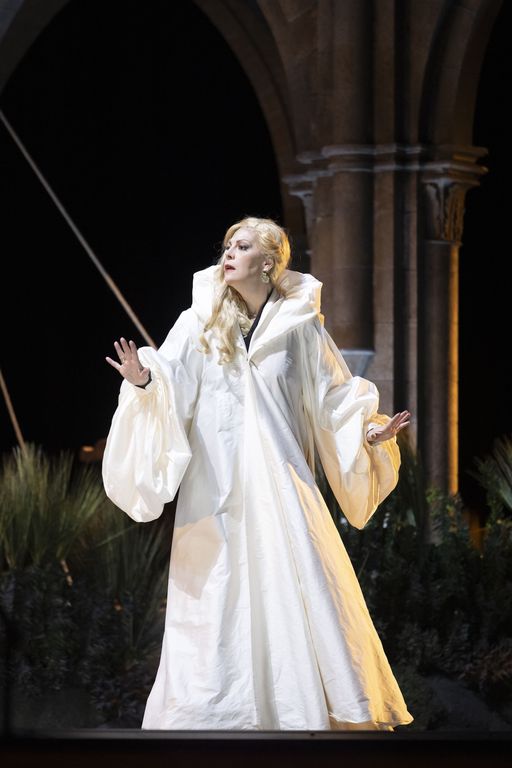
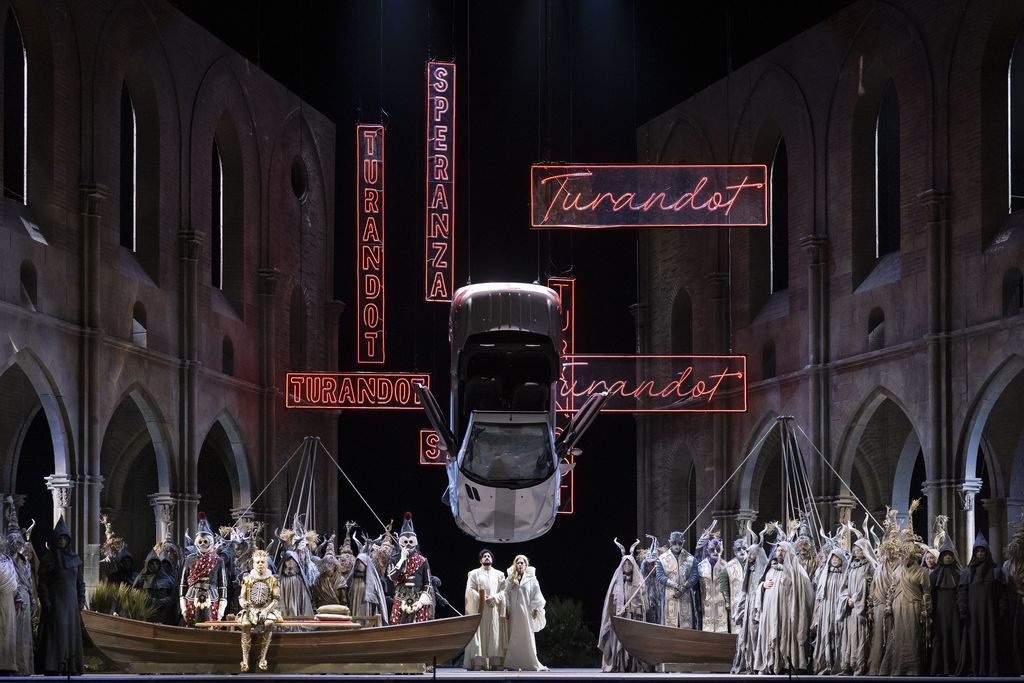
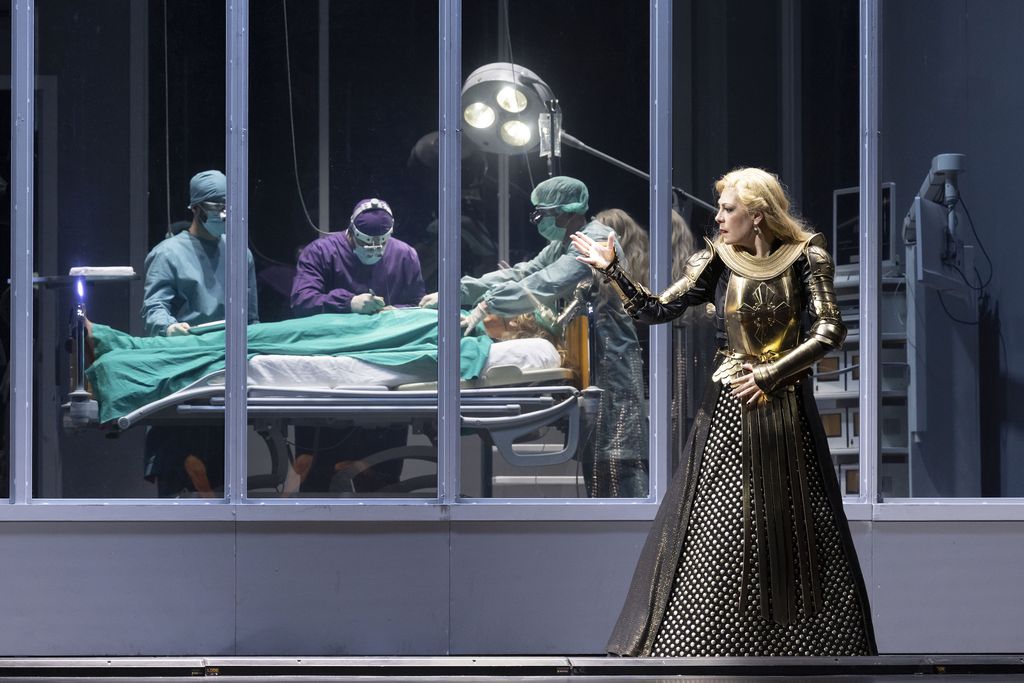
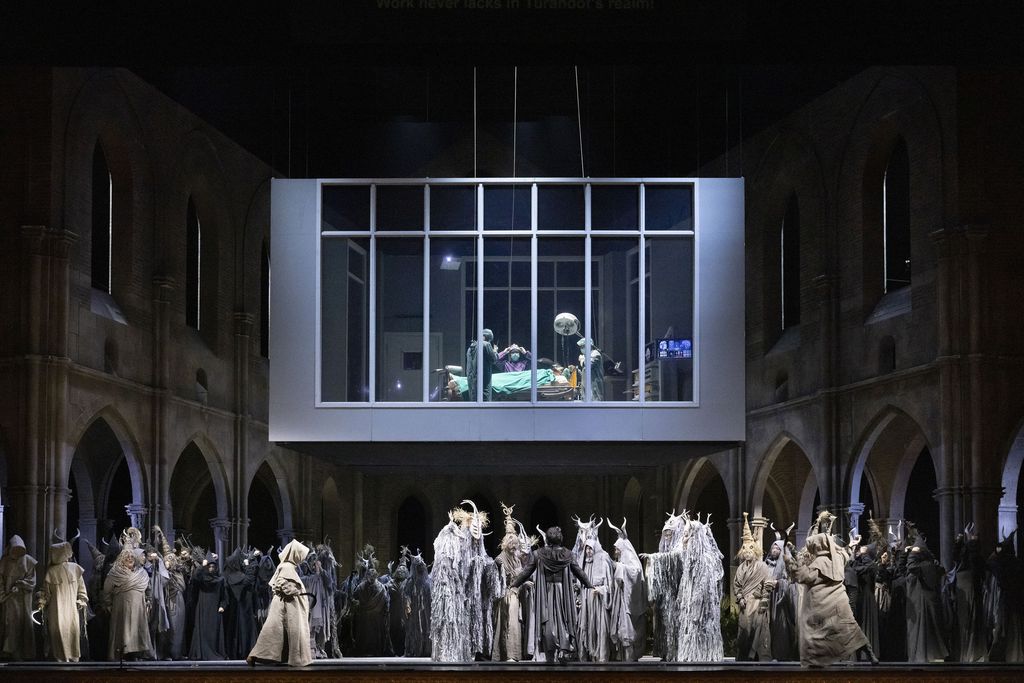
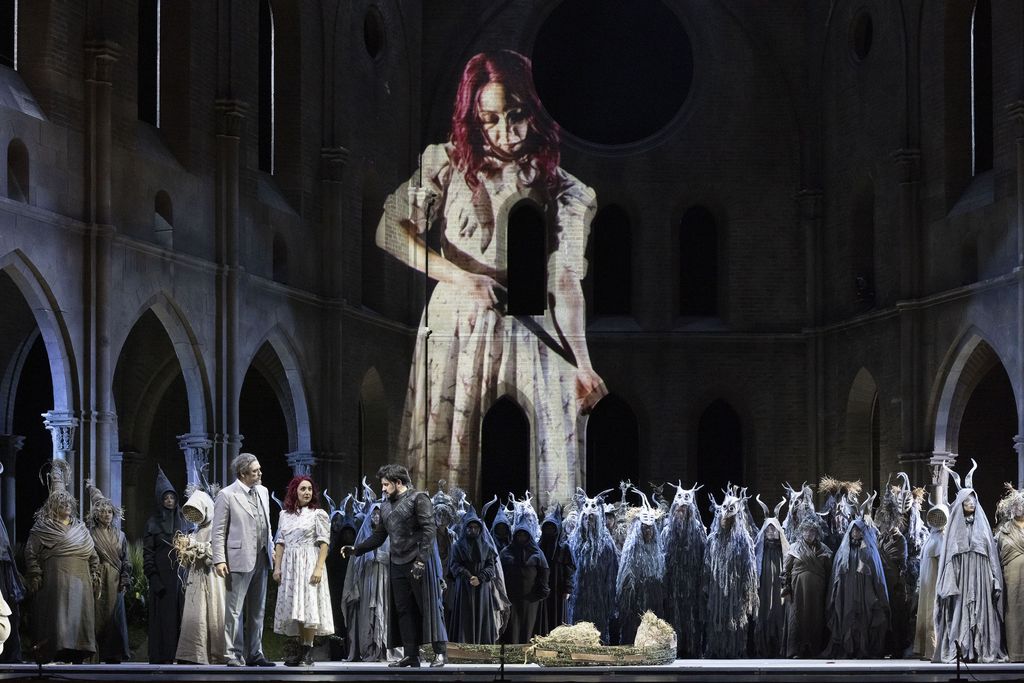
Indeed, not since Bieito’s staging in Nürnberg and Belfast have I been convinced by a Turandot as much as this one. The evening opens with a short movie, illustrating Sondra Radvanovsky’s Turandot and Yusif Eyvazov’s Calaf driving in a car, arguing. Their argument revolves around whether they should get married, about how Turandot feels that Calaf wants to just own her, and how both are living with the trauma of how Liù killed herself following a depressive episode caused by her previous relationship with Calaf. In one fell stroke, Barkhatov immediately humanizes those highly problematic issues in the libretto and makes the story utterly convincing. He does so by giving us three perspectives. Act 1 opens with Calaf being mortally wounded in the accident while Turandot lives; Act 2 opens with Turandot being seriously injured; while Act 3 ends with a happy end in which both are able to continue living. What plays out in front of us is Calaf in Act 1 wondering around in that liminal state, surrounded by the shadowy figures of the chorus, with images of Liù harming herself projected on the back of the stage, while Turandot occupies that state in Act 2. The presence of a hospital room that descends from the flies with either Calaf or Turandot in the bed reinforces that impression. Seeing Turandot’s first silent entrance as her rushing to Calaf’s bedside, while the chorus intones ‘principessa’ seemed utterly logical. Similarly, it felt that Barkhatov fully engaged in Liù’s story and made her presence in the plot also essential and natural.
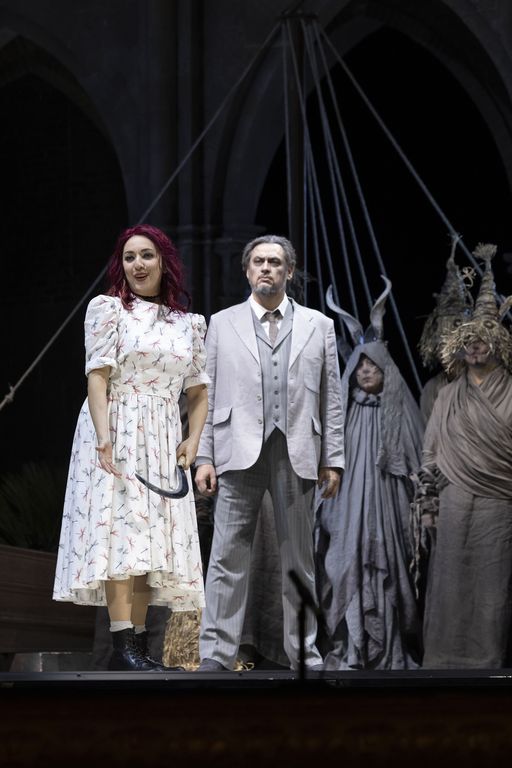
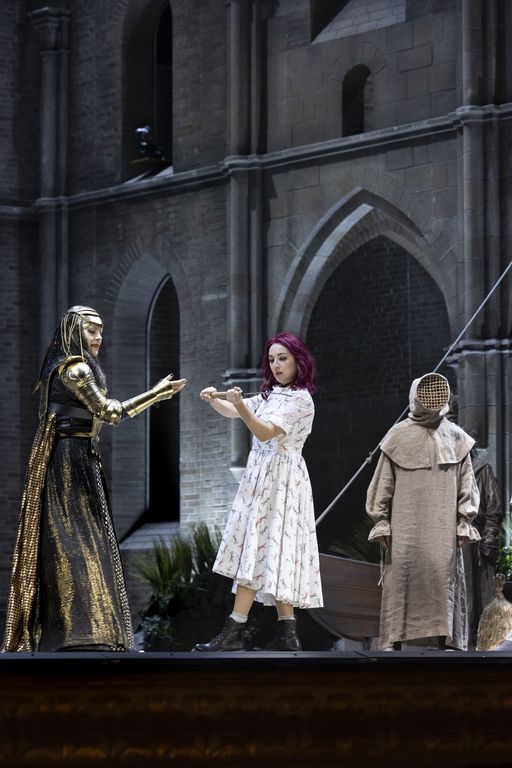
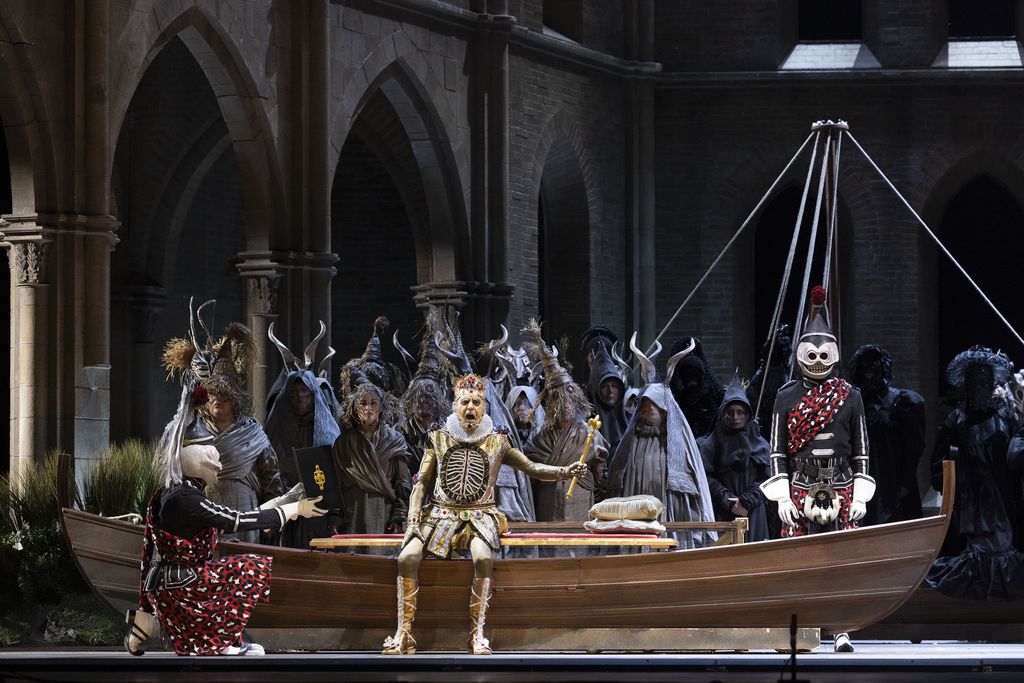
If there is a downside to Barkhatov’s staging, it’s in his managing of the chorus. This is of course, one of the most choral of operas. Here, the chorus tended to be parked on the side of the stage, which also meant that the huge choral sound was a bit recessed – at least from my seat at the rear of the Platea. And yet, I found Barkhatov’s reading so compelling and completely connected to the libretto. Indeed, as Calaf sang ‘nessun dorma’, holding a boat offered by a grim reaper figure that could take him to the afterlife, made me more aware than ever before that this is an aria not just about triumphalism, but also about doubt in the face of imminent danger. Barkhatov succeeds in what all good opera stagings should do – he gives us a logical reading that coheres, he engages with the difficult issues in the libretto and doesn’t shy away from them, and everything he does is based in an intelligent reading of the text.
Musically, there were some superlative aspects and others that were frankly extremely poor and not worthy of a house with such a storied reputation. Let’s start with the latter: Dan Ettinger’s conducting. This was the last performance of the run, so one might expect the cast to be a little tired, but the musical performance to be as tight as it could be. What I heard, instead, sounded in many places more like a rehearsal. There were so many points where Ettinger lost contact with the chorus who, admittedly perhaps due to their location on stage, frequently departed from the tempi he set. Some of Ettinger’s tempi were rather bizarre – ‘signore ascolta’ basically ground to a halt. The playing of the house orchestra was excellent, but the string sound was also recessed, which made the whole evening sound rather brass and percussion heavy. It was also a shame that the organ at the end of Act 2, if it was actually there, wasn’t penetrating enough. Piero Monti’s chorus was certainly enthusiastic, the sopranos gave us a huge high C-sharp at the end of ‘gira la cote’, but there were several places where some heavily vibrating voices penetrated the textures – although those difficult harmonies following Liù’s suicide were expertly traversed. The children’s chorus, prepared by Stefania Rinaldi, was excellent and sang with a firm unanimity of tone.
Radvanovsky gave us a magnificent Turandot. Her soprano has glorious amplitude, able to fill the theatre with ease and soar over those assembled forces. For once, it was such a pleasure to hear a Turandot who didn’t take the words ‘quel grido’ literally, instead shooting out a massive beam of sound into the auditorium. There was a defiance to her vocalism, but also a humanity, established through her ability to pull the tone right back, yet still carry into the house. The way that she responded to Liù in Act 3 with a perfectly pianissimo ‘amore’ was glorious – I don’t think I’ve ever heard a Turandot able to do that in the theatre before. Her final ‘amor’ at the end of Act 3 started as a pianissimo and opened up thrillingly to a huge fortissimo. In her use of dynamics, her ability to bring the voice right down yet also ring out on top, and the intelligence of her interpretation, Radvanovsky was absolutely thrilling.
Eyvazov was a respectable Calaf. The voice is rather individual in tone, with a distinctive fast vibrato that can turn into a bleat. At full volume, the top can sound as if singing in voix mixte, although he did give us an effective full-voiced high C (in fact 3) in the riddle scene. He’s clearly worked hard on the language, singing in very good Italian, using the words to colour the line. I do find the voice a bit narrow, lacking in the plentiful overtones that Radvanovsky has, but he was an engaging stage presence. He gave a respectable account of his big aria, made even more moving by the stage pictures. Eyvazov’s assumption was undoubtedly a decent one.
Rosa Feola gave us a deeply-felt Liù. Her soprano has a focused diamantine tone, narrow but able to reach into the house. She demonstrated some phenomenal breath control in her ‘signore ascolta’, not helped by a tempo from the pit that basically came to a halt, and held on to her closing note for a very respectable length of time. Her interplay with Turandot in Act 3 benefitted from both sopranos being able to float the tone high up most impressively. We had operatic history on stage with Nicola Martinucci singing the Imperatore. Now 82 years young, Martinucci still has plenty of voice left and sang his brief scene with admirable focus of tone and clarity of text.
Alexander Tsymbalyuk sang Timur’s music in a warmly lugubrious bass, although I did wish that he had coloured the text more. We had a very good trio of ministers. Roberto De Candia sang Ping, which was noted in the theatre’s website, but not in any of the posters around the house, nor in the program book or in an announcement from the stage – which I found rather disrespectful for such a fine artist. De Candia sang Ping’s music with firm tone and fine textual acuity, with Francesco Pittari and Gregory Bonfatti as Pong and Pang sang with characterful tone and energetic stage presence. Sergio Vitale’s Mandarino boomed effectively.
There was much to enjoy in this evening’s Turandot. Barkhatov’s staging is a work of great intelligence and insight. It engages with the difficult issues in the libretto, based in a cogent and convincing reading of the text. Musically, the evening was dominated by a thrilling assumption of the title role from Radvanovsky, with a deeply felt Liù from Feola and the opportunity to see operatic history on stage in Martinucci. Unfortunately, the evening was hampered by conducting that frequently lost contact between stage and pit. The Neapolitan audience responded with generous applause for the entire cast at the close.
 operatraveller.com
[…] was also a thrilling Turandot in Naples. What a pleasure it was to hear a Turandot who does not take the line ‘quel […]