Verdi – Nabucco
Nabucco – Ernesto Petti
Ismaele – Kim Youngwoo
Zaccaria – Evgeny Stavinsky
Abigaille – Marta Torbidoni
Fenena – Wakizono Aya
Il Gran Sacerdote – Lucas Singer
Abdallo – John Heuzenroeder
Anna – Claudia Rohrbach
Chor der Oper Köln, Gürzenich-Orchester Köln / Sesto Quatrini.
Stage director – Ben Baur.
Oper Köln, Staatenhaus Saal 1, Cologne, Germany. Sunday, December 1st, 2024.
The Oper Köln’s 2024 – 25 season contains a number of very interesting premieres. Indeed, it’s the strongest season here in some time, which makes it doubly frustrating that the house is still based in the Staatenhaus across the Rhine from downtown, while the permanent opera house continues to be restored. Following the musically excellent but scenically risible Schöpfung in September, and the superbly-conducted Elektra in October, tonight marked the premiere of this new production of Nabucco, confided to the stage direction of Ben Baur, more known as a set designer, under the musical direction of Sesto Quatrini.

One might have suspected that having an experienced set designer directing a production, might lead to a privileging of the visuals over the personenregie. The good news, is that in Baur’s production, this is most definitely not the case. In this most choral of operas, he moves the cast around the stage with confidence, making every single person on stage a recognizable and vivid individual. He sets the action within a single, industrial set, very much in the modern day. There’s nothing recognizably Jewish in Baur’s staging; instead he attempts to universalize the narrative making it more about the actions of a group of people in a claustrophobic setting. That said, despite the confidence with which he moved the forces around the stage, it did leave me questioning who these people were and what their motivations were. In removing the work’s Jewishness, I’m not convinced that Baur replaces it with anything that illuminates the narrative and brings it to life. It made me reflect on Calixito Bieito’s staging of La Juive in Munich that I saw back in 2016. There, Bieito removed the visible Jewishness, but managed to universalize it by making the personal relationships so strong, reminding us that there’s more that unites us than divides us. Here, it felt much more abstract.
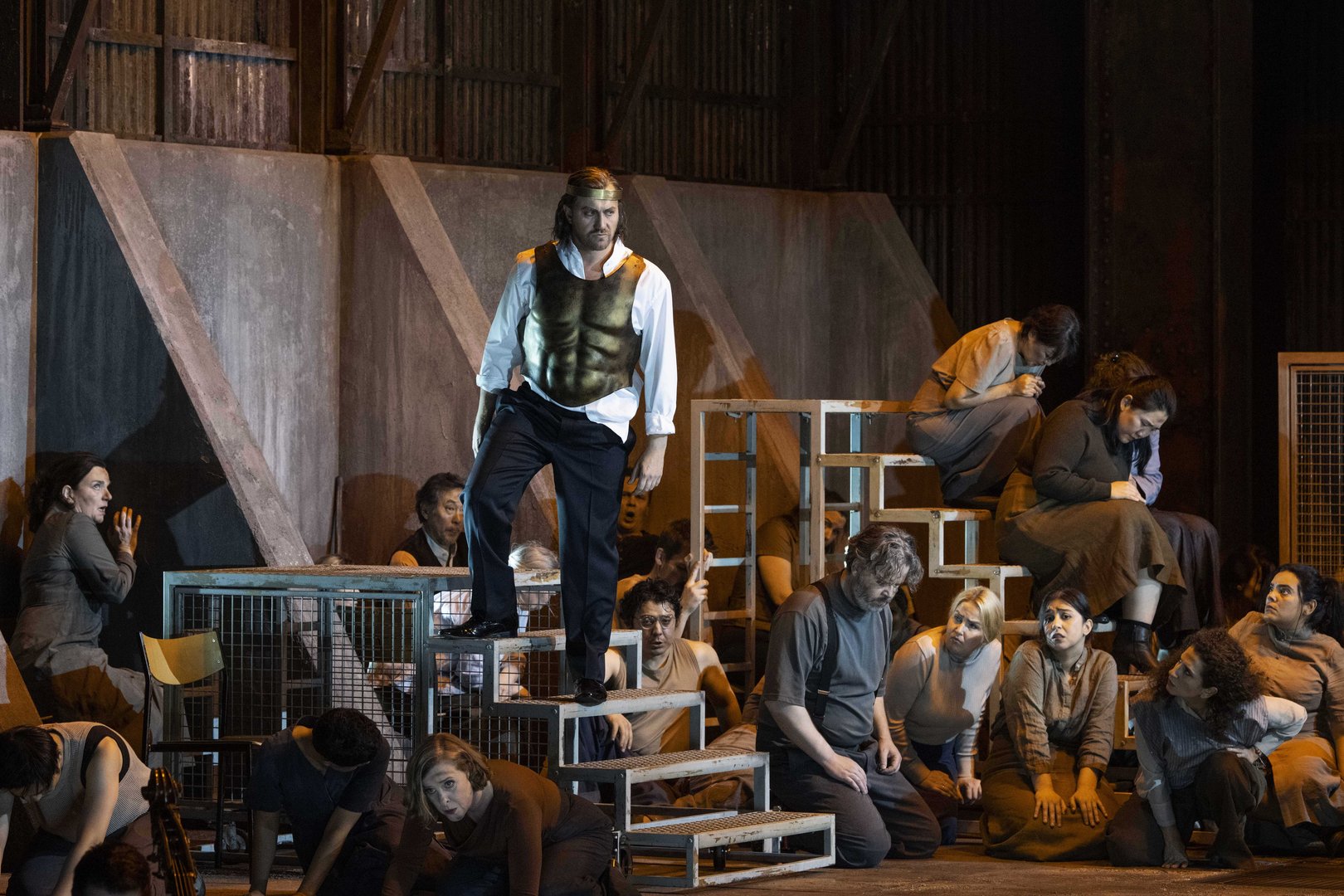
The evening has the only intermission after the first scene. This also made the production feel rather lopsided and lose momentum. I can imagine that working with the Staatenhaus has some limitations in terms of set management. That said, as far as I could see, there were no apparent reasons why the intermission needed to be there, or indeed was even required at all, given the relative brevity of the work. Baur also started the fourth part with a reading from a poem by Ingeborg Bachmann, one of the greatest writers in the German tongue, but again it was unclear why. It left me with a sense that Baur had started his production confidently, yet it had also lost its way as the evening progressed. If he had stayed on the course he had charted initially, I would have found it an appropriate framework to the action. Yet by adding more layers that seemed to be barely explained or explored, it felt that Baur had lost his command of the narrative, rendering it cloudy.
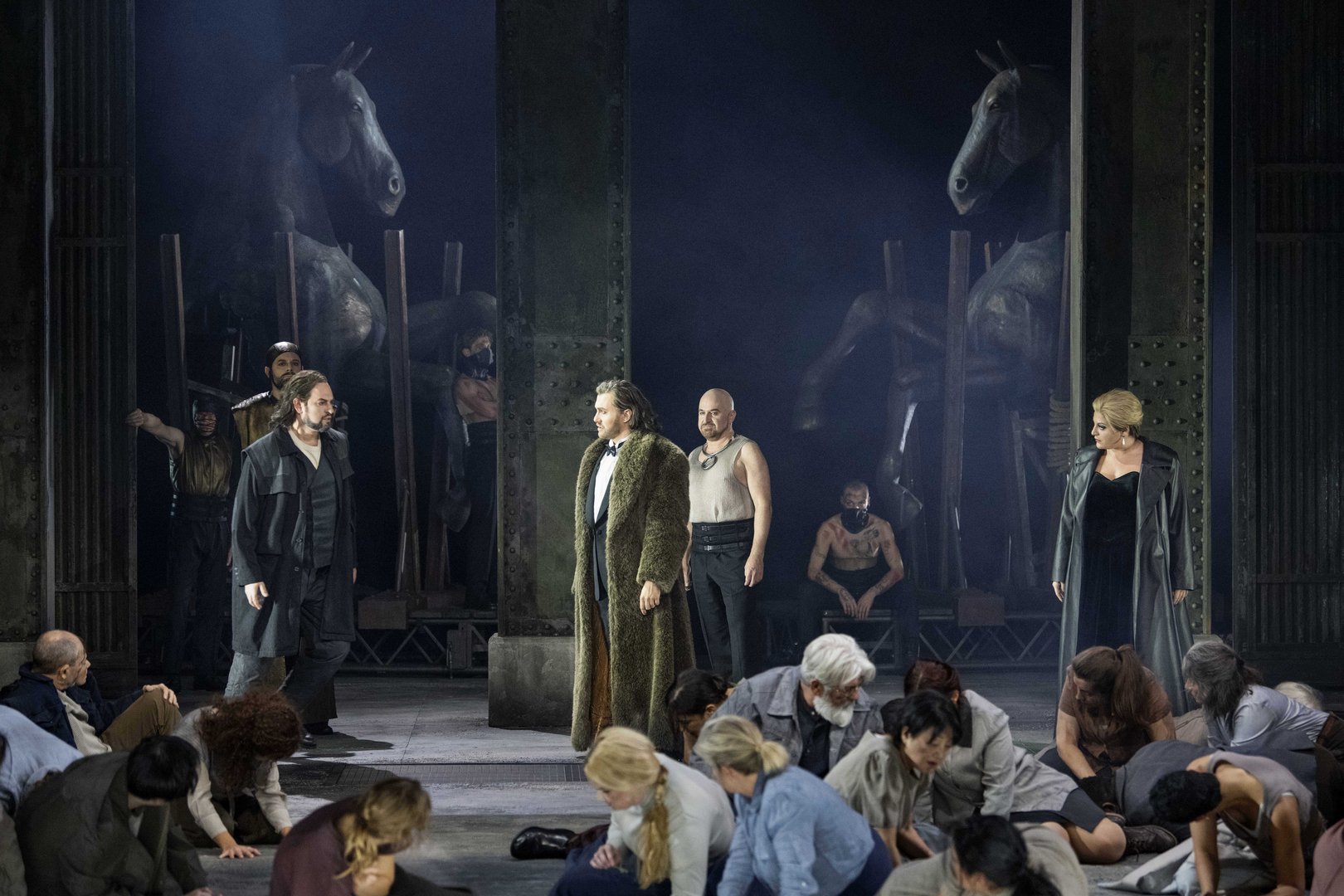
Musically, the evening started off with a terrific account of the sinfonia led by Quatrini. Even in this poor acoustic, the music was physically thrilling, driven with irresistible physical momentum. It was fascinating to watch Quatrini at work. His gestures were so minimal and clear, yet he obtained playing of the utmost precision from the band. He also encouraged the strings to play with minimal vibrato, which was extremely welcome, and made Verdi’s soundworld sound absolutely convincing. What was disappointing, was that he didn’t encourage his singers to ornament their cabalettas – something that’s absolutely essential in this repertoire and would have been of a piece with his reading. The chorus, prepared by Rustam Samedov, made the most of their big assignment. The tenors and basses were wonderfully rich of tone, although the sopranos vibrated a little too generously to provide optimal precision of pitching. The chorus did provide considerable amplitude and volume throughout, while they sang their ‘va’ pensiero’ with delicacy and feeling.
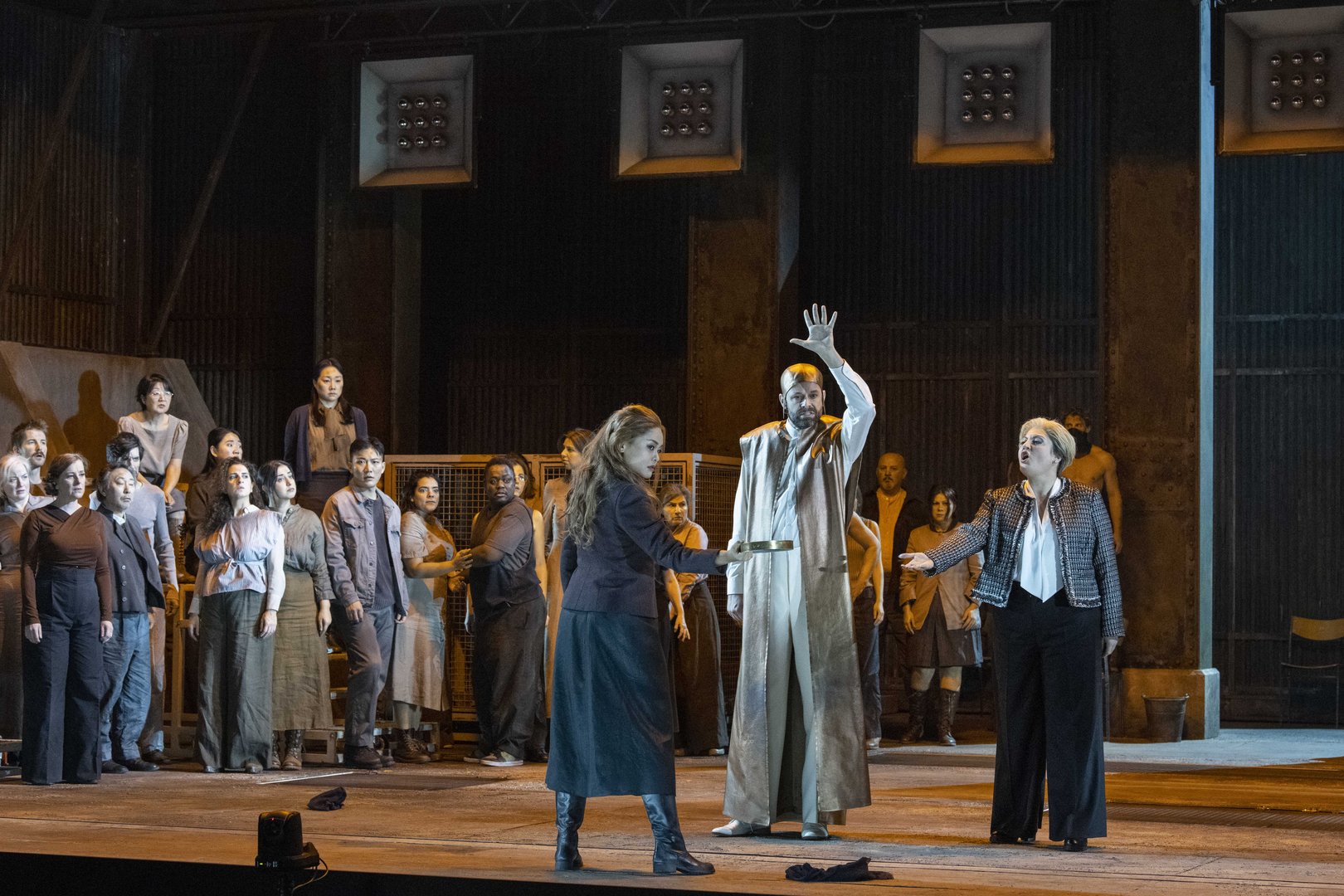
In the title role, Ernesto Petti was a somewhat frustrating vocal presence. His baritone has a tendency to dryness when he pushes the volume and the legato is occasionally lumpy. He was definitely not helped by the acoustic, the voice seeming to lack in amplitude. And yet, when he reached his ‘Dio di Giuda’, he sang like a completely different singer. He pulled the pressure off the tone, allowing the legato to pour out with liquid ease, demonstrating an innate understanding of the style and singing with genuine feeling. Unfortunately, he only sang one verse of the subsequent ‘O prodi miei, seguitemi’, which he ended with a rather dry high A-flat. Petti’s was a decent account of the role, if rather inconsistent. Evgeny Stavinsky’s Zaccaria also suffered from the acoustic, the voice sounding pale and lacking in resonance at the very bottom. His sung Italian was also a bit exotic in nature. He sang his music with confidence and a decent legato, although I wish he had ornamented his lines to give his singing more individuality.
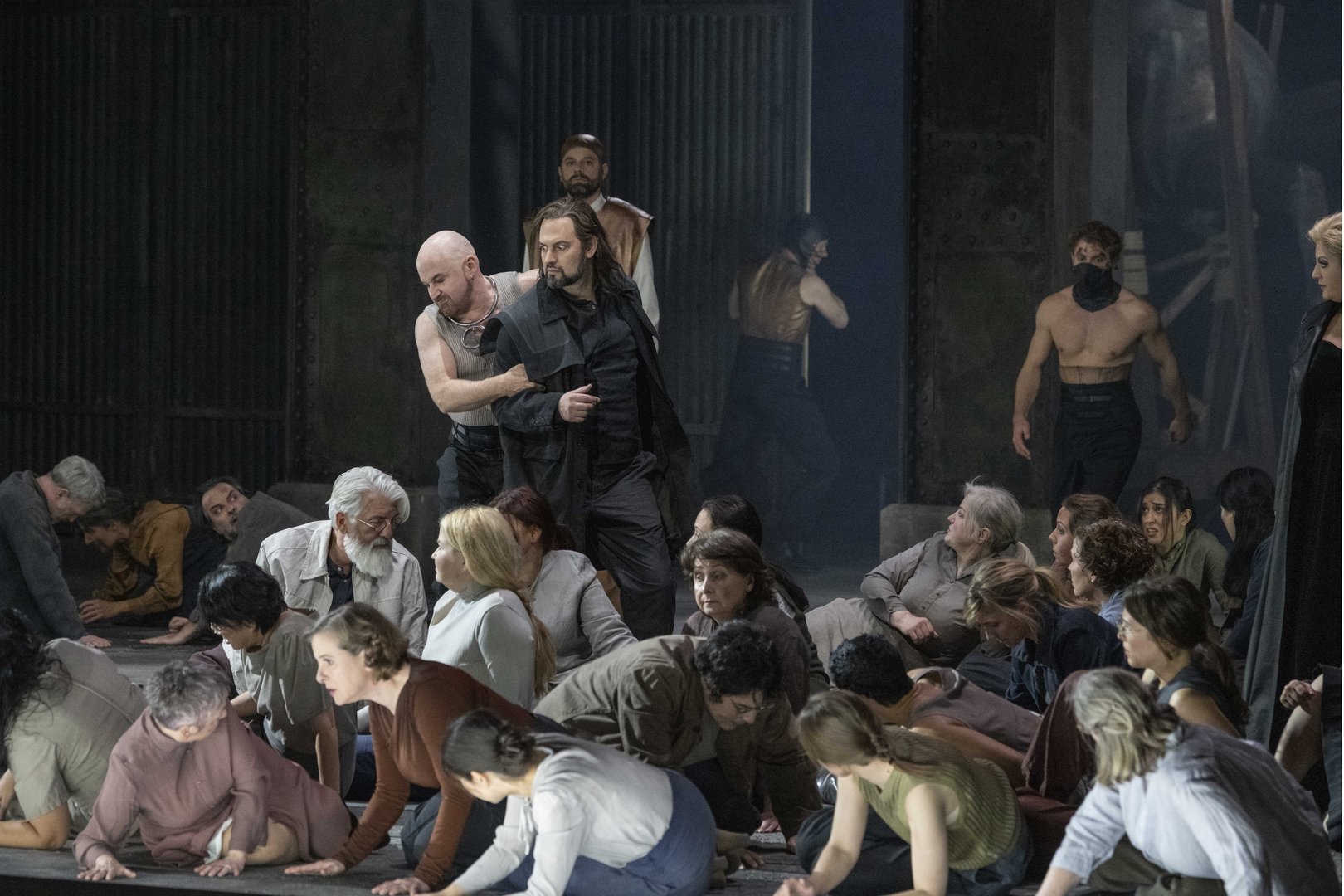
Marta Torbidoni sang Abigaille with uninhibited confidence, revelling in those massive leaps in the line. Her soprano isn’t the most refulgent, but she knows the style and was able to exploit a generous chestiness that she wasn’t afraid to use. She also gave us a genuine trill in her ‘Salgo già del trono aurato’, where so many before her have just left them out, capping it with a terrific high C. She wasn’t just about the volume either, shading her final scene with genuine delicacy and remorse. Wakizono Aya also sang Fenena’s music with stylishness. Her experience in Rossini gave her ‘Oh, dischiuso è il firmamento!’ an admirable elegance of line, soaring with ease on high. Wakizono’s mezzo has a delicious dark, claret quality to it, while the top emerges easily.

Kim Youngwoo sang Ismaele with ardent energy, the middle is rich with excellent focus, while the top has some squillo meaning that he was less hampered by the acoustic than others. Claudia Rohrbach brought an attractive, light soprano to Anna’s music, while John Heuzenroeder was a confident Abdallo. Lucas Singer boomed impressively in his music, indeed I would gladly hear him as Zaccaria.
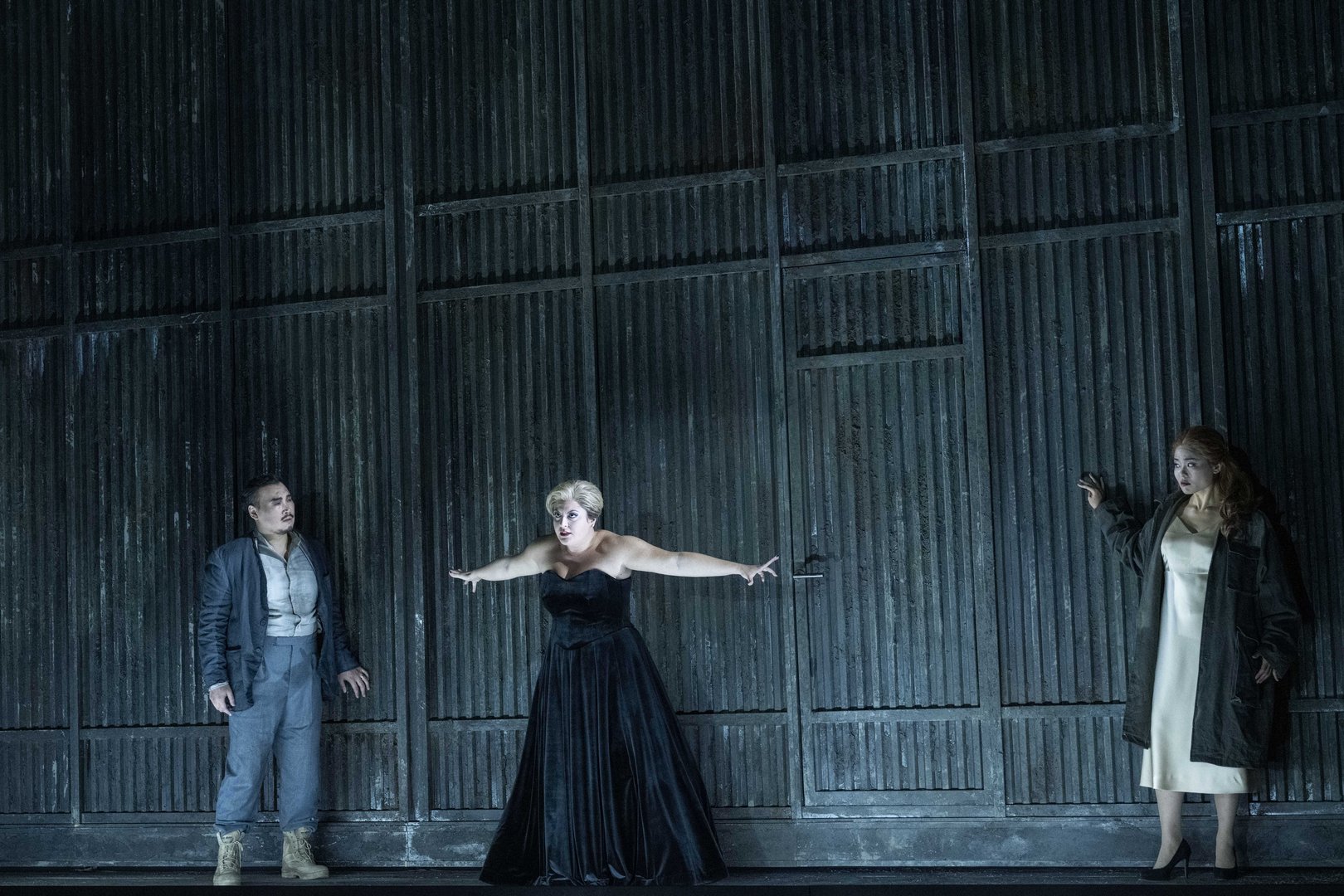
There was much to appreciate in this Nabucco, but also much that was inconsistent. Baur’s staging started off well, yet seemed to lose its way drowning in a symbolism that I found hard to get to grips with. Quatrini’s conducting was absolutely terrific in its precision of attack, with strings playing with a welcome lack of vibrato, although the lack of ornamentation in the vocal line was disappointing. The singing definitely had some positive aspects, with Torbidoni and Wakizono giving particular satisfaction, and Petti’s final aria showing a welcome stylistic understanding. The audience response throughout and at the end was polite. I had a couple of Italian gentlemen behind me who were the only vocal reaction to the evening. There were certainly some admirable qualities on display tonight.
 operatraveller.com
[…] kind of textual and musical understanding that cannot be taught. A thrilling artist. A Nabucco in Cologne was notable for Sesto Quatrini’s vigorous conducting, although it was disappointing he […]
[…] last heard Ernesto Petti as Nabucco in Cologne back in December, where unfortunately, he wasn’t ideally helped by the difficult […]