Puccini – La bohème
Mimì – Magdalena Hinterdobler
Rodolfo – Arthur Espiritu
Marcello – Miljenko Turk
Musetta – Emily Hindrichs
Schaunard – Wolfgang Stefan Schwaiger
Colline – Christoph Seidl
Benoît/Alcindoro – Lucas Singer
Knaben und Mädchen der Kölner Dommusik, Chor der Oper Köln, Gürzenich-Orchester Köln / Mino Marani.
Stage director – Michael Hampe.
Oper Köln, Staatenhaus Saal 2, Cologne, Germany. Friday, January 10th, 2025.
During this evening’s performance of La bohème it struck me that Puccini’s masterpiece may well be the perfect opera. After all, it takes us from the highest of highs – reminding us of how it feels to fall in love – to the lowest of lows, and that devastating feeling of loss when that love disappears. It succeeds in doing so, not only through Puccini’s glorious score, with those fabulous, soaring melodies that only the master from Lucca could write, but also in the libretto, full of the dreams of creating those castles in the air from nothing.
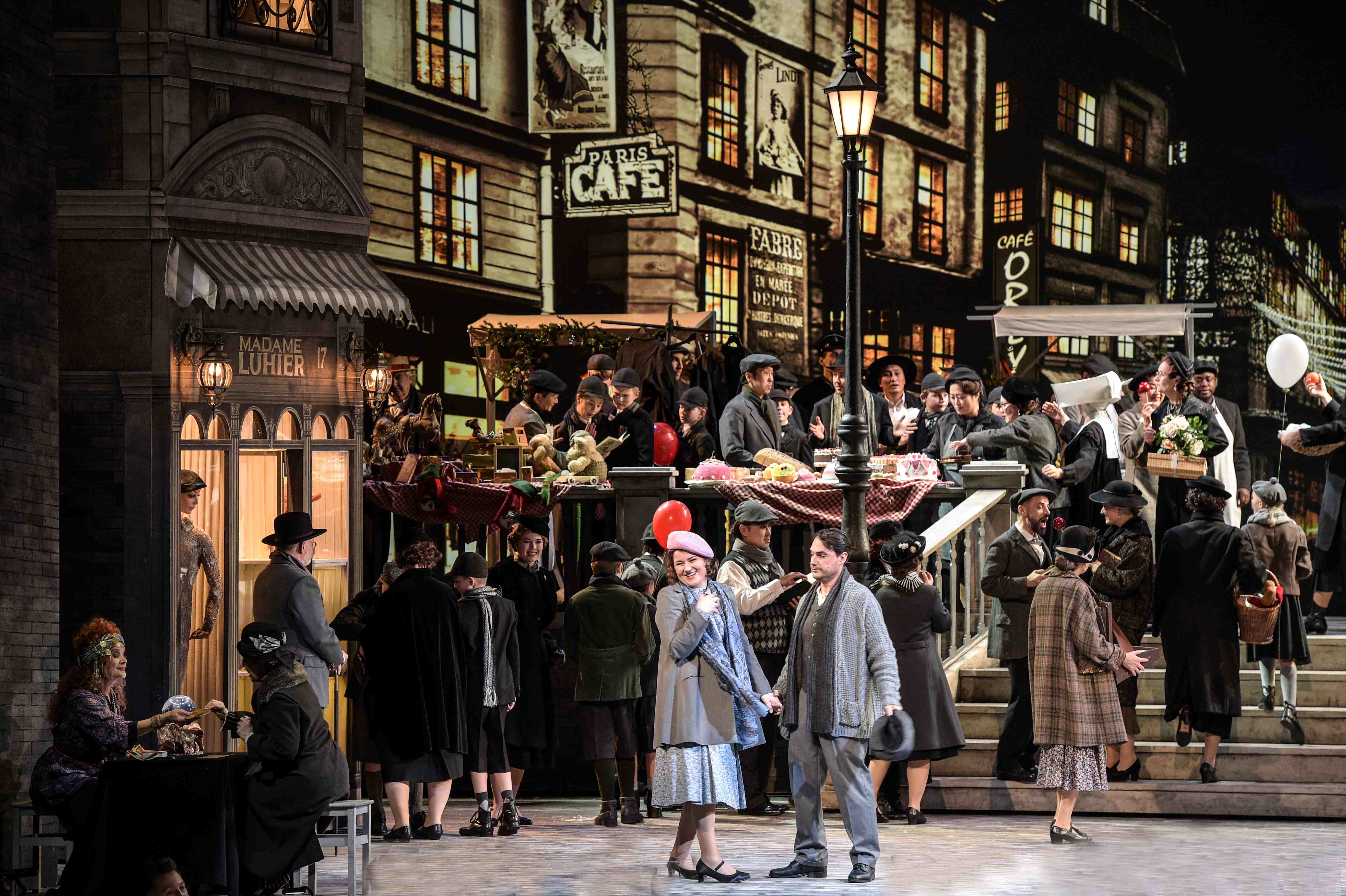
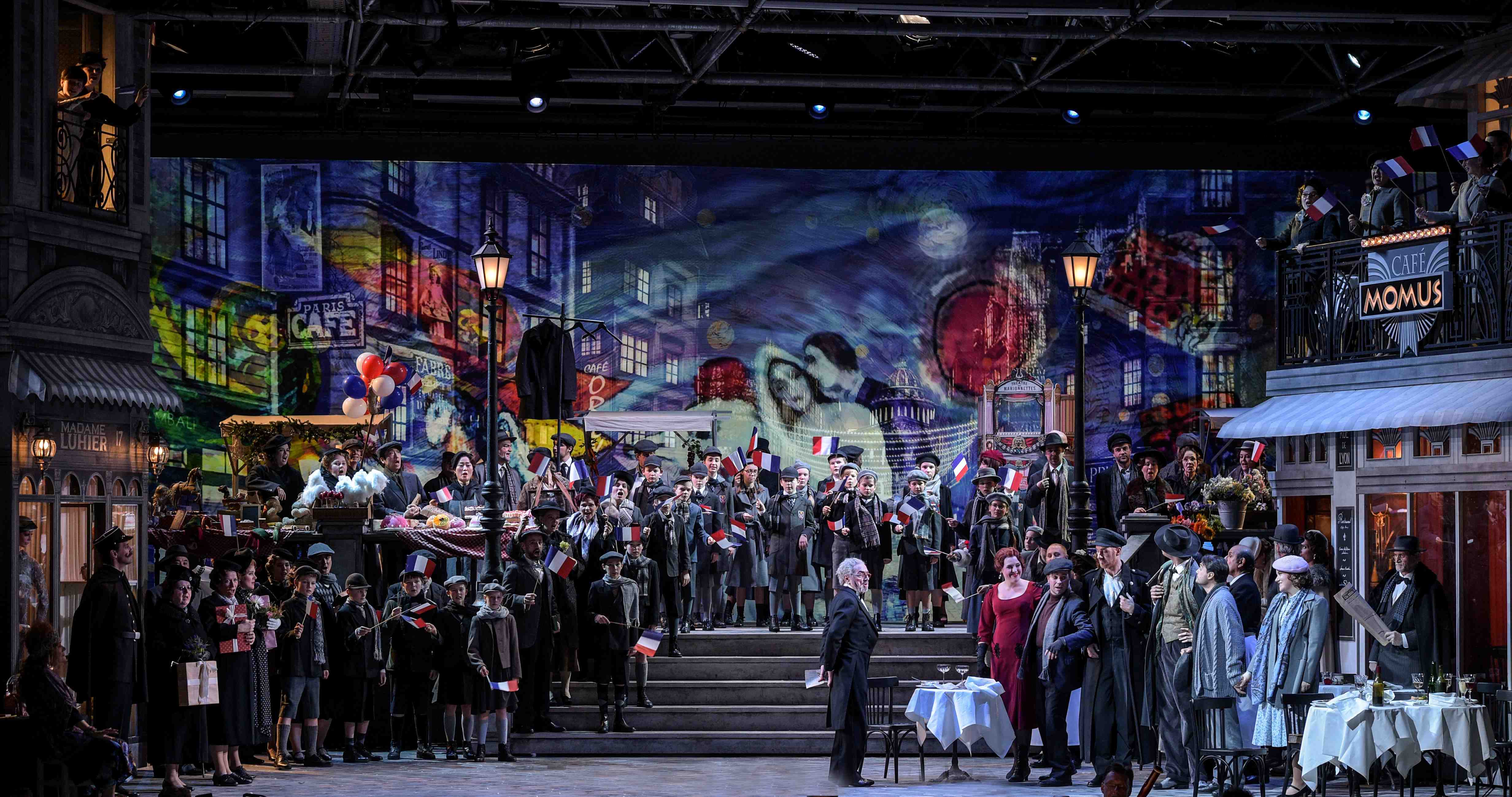
This evening was a revival of the late Michael Hampe’s 2015 production for the Oper Köln, revived for this run by Eicke Ecker. Hampe sets the action in a fairly conventional set, by Germán Droghetti, who also designed the costumes. Each act takes place in a clearly designed space, whether the attic with panoramic views of la ville lumière, a packed stage for Momus, or the icy desolation of Act 3. It all makes for a perfectly serviceable and effective framework for the plot to unfold in. And yet, there was an aspect in Hampe’s staging that moved me immensely and that succeeded in amplifying Puccini’s miraculous score. That was the use of video to create the backdrops at the back of the stage, designed by Thomas Reimer. The video shows us precisely what the libretto illustrates, whether in the fantastical images that occur alongside the big Act 1 arias and duet, or that aforementioned desolation of Act 3. Similarly, as Mimì recalled her first meeting with Rodolfo in her final moments, the video backdrop took us back to the magical images that were conjured up in those moments of falling in love. Moreover, the video rendered the final moments of the score even more moving, transforming the stage into a black and white vision, with Mimì’s demise literally taking all of the colour out of the world. I found it a moving and thoughtful staging that was clearly eminently revivable.
As readers will well know, given that this is my fourth visit to Cologne this season, the house is still based in its temporary home in the Staatenhaus, an exposition centre on the other side of the Rhine from downtown. I have to say that after tonight, their move back to Offenbachplatz cannot come soon enough. The evening was significantly hampered by the acoustic, the voices sounding as if they were in another room. Even the large chorus in Act 2 sounded distant. In turn, conductor Mino Marani had to work very hard to keep the orchestra down to allow the voices through. He did this most successfully, always ensuring the voices were able to be heard. The downside is that the orchestra didn’t sweep us along in the way that they would be able to in a much more sensitive acoustic. Even though this is a German orchestra, Marani got them to play with real idiomatic verve, phrasing the music lovingly. He also displayed a very impressive grasp of rubato, always keeping his musicians with him as he phrased the score organically. There was also a wonderful, almost balletic freedom, in Musetta’s intervention in Act 2, bringing out that free-spirited nature that the score needs. The solo clarinet also played with real poetry. Marani clearly loves this music as much we do, but it is possible to love something a little too much. His tempi for the big arias in Act 1 as well as ‘donde lieta usci’ were a bit too slow for my taste and it was clear, in the Act 4 duet between Rodolfo and Marcello, that the singers wanted him to get a move on. That said, Mimì’s demise didn’t come to a stasis, as it so often has in other hands.
Arthur Espiritu sang Rodolfo in a focused tenor, with a tangy bite to the tone. His sung Italian was excellent, bringing out those distinctive double consonants in a way that was not uniform across the cast. He’s also an engaging and genuine stage presence. He sang his ‘che gelida manina’ with genuine sensitivity, the high C nice and full, although his legato has a tendency to be aspirated, distracting from the pleasure of his healthy tone and vocalism. Still, he’s most certainly a useful tenor in this repertoire and, if he can smooth out his legato, his singing would be even more satisfying. Magdalena Hinterdobler sang Mimì in a silky soprano with a creamy core. She really wasn’t helped by the acoustic, the voice taking on a hardness that one might not find in a more sensitive venue. Her diction also lacked somewhat in clarity, compared to her castmates. That said, she evidently has a very well schooled technique, the voice founded in a warm and juicy bottom, combined with an admirably smooth legato. She brought genuine feeling to her music, making a real effort to shade dynamics and find beauty of line. Again, in a more voice-friendly acoustic I think her performance would have been even more impactful.
Emily Hindrichs was a terrifically game Musetta. She brightened up the stage whenever she appeared, singing her music in impeccable Italian. The voice is rather narrow, again not helped by the acoustic, but has a crystalline purity and ease on high that gave great pleasure. Miljenko Turk sang Marcello in a bright, high baritone. The vibrations have loosened somewhat, but he was a genuine and warm presence on stage. Wolfgang Stefan Schwaiger was taxed slightly by the higher reaches of Schaunard’s music, landing occasionally south of the eventual destination, but his firm baritone carried well. Christoph Seidl sang Colline’s ode to the coat with lugubrious warmth and real eloquence, the text nicely clear. Lucas Singer was an effectively extrovert presence as Benoit and Alcindoro. The adult chorus, prepared by Takai Yusuke, were hampered acoustically, their singing losing the impact it should have had due to the space. The children were absolutely terrific, delightfully raucous, and singing in Italian so good I forgot they were German.
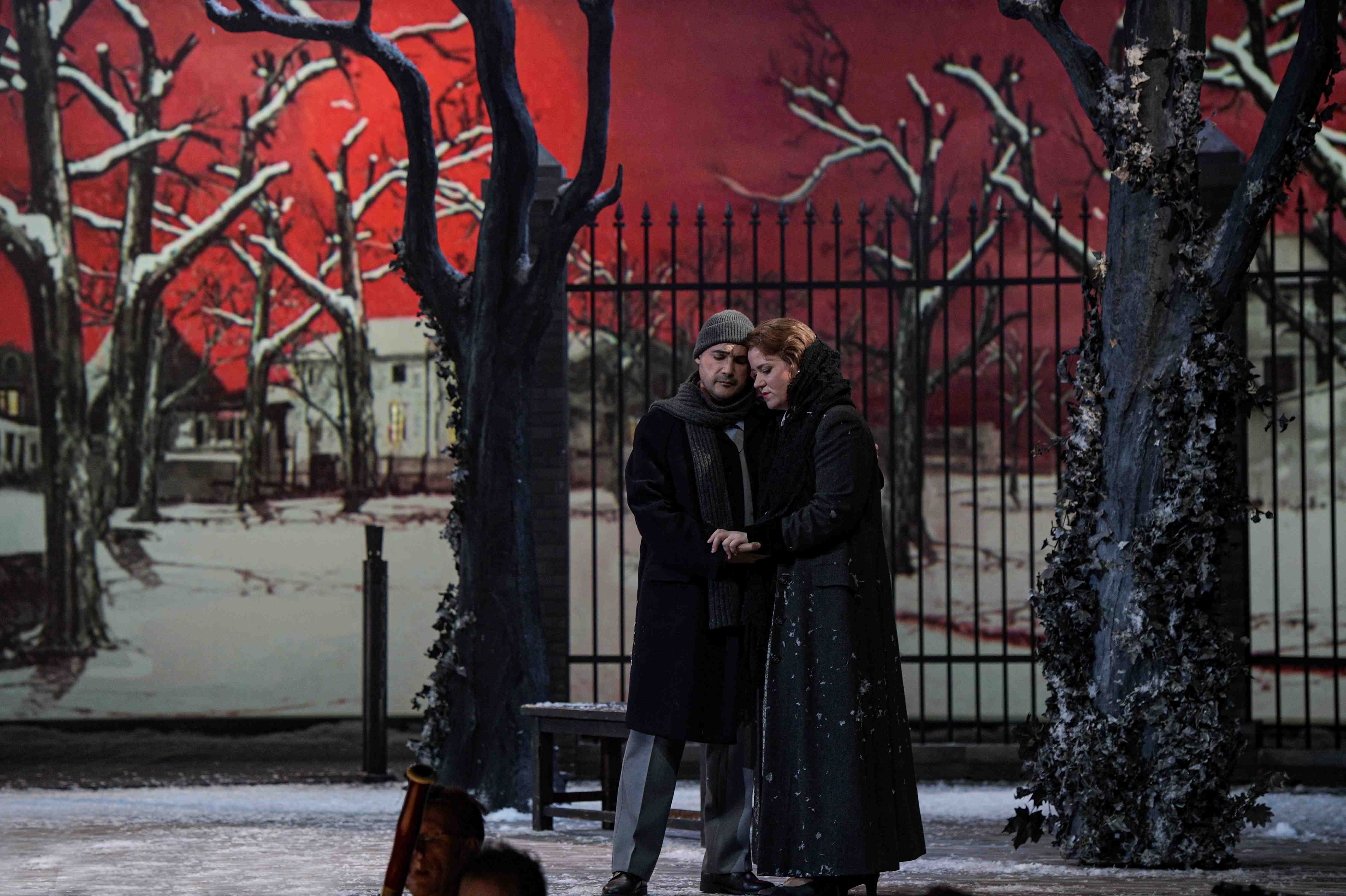
This was a decent repertoire performance of this splendid work, with a youthful cast, conducted with idiomatic style and very well played. Hampe’s staging provided a fitting framework for the action and amplified the music, just as it should. The audience responded at the close with warm applause.
 operatraveller.com
[…] It was wonderful to be able to see a trio of Bohèmes this year, led by young conductors. In Cologne, Mino Marani led an idiomatic reading with a youthful cast, sadly hampered by the poor acoustic of […]