Wagner – Der fliegende Holländer
Holländer – Claudio Otelli
Senta – Dorothea Herbert
Erik – Ewandros Stenzowski
Daland – Park Youngdoo
Steuermann – Joshua Sanders
Mary – Ariana Lucas
Extrachor des Hessischen Staatstheaters Wiesbaden, Chor des Hessischen Staatstheaters Wiesbaden, Hessisches Staatsorchester Wiesbaden / Lin Chinchao.
Stage director – Martin G Berger.
Staatstheater, Wiesbaden, Germany. Friday, April 10th, 2025.
My last visit to the Staatstheater in Wiesbaden was back in 2018, so I was certainly overdue a visit. The house is absolutely exquisite, with one of the most beautiful theatre bars anywhere. It’s also a very intimate space, which meant that when I saw Götterdämmerung here back in 2018, with the great Evelyn Herlitzius and Andreas Schager singing their opening duet, it was one of the loudest things I’ve ever heard. The size of the house also meant that this evening’s fliegende Holländer was similarly visceral in musical impact, with both the orchestra and voices extremely vivid and prominent.

I don’t think I’d come across the work of stage director Martin G Berger previously. Upon entering the auditorium, the surtitles set the scene: An entrepreneur, Daland, hosts a pirate-themed party every seven years. Twenty-one years ago, his wife took his then fourteen-year-old daughter Senta away. This year was the first time she had returned to her originally family home. As Senta entered the home during the overture, she was handed a red skirt. Then the Steuermann, after the sailors brought beer in to the garage of the house, raised one of the floorboards to find a box below, full of photos, that he proceeded to masturbate to. Berger used video, by Vincent Stefan, to illustrate the fact that the younger Senta was forced to dress up in the red skirt to then be abused by a figure dressed up as a pirate. Berger isn’t the first to reflect on this story as the product of abuse, but he may be the first to illustrate it so blatantly. This was a world where rather than spinning wheels, Mary encouraged the ladies to spin the bottle. A world where women, and indeed men, were seen as sexual objects to be had and disposed of.

Given that Daland promises Senta to the Holländer in the libretto as an object to have, at first glance using Senta as being given to another man to abuse, might seem to be a cogent and logical starting point for a staging. Yet unfortunately Berger’s staging abounds in non sequiturs. What is the role of Erik precisely? Who is the Holländer and why is Senta obsessed with him? Is Senta’s single-minded pursuit of the Holländer simply her way of avenging her abusers? I’m not convinced in the slightest that Berger actually manages to answer these questions or indeed actually give us a persuasive staging that stands up to any kind of deeper critical scrutiny. Both Dorothea Herbert and the chorus were absolutely fearless physically, despite the difficult demands placed on them to simulate abuse. While I am loathe to give spoilers, in the closing three minutes, Berger did at least attempt to find some kind of dénouement. A group of teenagers, of all genders, approached the front of the stage, similarly outfitted in a red skirt similar to that which Senta wore when she was abused. At the rear of the stage, a group of chorus members, put on pirate hats for the final tableau. This was the moment where Berger finally started to explain his concept, but by then it felt far too late. Despite the best efforts of the cast, the personenregie that consisted of barely-directed principals gesticulating to the front, combined with the fact that there were so many gaps in the concept and narrative that Berger presented, all meant that this was an evening that felt considerably longer than its two-hour and fifteen-minute running time.

That is in no way a reflection on the quality of the musical performance. Having not been here for a number of years, I was pleasantly surprised by the improvement in the quality of the orchestra since my previous visit. Yes, there were a few split brass notes, but string intonation was true throughout and there was some very individual and characterful wind playing – particularly from the solo oboe. This points to the positive standards obtained by the house music director, Leo McFall. Unfortunately, McFall was unable to conduct as planned tonight, and the evening was led by resident conductor Lin Chinchao. Lin’s reading showed some really good qualities, not least in the way that the melodies found a lyrical logic in the overture, making it sound like Teutonic bel canto, just as it should. Indeed, the opening Daland/Holländer duet sounded like something from Bellini, with long, lyrical lines superimposed over a pulsating rhythmic foundation. I did find, however, that Chin’s tempi did have a tendency to sag in some of the later duets, not helping the lack of dramatic insight on stage. Still, it was an efficient reading and he kept the disparate forces together with precision.

Claudio Otelli was the third Holländer scheduled for this evening and I was eager to hear him, having heard his thrilling Alberich in Bologna last year. Otelli is in his late sixties but the voice and technique are as strong as ever. The sound he produces is big and focused, with words always front and centre. The tone is firm, with a slight grey edge that brought out the Holländer’s world-weariness fully. The voice is so even from top to bottom, the tessitura holding no terrors for him. A seriously impressive piece of singing. Herbert sang Senta in a bright, slightly chalky soprano. The voice is big, with a visceral impact in a house of this size. She had clearly worked hard on the passaggio-crossing treacherousness of the ballad, while the voice rang out at the top, those long, high-lying phrases holding no terrors. Naturally, her diction was also impeccable. Perhaps there’s a relatively limited palette of tone colours there, but Herbert knows how to use dynamics to illustrate the music most intelligently.

As Erik, Ewandros Stenzowski sang his music in an equally bright tenor, able to ring out on high with ease. The tone does have a slight graininess to it, but he’s clearly an agreeably musical singer. Park Youngdoo sang Daland in a big, rich bass, words always clear and forward. Ariana Lucas was a fruity Mary, with a rich chestiness, while Joshua Sanders sang the Steuermann in a beefier tenor than we might be used to, and could certainly make a very good Erik in future. The choruses, prepared by Albert Horne, sang with confidence and generosity. The tenors and basses made a massive sound, the tone firm and rich and ensemble impeccable. The sopranos and mezzos were generous in their vibrations, although the exuberance of the sopranos’ tone dd not always ensure a consistency of approach to tuning.
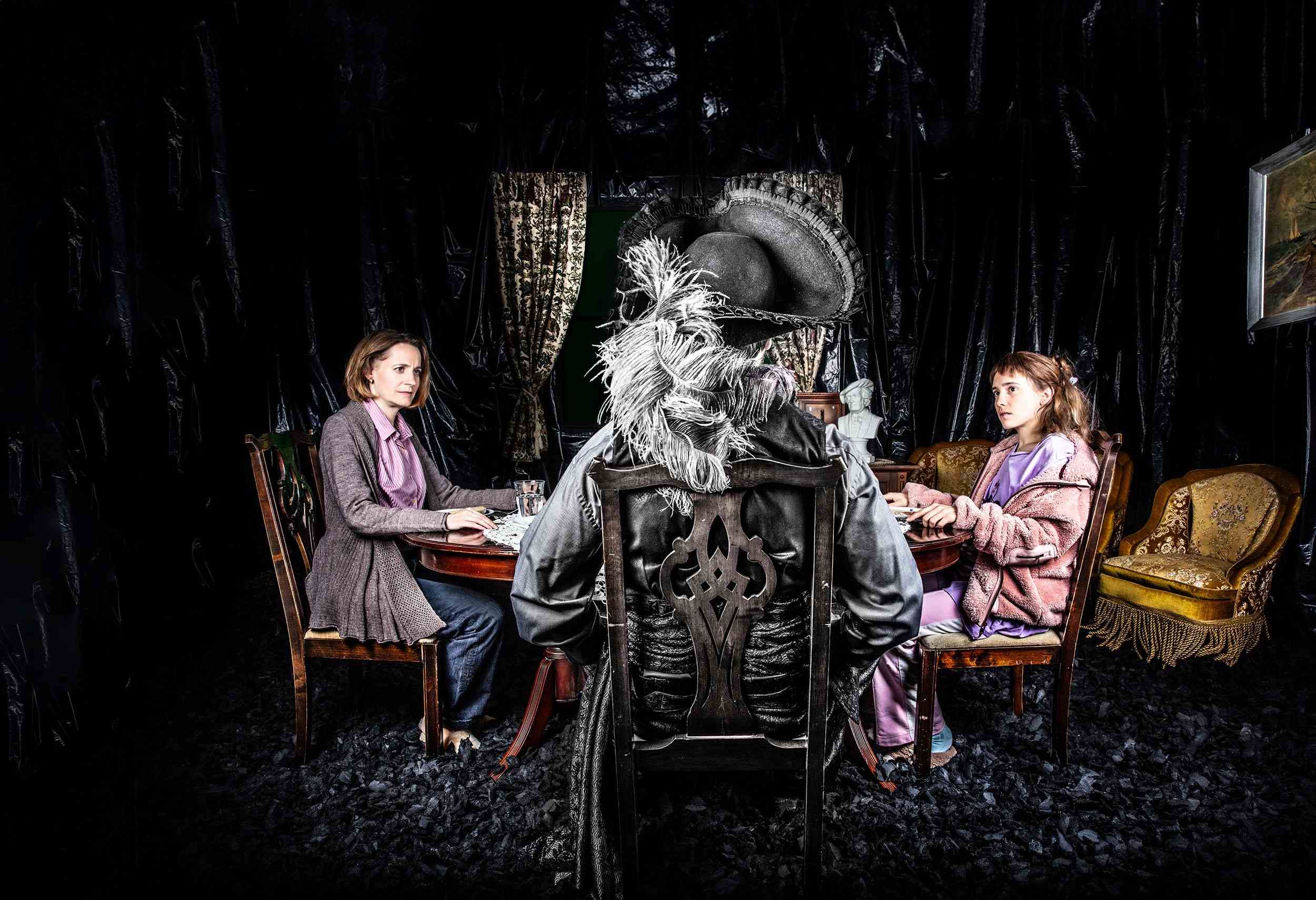
Musically, this was a more than decent account of the score. The singing of the principals gave so much to enjoy and Lin gave us an efficient and vivid traversal of the score. The orchestral playing and choral singing had so much to offer. Sadly, the evening was let down by Berger’s staging. It’s not that Berger lacked an interesting take on the narrative – certainly the starting point that he had would make for an interesting exploration of the work. Sadly, this wasn’t it. It looked expensive and I left wondering if the money would have been better spent on some more detailed and coherent personenregie. The audience reaction at the close was extremely generous to the singers and musicians.
 operatraveller.com