Korngold – Die tote Stadt
Paul – Eric Cutler
Marie/Marietta – Vida Miknevičiūtė
Frank/Pierrot – Björn Bürger
Brigitta – Evelyn Herlitzius
Juliette – Rebeca Olvera
Lucienne – Daria Proszek
Gaston – Raúl Gutiérrez
Victorin – Nathan Haller
Graf Albert – Álvaro Diana Sánchez
SoprAlti Kinderchor der Oper Zürich, Zusatzchor der Oper Zürich, Philharmonia Zürich / Lorenzo Viotti. Stage director – Dmitri Tcherniakov.
Opernhaus Zürich, Zurich, Switzerland. Friday, May 2nd, 2025.
For its new production of Die tote Stadt, premiered last week, the Opernhaus Zürich confided the work to the stage direction of Dmitri Tcherniakov. As always, one would be right not to expect a conventional reading of the narrative, but what Tcherniakov does instead with the piece is something very special. It’s probably helpful that he has a number of the cast making role debuts, notably Eric Cutler as Paul and the great Evelyn Herlitzius making a cameo appearance as Brigitta, ensuring a freshness of approach that feels at one with Tcherniakov’s vision.

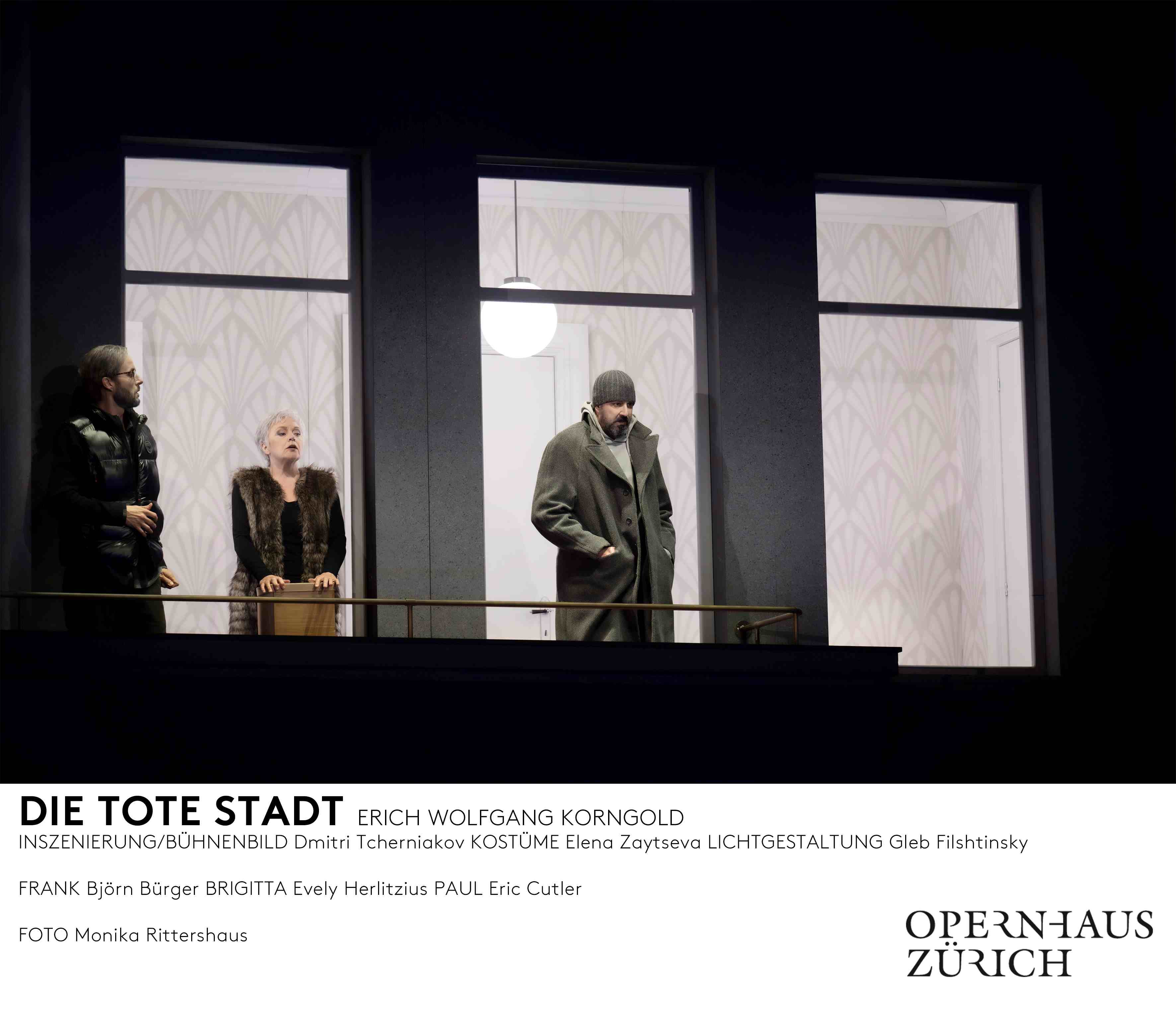
Both Rodenbach’s original novel and Korngold’s score occupy a world where reality and imagined seem to combine. Tcherniakov takes this one step further, he adds additional layers onto the narrative, in a way giving us a Russian doll of an evening, one in which he never quite allows us to conceive of what is actual and illusory. Prior to the start of the music, he has a voice describe a relationship between a 41-year-old man and a 16-year-old girl. This immediately sets up an idea in the audience’s mind that the relationship between Paul and Marie was one of exploitation. It also serves to give us a backstory that suggests that Marie committed suicide. Then, as Frank and Brigitta enter, they do so holding torches, with Frank taking notes of his conversation with Paul, suggesting detectives investigating a murder. The set, also by Tcherniakov, contains an apartment viewed from outside, divided into rooms, similar to the one featured in his stagings of Elektra and Salome, in which the bulk of the action takes place. Underneath, Bruges is portrayed as a blank space, with white walls, with a revolving stage illustrating life going on outside.
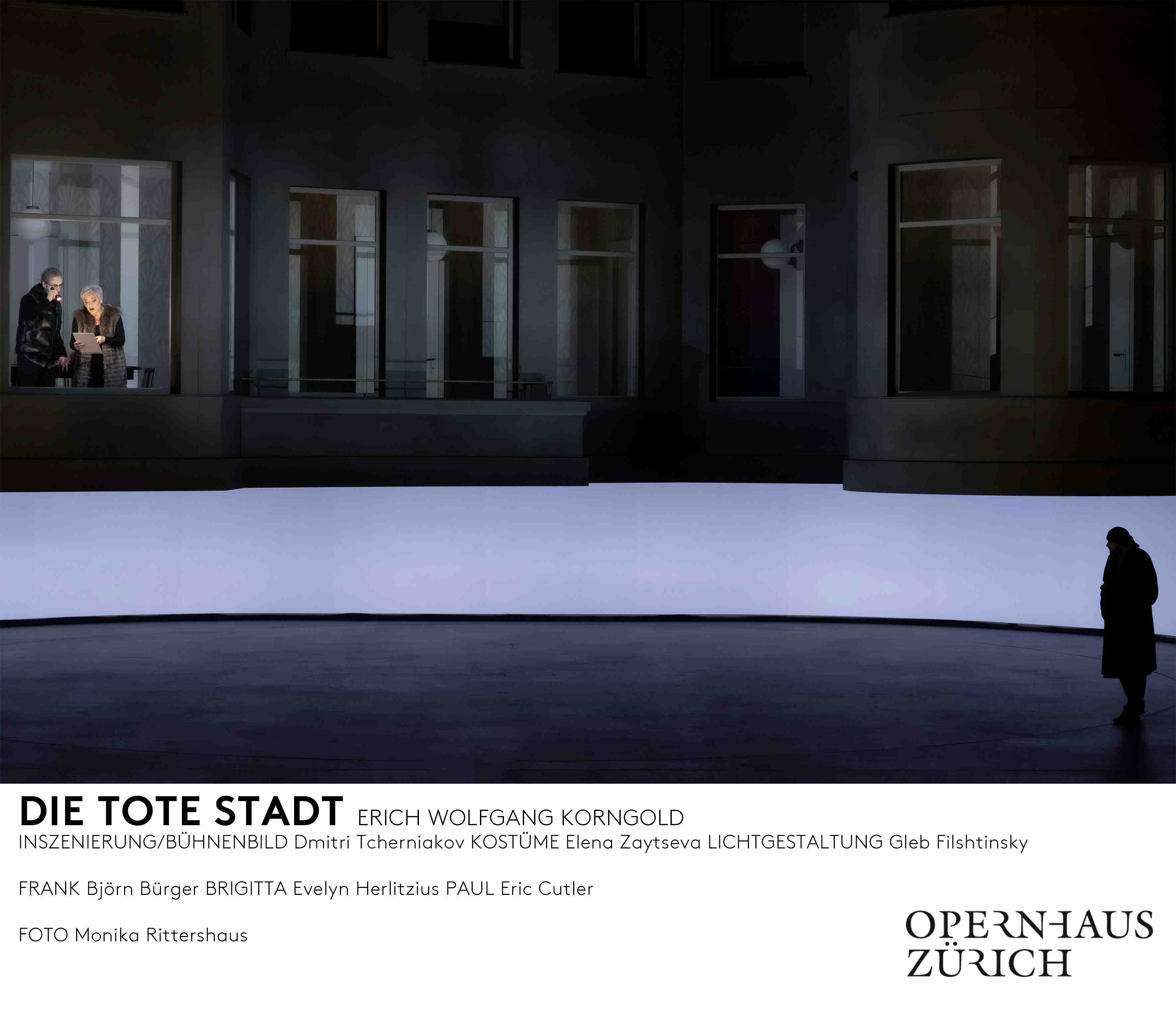
Tcherniakov asks a lot of his singers, with Marietta’s troupe in Act 2 on rollerblades rolling around the revolving stage while singing, or the eventual murder of Marietta by Paul which is horrifying in its immediate physicality. Cutler’s Paul is also unflinching, whether in his apparent loss of his senses at the end of Act 1, literally disintegrating physically in front of us, or in his energetic pursuit of Frank while the latter jogs around the revolving stage at the start of Act 2. Yet, what will stay with me from tonight is how the ambiguity of Tcherniakov’s vision transforms itself, in the final moments, into a devastating exposition of loss and grief. Marietta may be three different women – a spiky-haired young woman in a minijupe in Act 1, an experienced actress in Act 2, or a tiktoker in Act 3 acting out her experience for the web – yet each seems to reflect a different manifestation of Paul’s experience of grief. Similarly, the fact that Paul dresses up as a bishop in Act 3 for the procession, almost seems to want to repulse the audience, to make them retract from Paul as a character. Yet, it’s testament to Cutler’s performance and Tcherniakov’s direction that ultimately, what they succeed in doing is to make us feel for Paul in those closing moments. In many respects, I imagine each audience member will have their own view of what Tcherniakov and his cast achieve. For me, however, the entire evening builds up to a devastating dénouement that reveals that what we witnessed was the grief process of a man who found it impossible to come to turns with the greatest loss. Tcherniakov and Cutler make so much of that moment of realization where what we had just witnessed was a dream of coming to terms with grief, precisely asking that question of ‘Wie weit soll unsere Trauer gehen, wie weit darf sie es, ohn’ uns zu entwurzeln’?

If Tcherniakov’s staging is one of exceptional power and insight, I do have one significant reservation and that is the set design. With so much of the action taking place in the rooms, there were significant issues with sightlines and with audibility of the singers when they sang from the rooms, certainly from my seat in the Parkett. Yes, it added to the claustrophobia of the narrative, but it wasn’t optimally designed for viewers or indeed for the singers, particularly with an orchestra as large as this. The Philharmonia Zürich was on stupendous form for Lorenzo Viotti. The quality of the playing he obtained from them was absolutely superlative, rich in so many shades, the strings giving us a sheer rainbow of tone colours, founded on a strong bass line, all underpinned with the organ pedal below. Viotti revelled in the Hollywood technicolour of Korngold’s writing, offering soupy portamenti and richness of sound throughout. By and large, and particularly given the acoustic issues with the set, he consistently let the singers through, even though the voices were frequently recessed in the sound picture. His tempi were sensible, although with some reservations. The lute song did threaten to ground to a halt and I lacked a sense of the incipient violence under the chords that accompanied the procession. The choral interjections, with adults and children both prepared by Ernst Raffelsberger, added an appropriate halo to the sound.

Cutler’s Paul was the kind of performance that defines a career. In this beast of a role, Cutler was tireless both vocally and physically. It sits well for his big, high-lying tenor, allowing him to let rip at the top of the voice with ease. He clearly knows how to pace the role, conserving enough in the tank to keep him going to the end of the evening, where so many before him have run out of gas. Cutler found so much detail in the text and in the tone, shading it in Act 1, making exquisite use of voix mixte in his recollections of Marie to colour the tone memorably. Another notable role debut from his generous singer. Vida Miknevičiūtė sang Marietta in a good-sized soprano with decent cutting power. The tone itself has an attractive fast vibrato around a creamy core. Unfortunately, Miknevičiūtė ran out of steam in Act 3, coming to grief in the higher, sustained writing, while the fast vibrato did mean that her tuning wasn’t always optimal higher up, sitting around the note rather than directly on it. Still, she was a very convincing and brave actress.

Björn Bürger had one of the most exquisite moments of the score in the Pierrot-Lied, which he sang with handsome tone, an impeccable legato, a top seemingly without limits, and impressive breath control. Even more impressive, since he sang his celebrated aria on rollerblades on a revolving stage. Elsewhere, the humanity in his final lines to Paul was palpable through the beauty of his tone and use of text. Herlitzius gave the brief role of Brigitta a Shakesperean depth of characterization. She brought out so much through the text, making every word count, and, unlike so many before her, the voice rose up with ease and autumnal warmth in her soaring phrase on ‘Liebe’ in Act 1. The remaining cast reflected the excellent standards one has come to expect at this address, the remaining roles mellifluously sung.
This was an overwhelming evening in the theatre, one that renewed hope in this glorious artform. Tcherniakov gives us a staging that stays so true to the work, that takes us on a profound psychological journey, challenging our preconceptions of grief and those who grieve, while eliciting performances of thrilling vividness from his entire cast. Musically, it was absolutely superb. Viotti led an orchestra at the top of its game, while Cutler was utterly fearless in giving so generously of himself to us. This is an evening that needs to be seen and I very much hope that the house will be filming it for a commercial release. The audience responded at the close with extremely generous ovations for the entire cast.
 operatraveller.com
[…] in a fascinating production by Vasily Barkhatov. Another child genius was Korngold, and his Die tote Stadt was performed in Zurich in a similarly fascinating production by Dmitri Tcherniakov. Eric […]