Rameau – Les Indes galantes
Amour / Phani / Fatime / Zima – Julie Roset
Hébé / Émilie / Zaïre / Atalide – Ana Quintans
Valère / Don Carlos / Tacmas / Damon – Mathias Vidal
Bellone / Osman / Huascar / Ali / Don Alvar – Andreas Wolf
Structure Rualité, Chœur de Chambre de Namur, Cappella Mediterranea / Leonardo García-Alarcón.
Stage director and choreographer – Bintou Dembélé.
Teatro Real, Madrid, Spain. Sunday, June 1st, 2025.
This ‘choreographed concert’ performance of Les Indes galantes, has its origins in a staged production at the Opéra de Paris back in 2019. There, Clément Cogitore invited Bintou Dembélé, one of France’s most acclaimed hip-hop dancers and choreographers, together with her company Structure Rualité, to provide the dance element for this ballet héroïque. Following the success of that production, the conductor, Leonardo García-Alarcón, was keen to continue his collaboration with Dembélé and the result is this version which, after these four Madrid performances, of which tonight was the last, will also be seen in Lyon, the Scala, and São Paulo, among other places.

Although billed on the Teatro Real’s website as a semi-staging, this was so much more than that. This was a performance in which soloists, dancers, chorus and orchestra were as one. The orchestra was placed on stage, around the back, while from time to time, groups of instrumentalists were brought to the front. García-Alarcón started the evening conducting from the front of the stage, without a score, to then move to the centre of the orchestral forces to lead the music from one of the two harpsichords on stage. The vocal soloists were positioned from both being around the room, starting the evening from the royal box, to also being on stage. Similarly, the chorus sang from the auditorium and from the stage, while the dancers were also positioned strategically, entering and exiting through the Platea or, at one point, waving large cloths around to imitate sails from throughout the auditorium.
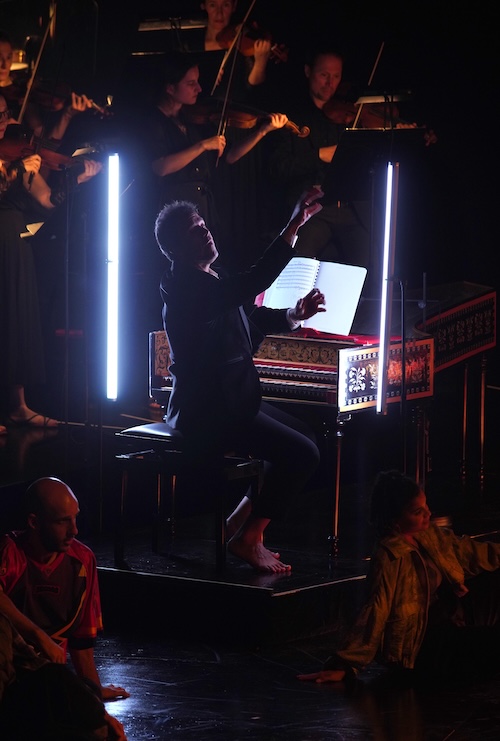
Despite the lack of set, a large light feature, by Benjamin Nesme, dominated the stage, able to illustrate the text through becoming the sun or by bathing the auditorium in streams of light. There was something utterly magical to hear Ana Quintans’ soprano ring out across the auditorium in the opening moments of the prologue; similarly, as Julie Roset sang ‘Viens, Hymen’ from a side balcony, the flute solo situated on the opposite balcony, the effect was utterly captivating. I found the way that Dembélé’s choreography paced the evening to be similarly insightful. At first, the dancers seemed to be engaging in traditional, eighteenth-century courtly movements. Then, as the evening developed, they brought movements reflective of hip-hop dancing, including krump, to the stage. Dembélé choreographed the singers of the Chœur de Chambre de Namur as much as she had choreographed her dancers, offering stage pictures of increasing complexity, making us wonder whether we were indeed watching singers or dancers. There was something extremely moving to watch these two disparate art forms come together to create a total work of art – even in what was ostensibly a concert setting. The dance amplifying the music, and vice versa. Yet what Dembélé has given us is something even deeper. It’s no coincidence that this is a work that exoticizes the ‘other’, whether Turkish, Inca or Aboriginal American. Uniting dancers and musicians from two very different traditions gives this music a sense of timelessness, of uniting people across boundaries and traditions that are ultimately artificial. Yet, what will stay with me is the choreography of ‘forêts paisibles’. Allow me to take a moment to remind you of the text:
Forêts paisibles,
Jamais un vain désir ne trouble ici nos cœurs.
S’ils sont sensibles,
Fortune, ce n’est pas au prix de tes faveurs.
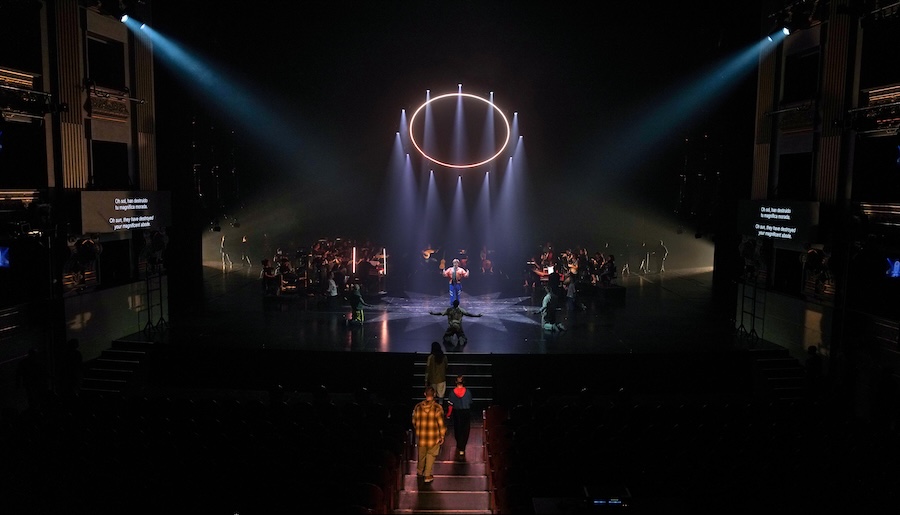
Street dance has its origins as a way of social expression and cultural identity in urban communities, something that on surface level might seem far from the world of Rameau. And yet, here, I feel that Dembélé takes us into something much deeper. For so many of us, music is a way of escaping the world, of finding expression in something deeper – in the same way that dance is for others. In so doing, the dancers and singers here find a way to use the music and text to express themselves, to find a freedom from the world that exists through musical and physical expression. So that our hearts are not troubled, but instead find peace and freedom through artistic expression. I found it extraordinarily moving, with the singers dancing as much as the dancers, and dancers using the music to express their physicality, both from different traditions, yet united by text, dance and sound. It really is one of the most extraordinary things I’ve had the privilege of seeing.
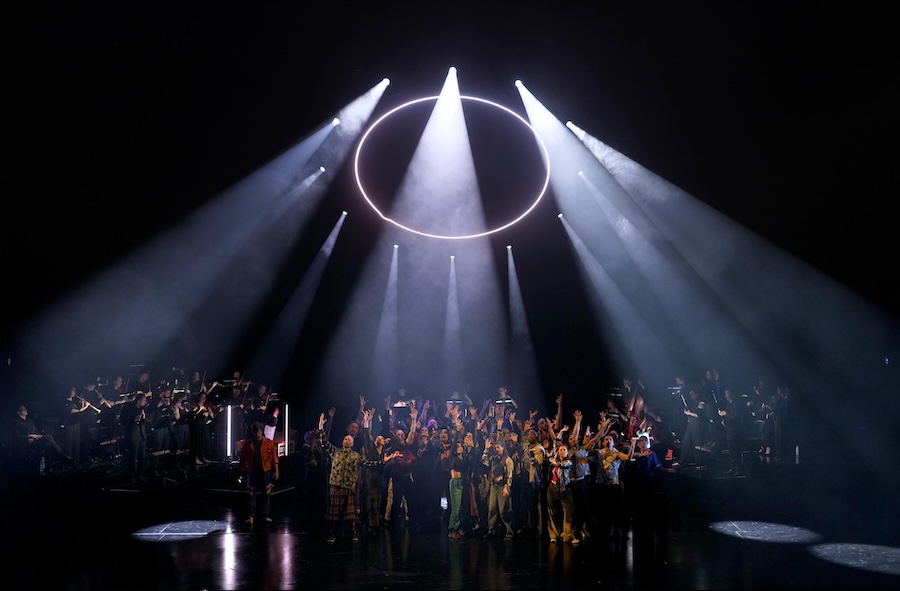
Of course, the evening would not have had the impact it did without the musical side being so strong. Despite conducting from various places around the stage, and despite the disparate positioning of the singers and instrumentalists around the auditorium, ensemble throughout the evening was absolutely immaculate. The singers of the Chœur de Chambre de Namur not only managed to execute complex dance moves, they also managed to sing their music without a single stray note or entry out of place. The precision and quality of their singing was absolutely staggering, the blend unanimous and pitch unwavering. They had clearly been exceptionally well prepared by Thibaut Lenaerts. The orchestral playing was similarly excellent. The winds were particularly engaging, with piquant oboes and deliciously raspy bassoons. The trumpets also were on their very best behaviour, ringing out over the textures, and the string intonation was solid. García-Alarcón’s tempi felt ideal. He gave his singers space to float those long, melismatic lines, but also gave a rhythmic precision that swept the evening along and made the hours feel like seconds.
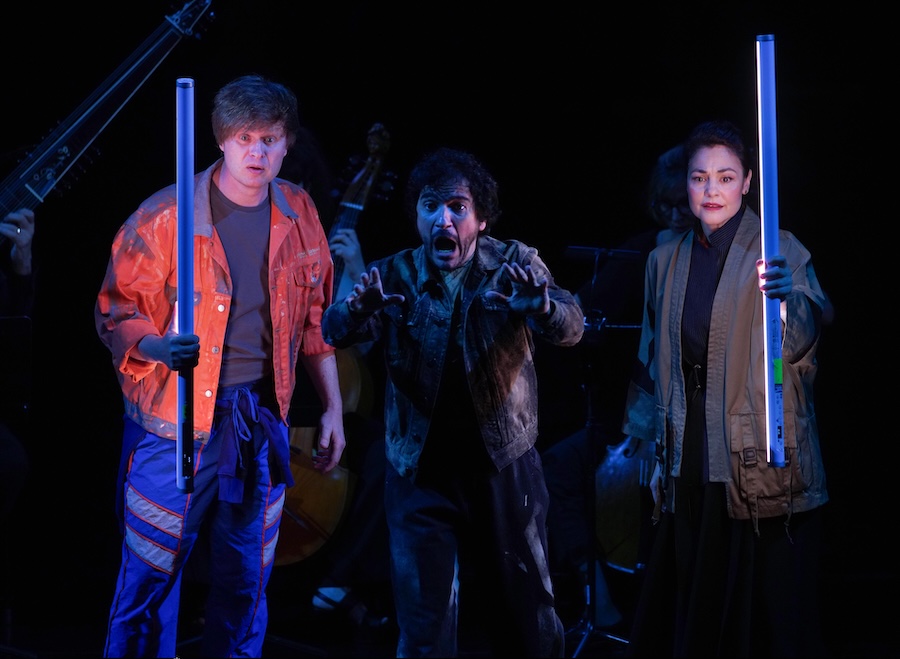
Quintans has one of the most ravishingly beautiful soprano voices around. The way that she floated the opening phrases of the prologue with long, twisting lines, a legato of incredible smoothness, and fabulous trills, was enchanting. She really understands this music implicitly, singing in eloquent French, using the words to illustrate the line and bring out meaning. The voice soars with such glorious beauty, it was impossible not to be transported. Roset of course had one of the most wonderful arias in her ‘Viens, Hymen’. Her tone is narrower that Quintans and, at the start of the evening the words were somewhat occluded, but she warmed up nicely to sing with haunting purity, the voice soaring with ease, unencumbered by the forces of gravity. Mathias Vidal brought his customary focused tenor to his music, at one point accompanying himself on the harpsichord. This was the fourth performance in four days, so any tiredness at the very top of the voice is understandable. As always, his verbal acuity and freshness of tone gave much pleasure. Andreas Wolf coped extremely well with music that took him from very low to very high. His bass-baritone is in excellent shape, firm and healthy of tone, and rich and full at the bottom.
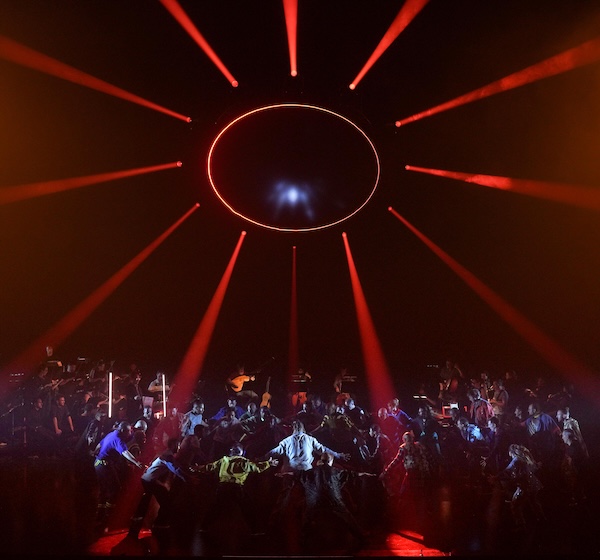
This was an evening unlike any other. Dembélé and García-Alarcón have given us something astonishing, a total union of art forms that entertains, inspires, and moves in equal measure. Musically, it was absolutely superb on every level, and the visuals, both the lighting, placement of artists around the room, and the sheer physical energy produced, all combined to amplify and highlight this remarkable score. I very much hope this is only the beginning of the collaboration between these two great artists, and that Dembélé will be inspired to explore more of the French baroque with García-Alarcón. The audience response at the close was completely ecstatic, understandably so, because this is a very special evening.
 operatraveller.com
[…] collaboration between Leonardo García-Alarcón and Bintou Dembélé in Rameau’s Les Indes galantes has led a peripatetic existence since being first seen in Paris, France, back in 2019. I got […]