Puccini – Tosca
Floria Tosca – Carmen Giannattasio
Mario Cavaradossi – Giorgio Berrugi
Il barone Scarpia – Claudio Sgura
Cesare Angelotti – Lorenzo Mazzucchelli
Il sagrestano – Pietro Di Bianco
Sciarrone – Giuseppe Todisco
Spoletta – Francesco Domenico Doto
Un carciere – Giuseppe Scarico
Un pastore – Weerasingha Sanuthi Vethara, Aldo Gaeta
Coro di Voci Bianche del Teatro di San Carlo, Coro del Teatro di San Carlo, Orchestra del Teatro di San Carlo / Dan Ettinger.
Stage director – Edoardo De Angelis.
Teatro di San Carlo, Naples, Italy. Saturday, September 19th, 2025.
Over the years, the Teatro di San Carlo has hosted some of the greatest singers in the world for its productions of Tosca. Indeed, a quick look through the program book reveals that thirty years ago, for instance, Raina Kabaivanska, appeared in the title role alongside Luciano Pavarotti as Cavaradossi. This year, the house revived Edoardo De Angelis’ 2020 staging with a revolving cast, with local favourites Anna Pirozzi and Sondra Radvanovsky sharing the title role with Carmen Giannattasio, who I heard tonight. Cavaradossi is being taken by Giorgio Berrugi, Vittorio Grigolo and Francesco Meli, some of who appear in the photos, while Scarpia is sung by Claudio Sgura and Luca Salsi.
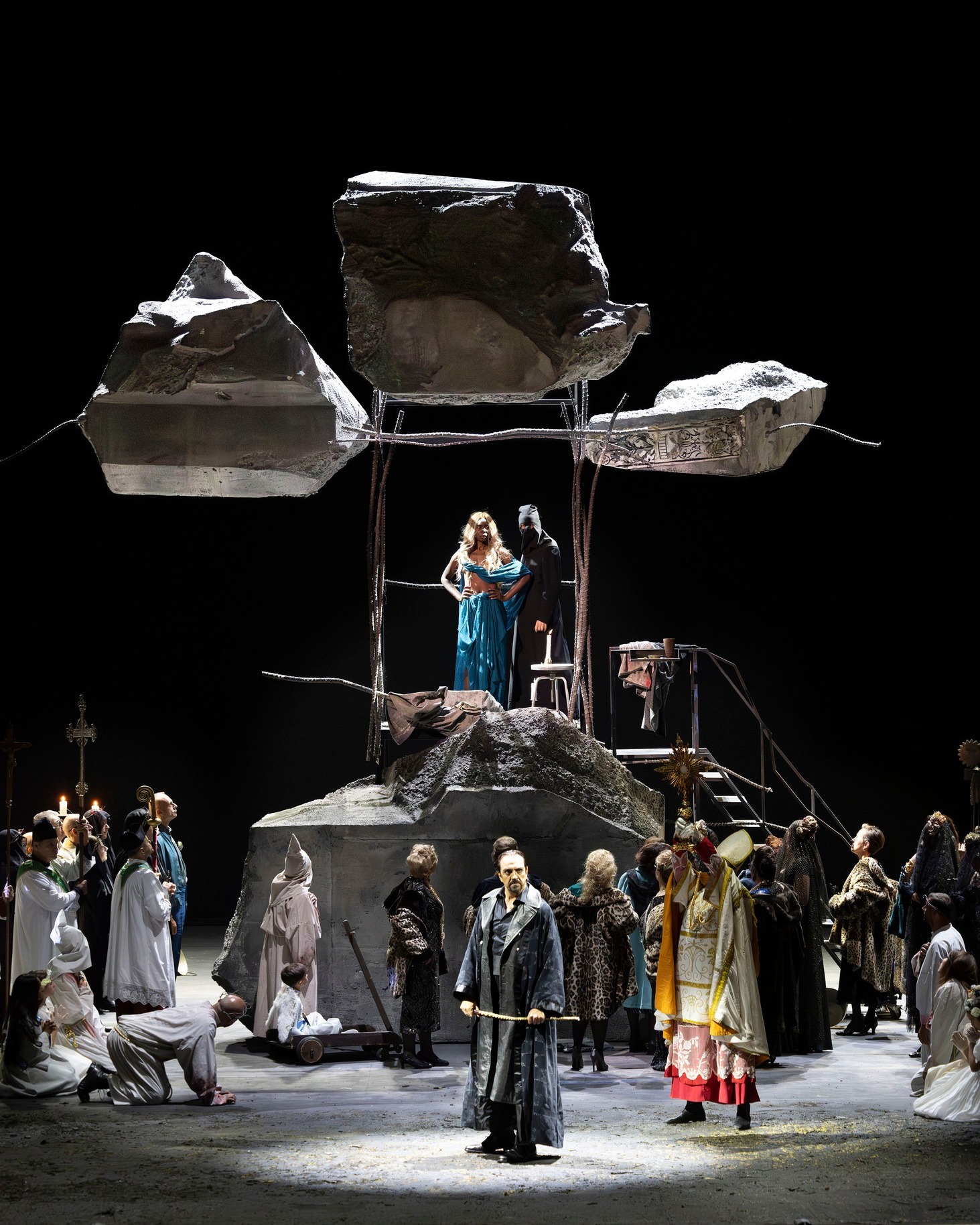
De Angelis is better known as a film director and screenwriter and his production of Tosca certainly offers striking visuals, while also betraying the fact that it’s the work of an operatic novice. The entire evening is set within a visually spare environment. The set in Act 1, designed by Mimmo Paladino, has a single focal point – that of a scaffold upon which Cavaradossi is working on a statue of the Madonna. Act 2, has a little more furniture, notably a long dining table, a crocodile hanging from the rafters, and what looks like a wooden stature of a woman at the back. Finally, the third act, simply has a desk for the jailer and a large overturned statue with its head cut off. It’s undoubtedly symbolic, particularly in how Scarpia removes the Madonna’s clothes at the climax of the Te deum to reveal her breasts, presumably to illustrate how sexually depraved he is. The effect, however, just felt cartoonish rather than shocking. Indeed, in De Angelis’ staging I failed to find a sense of the sheer gruesomeness and violence contained in the work. Rather, it all felt somewhat routine.
That effect was compounded by the personenregie, with this run revived by Paolo Vettori. Far too often, characters just gesticulated to the front, opening their arms wide to likely enhance the importance of the moment. Furthermore, the wide-open spaces of the set made it very difficult for Giannattasio’s Tosca to assert herself dramatically, seemingly lost in the open space, even though she was the Tosca in the first run of this production back in January 2020. The set also had implications for the audibility of the singers, since it failed to give them any acoustic support. When they were placed further back on stage, they were frequently barely audible – Giorgio Berrugi’s Cavaradossi was particularly impacted by this in his ‘recondita armonia’ sung from the scaffold, while Giannattasio’s leap from the battlements also suffered from being so far back. Although I must admit the excitement of the lady next to me when she leapt was wonderfully uplifting. De Angelis’ staging isn’t devoid of ideas. The 1960s costumes point to a time of revolution. And yet, where it falls down is in its execution, if you pardon the pun, and the fact that it fails to support the singers in the acoustic space and in the personenregie.
The evening was also hamstrung by Dan Ettinger’s conducting. He clearly adores this score, phrasing the love music in Act 1 with amorous portamenti and elastic use of rubato. And yet his tempi throughout the evening were simply far too slow, sucking the dramatic life out of the evening. This is a score that should crackle with dramatic tension, that should build up into an unbearable thrill. I can’t help but think back to Andrea Battistoni in Munich last year, who made Scarpia’s entry in Act 1 sound like the most terrifying thing I’ve ever heard. Here, there was no sense of urgency, no sense of transition. Instead, those brassy chords seemed to emerge out of nowhere. He also failed to allow his singers through due the acoustic issues in the set, particularly in the ‘recondita armonia’ as mentioned above. Ettinger did obtain a unanimity of approach in the band, although there were a very few ragged entries in the winds and brass. The string playing had an agreeable transparency in the quieter moments and the brass certainly rose to the occasion. The children’s chorus, prepared by Stefania Rinaldi, had been extremely well trained, while the adults, prepared by Fabrizio Cassi, sang mellifluously in their off-stage contribution to Act 2.
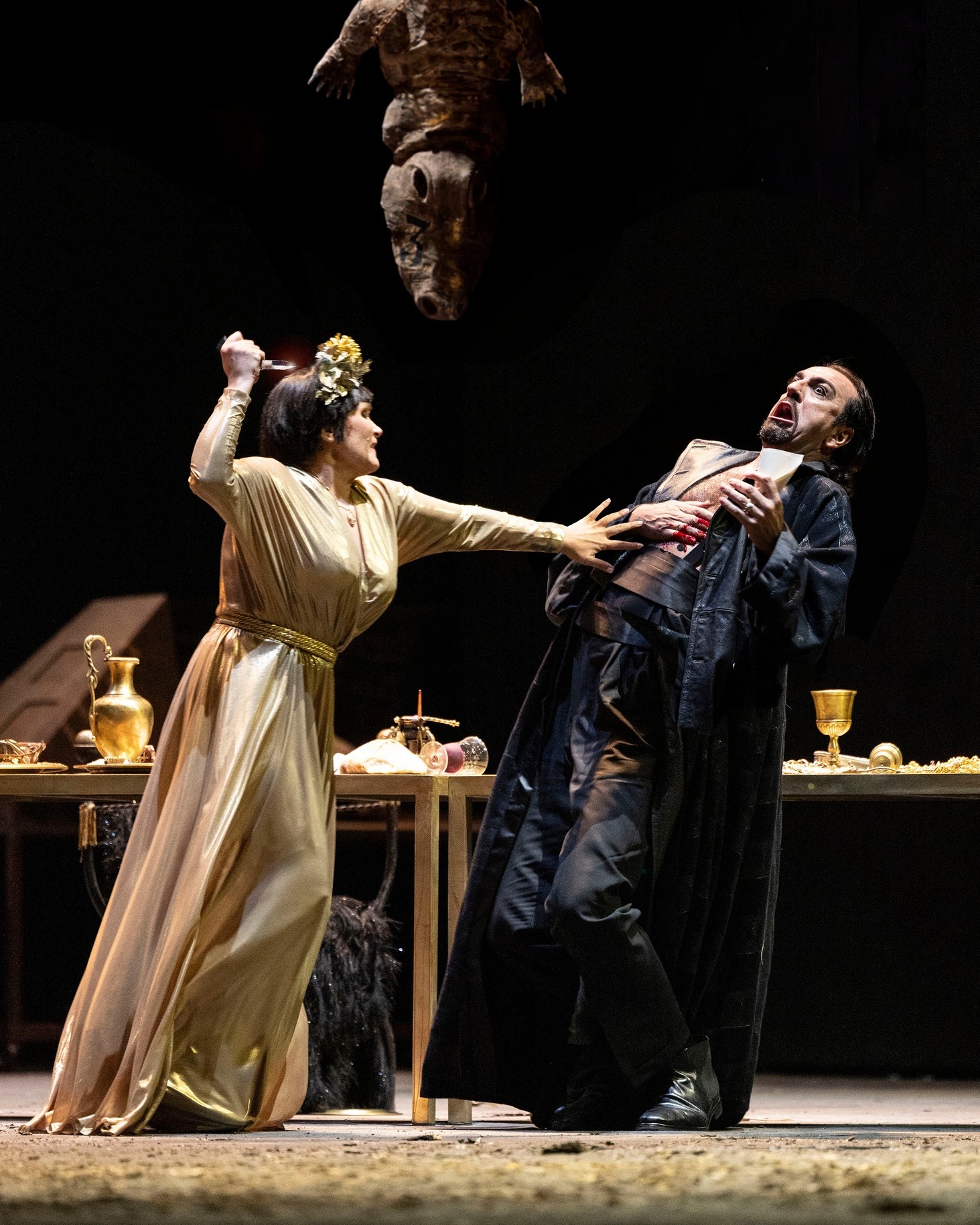
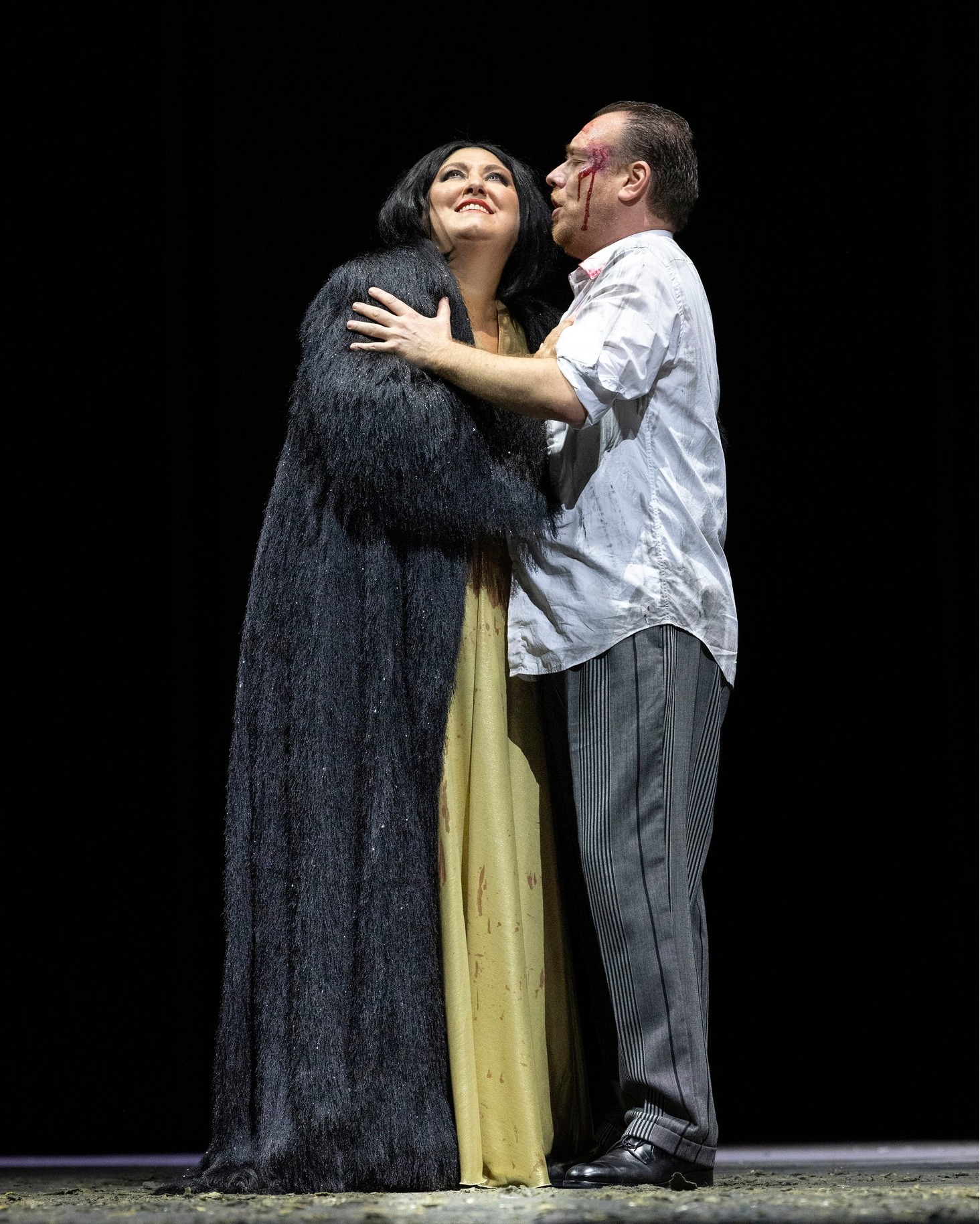
This was my third encounter with Giannattasio’s Tosca, having heard her previously in Macerata and Caracalla. She was in much fresher voice tonight than on those previous occasions and, despite physically being lost in the wide-open spaces of the set, did manage to assert herself dramatically at the moment it truly mattered – the murder of Scarpia. Indeed, her final ‘muori’ was deliciously feral, which made up for the fact that her ‘Questo è il bacio di Tosca’ was lost under the orchestral tumult. She sang a ‘vissi d’arte’ with long lines and attention to text, although the vibrations did widen somewhat at the climax. Giannattasio was certainly committed and gave generously of herself.
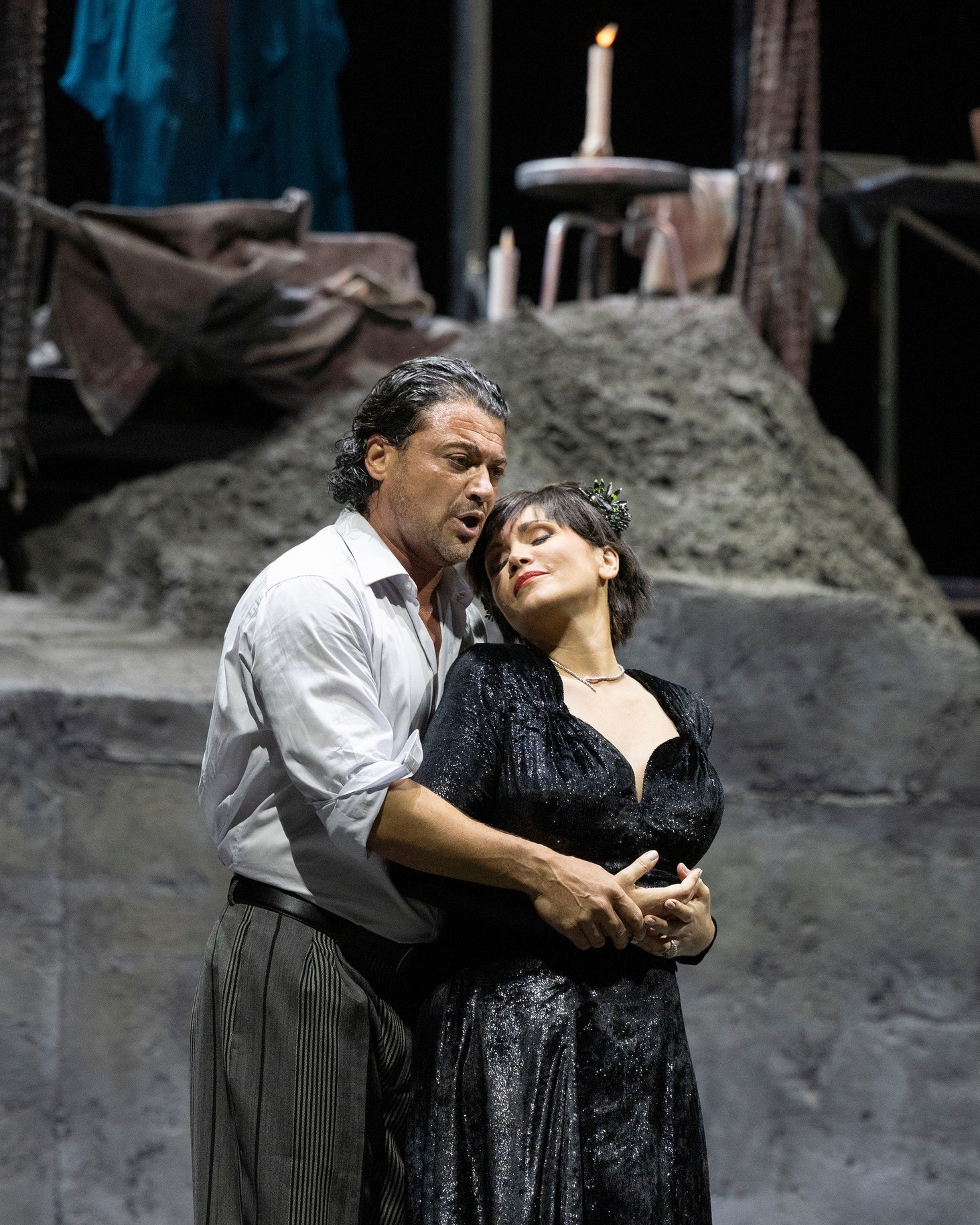
Berrugi’s Cavaradossi was a more complex portrayal than we often hear. The voice has an agreeable Italianate richness. It does, however, need a little bit of heavy lifting to get up to the top. His ‘vittoria’s were less trumpeted out, and more audibly the sound of a man exhausted from torture, which I found to be an interesting take on a line that far too often just seems gratuitous. Berrugi also had a thought-provoking take on ‘e lucevan le stelle’. The first part of the aria was taken relatively softly, while the second half took on a powerful urgency, the line ‘E non ho amato mai tanto la vita’ given a dramatic force and frustration that I found particularly compelling. Berrugi undoubtedly phrased his music with real feeling and insight.
Claudio Sgura’s Scarpia was also very different from the bruisers we often hear. His baritone is somewhat soft grained, particularly at the very top, which made his Scarpia much more refined and quotidian in his evil. There was a beauty in his singing which made his depravity even more shocking. While I don’t like to comment on singers’ physiques, Sgura is an extremely tall gentleman, which gave him electric stage presence, dominating the empty space in a way his colleagues struggled to. Sgura’s was an unconventional Scarpia, in that he made everything so beautifully sung, but I similarly found his interpretation to be just as compelling. The remaining roles were adequately taken. I did find that Lorenzo Mazzucchelli’s Angelotti was a bit casual in rhythm and pitch, perhaps overly excited by his escape, while Pietro Di Bianco was an extrovert Sagrestano. Francesco Domenico Doto gave us a Spoletta full of textual eloquence, obsequious in his relationship with Scarpia. The two shepherds had also clearly been well trained.
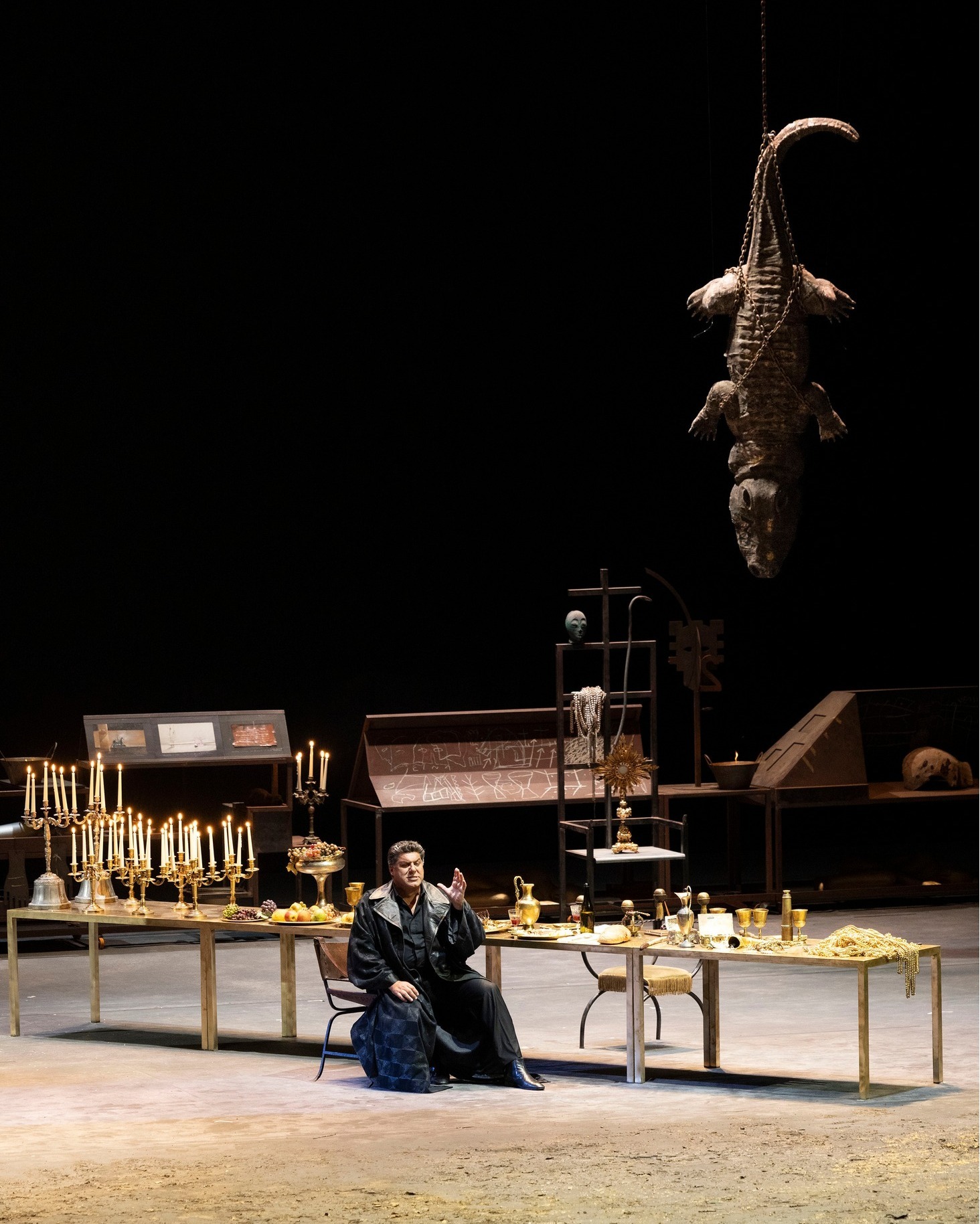
Tonight’s Tosca was not a vintage night at this historic house. While the singing did offer some rewards and insight, the evening was seriously hampered by Ettinger’s weighty conducting that sucked the dramatic life out of the piece. De Angelis’ staging also had a similar effect by placing the action in an empty space, sucking out the dramatic energy from the principals and not providing acoustic support. The audience response was initially tepid at the end of Act 1, but grew in enthusiasm with some cheers at the end.
 operatraveller.com
[…] common with last night’s Tosca in Naples, this staging of Pêcheurs is the work of a celebrated film director moving into opera, […]