Rossini – La Cenerentola
Angelina – Anna Alàs i Jové
Don Ramiro – Theodore Browne
Dandini – Wolfgang Stefan Schwaiger
Don Magnifico – Omar Montanari
Clorinda – Giulia Montanari
Tisbe – Alicia Grünwald
Alidoro – Christoph Seidl
Chor der Oper Köln, Gürzenich-Orchester Köln / Matteo Beltrami.
Stage director – Cecilia Ligorio.
Oper Köln, Staatenhaus Saal 2, Cologne, Germany. Saturday, January 3rd, 2026.
In something of a neat coincidence, I’m starting my 2026 operagoing in the same theatre where I started 2025: the Oper Köln, still located in its ‘temporary’ theatre on the opposite side of the Rhine from downtown Cologne. As was the case last season, they have an interesting program planned for the year, and I was keen to see this revival of Cecilia Ligorio’s staging of La Cenerentola, with a youthful cast of both Italian and non-Italian singers, under the musical direction of Matteo Beltrami. Of course, this time of year, some cast replacements are inevitable, and tonight was no exception, with Anna Alàs i Jové jumping in at the very last second for the originally-cast, Adriana Bastidas Gamboa (pictured). Fortunately, Alàs had already sung the role in this production four years ago, which meant that she was already familiar with Ligorio’s staging.

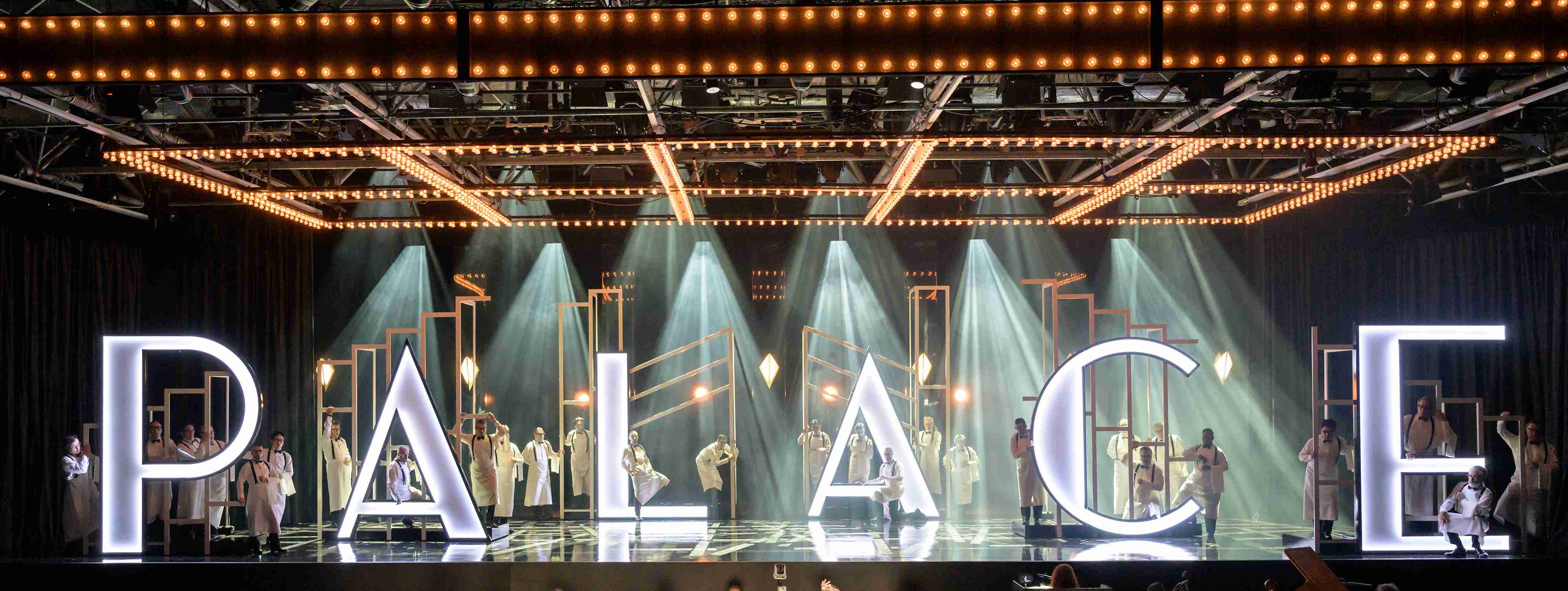
This was my first experience of Ligorio’s work and I must say that it was a positive one. She sets the action in what appears to be the 1950s and the golden age of Hollywood. The story appears to be evolving as Alidoro’s plot for a film. At the start of the evening, we see him at a typewriter, while in Angelina’s first encounter with Ramiro, she reads out her backstory from a piece of paper. Similarly, in the storm scene, reams of paper fly around the set, which the cast then attempt to assemble and put back together. At first, I found the idea of Alidoro creating the action from the side rather distracting, but I must admit that it grew on me as the evening progressed. Particularly so, in conjunction with the set for the palace scene, by Gregorio Zurla, that is composed of the letters for the word ‘palace’ as if created for the credits of a Hollywood movie. Similarly, the backdrop for Angelina’s bravura final scene, with the words ‘The End’ posted at the back of the stage, gave the set a real magic that I found particularly uplifting.

The downside of Ligorio’s staging and Zurla’s set is the Staatenhaus itself. The acoustic is extremely poor, not helped by the fact that we weren’t listening to the world’s biggest voices. For much of the evening, the cast was less than optimally audible, and this despite Matteo Beltrami’s singer-friendly conducting. Not having a set that gave the singers something to resonate off, particularly in Act 2 where the stage was surrounded in sound-absorbing drapes, was less than helpful. There were several moments in the ensembles of Act 1 where some of the voices sounded as if they were singing off-stage from a distant space. That the Oper urgently needs to move back home to Offenbachplatz is long overdue. It was also a very cold evening in Cologne and perhaps this explains why the audience response was tepid throughout. There was a significant absence of laughs throughout the evening. Was this as a result of the surtitles being placed at the sides of the room and not above the stage? It certainly wasn’t due to the hard work or comic timing of the singers, whom I found engaging; although, again they really weren’t helped by the acoustic. The result was an evening that stayed relatively earthbound throughout.

Beltrami’s conducting had much to appreciate. He asked his trumpeters to alternate between using natural and modern instruments and their contributions to the ensemble were deliciously raspy. Curiously, throughout the evening intonation and attack in the strings was agreeably unanimous, yet in the final scene, they seemed to fall apart, losing that discipline that characterized their contribution to the evening up until that point. Perhaps it was as result of Beltrami being more sensitive to his replacement Angelina – although for the previous three hours that hadn’t been a problem. The winds were nice and forthright in the textures and we had an agreeably improvisatory fortepiano from Theresia Renelt. The chorus, prepared by Jung Bangin, was appropriately lusty in its contributions.
Alàs must have had nerves of steel to come on and give such a confident performance, at such short notice, in a staging she hadn’t seen for four years. Particularly as, in the closing ensemble of Act 1, the cast had to sing from tables that were being moved around by danseurs. The voice has a deliciously Catalan warmth to the sound, the middle is ruby red like a fine Priorat. She sang her ‘Una volta c’era un re’ with disarming simplicity, and an easy line. She also has a real affinity for the idiom, able to turn the reams of coloratura into something full of musical expression. If she did run out of steam somewhat in her final scene, the top sounding effortful, that is completely understandable in the circumstances. I hope to have the opportunity to hear Alàs again in more congenial circumstances.

Her Ramiro was Theodore Browne, a new name to me. I found that he was affected more by the acoustic issues than his castmates. In his first entry, I found the voice to be well-placed, easily penetrating the room. Later, as he varied his position on stage, the voice did tend to be absorbed into the air. I’d certainly like to hear him in a more appropriate venue. Browne also has real flexibility in his technique. His tenor is somewhat soft-grained, but he has an easy top that he pulled out with bravura in his big aria. Wolfgang Stefan Schwaiger is singing Dandini alongside singing Don Giovanni in Flanders. I found Schwaiger’s singing tonight to be significantly more enjoyable than the previous occasions I’ve heard him. It’s as if the confidence that he would have as Giovanni has found its way into his Dandini, singing with extroversion and an elegant line – and appropriately idiomatic Italian.

Christoph Seidl was a warm and generous presence as Alidoro. He made a conscious effort to sing his aria in long, eloquent lines, with genuine warmth of tone. Omar Montanari’s Don Magnifico was sung with genuine textual awareness, even if the tone didn’t always manage to surmount the acoustic difficulties of the venue. Giulia Montanari was a scintillating Clorinda, the voice bright with a smile in the tone, and she had terrific rapport with Alicia Grünwald’s nicely spiteful Tisbe, sung in a healthy mezzo.

This was something of a mixed experience. There was so much I enjoyed in Ligorio’s production, which was appropriately full of joy and fantasy. Yet, despite the uplifting nature of the visuals, they didn’t always manage to penetrate into the room. This is no fault of the cast who really did give it their all, but more due to the inadequacy of the Staatenhaus and its lack of suitability for opera. The singing was always honest and generous and Beltrami led a reading that had so much to offer. As mentioned above, the audience reaction during the evening was muted, which made it doubly surprising that, at the curtain calls, the ovations were extremely loud and generous.
 operatraveller.com