Bizet – Carmen
Carmen – Ketevan Kemoklidze
Don José – Ragaa Eldin
Micaëla – Roberta Mantegna
Escamillo – Fabrizio Beggi
Frasquita – Francesca Benitez
Mercédès – Alessandra Della Croce
Moralès – Paolo Ingrasciotta
Le Dancaïre – Armando Gabba
Remendado – Saverio Fiore
Zuniga – Andrea Concetti
Pueri Cantores “D. Zamberletti”, Coro Lirico Marchigiano “Vincenzo Bellini”, FORM-Orchestra Filarmonica Marchigiana / Donato Renzetti.
Stage director – Daniele Menghini.
Macerata Opera Festival, Sferisterio, Macerata, Italy. Thursday, July 20th, 2022.
Tonight marked the opening night of the fifty-ninth Macerata Opera Festival with this new production of Carmen, staged by Daniele Menghini. It was also my second visit to this beautiful hilltop city, with genuine charm – although getting a taxi from the station up those hills is something of a challenge. The festival takes place in the imposing, open-air arena of the Sferisterio. The audience is certainly lively. The lady two rows in front of me clearly didn’t care about disturbing those behind her as she held up her phone to film the ‘habanera’ and ‘chanson bohème’. Nor did the man next to me, who occasionally joined in, in song with the cast. Still, it’s a lovely place to see a show, full of atmosphere and such a magical setting under the starry, Macerata sky.
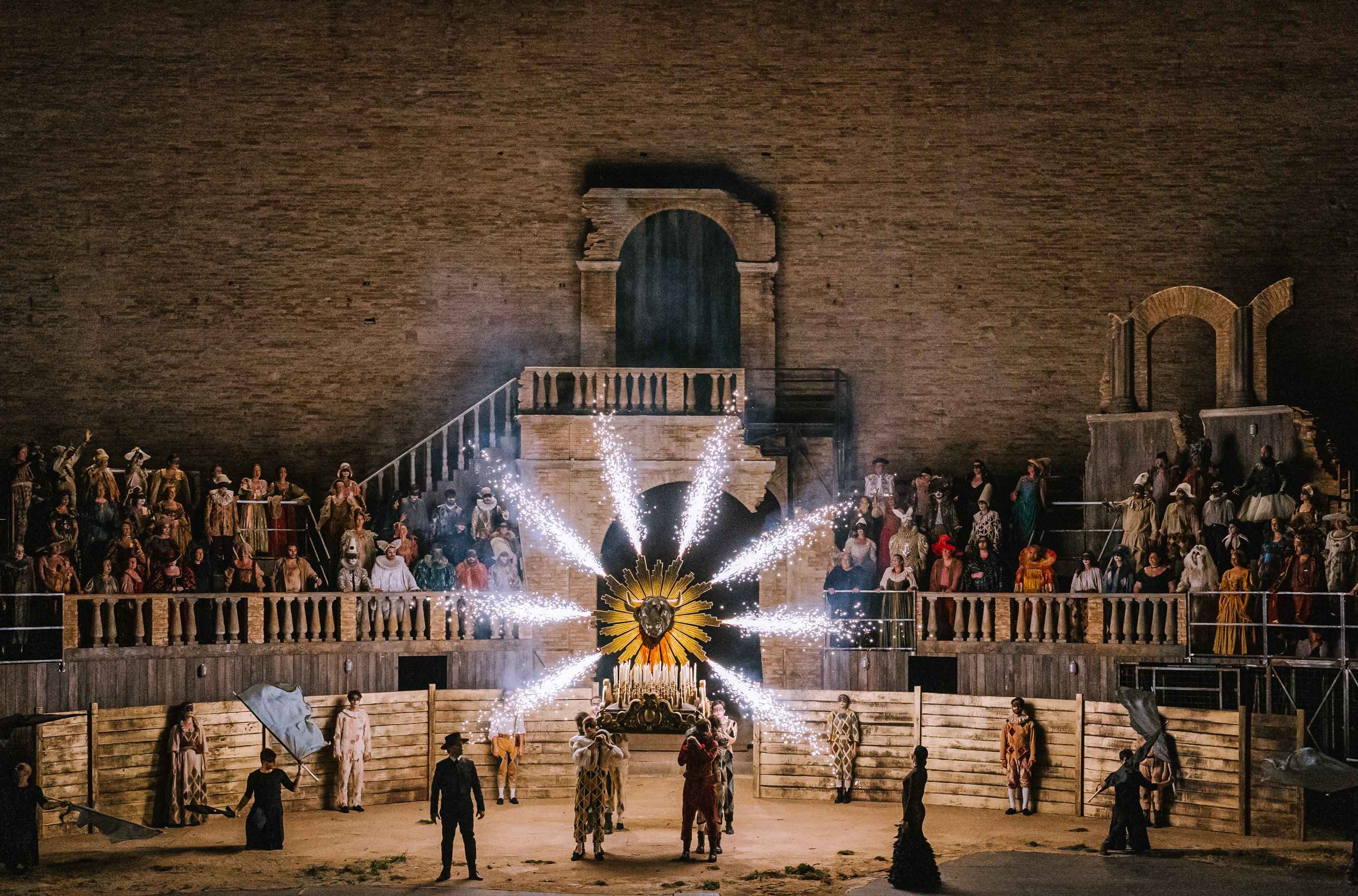
Menghini’s staging sensibly focused the action at the centre of the wide yet shallow Sfteristerio stage. The sets, by Davide Signorini, place the action around what appears to be a bullring, within which the final confrontation takes place. It struck me that Menghini set out with two objectives: the first, to give the audience a spectacular show, and the second to add on a thoughtful additional layer to the narrative. On the first, he most definitely succeeded. The fireworks set off at the end of Act 2, or the exciting fire dancing and additional pyrotechnics in the jubilance of Act 4 were certainly stimulating.
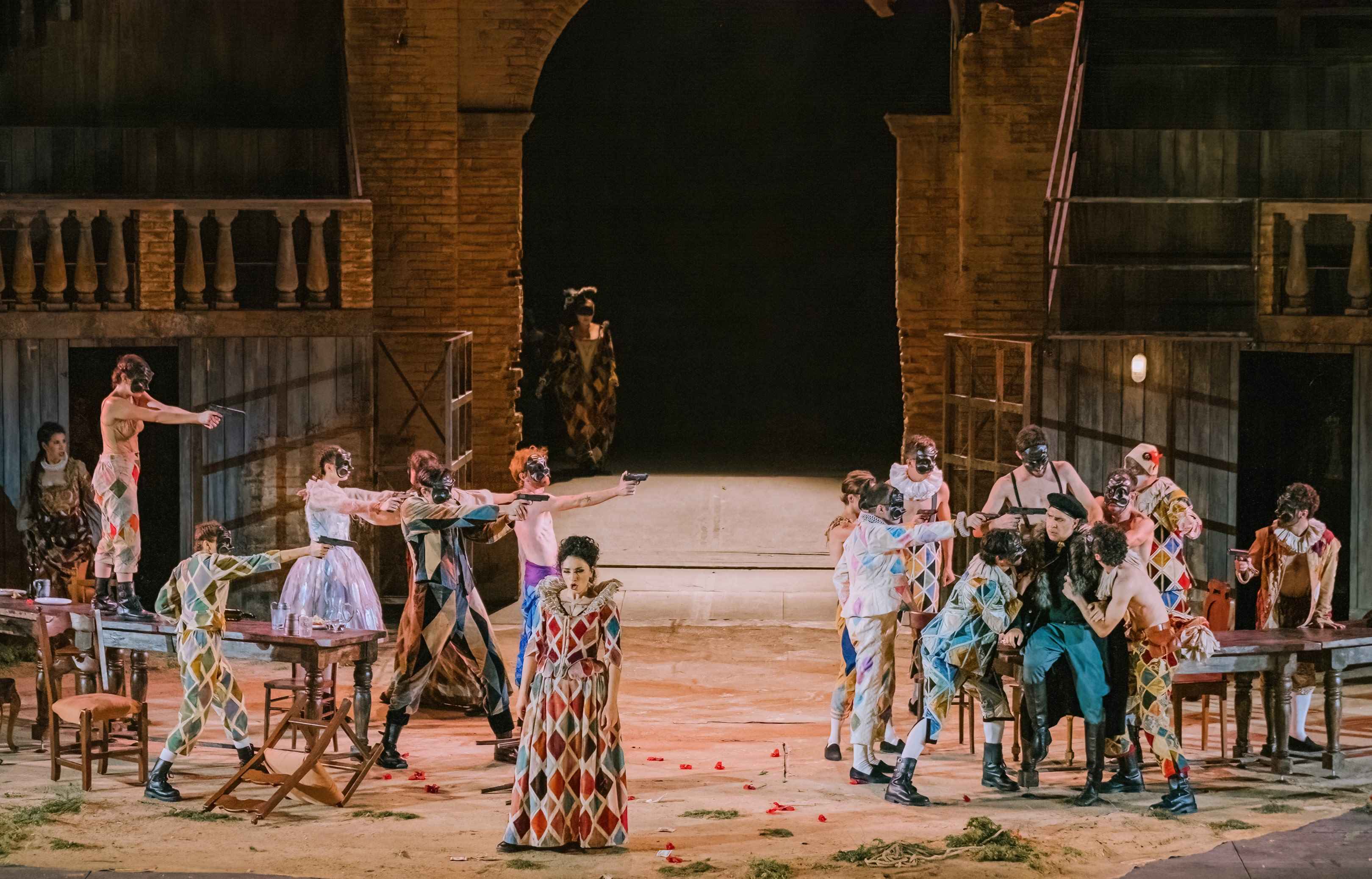
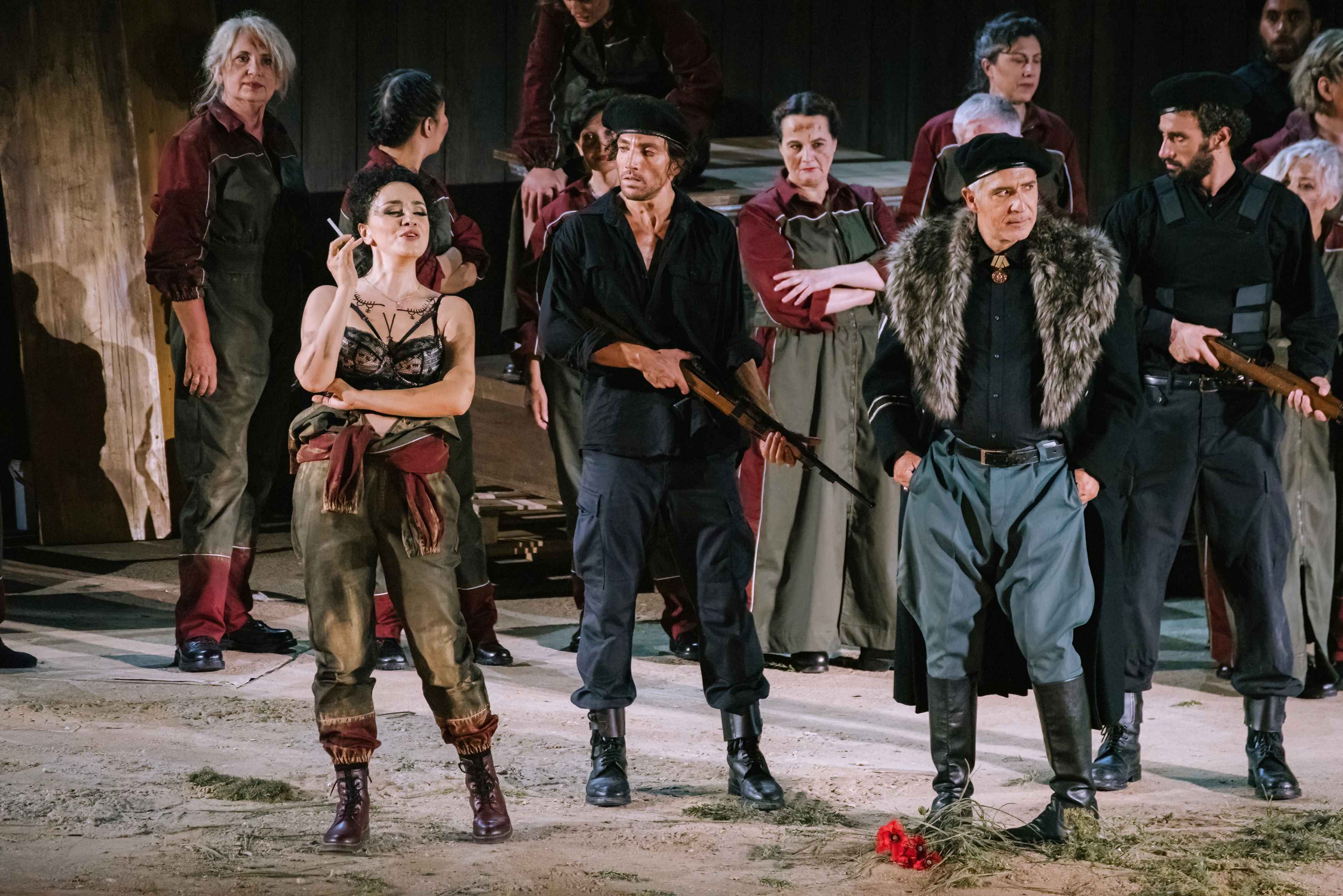
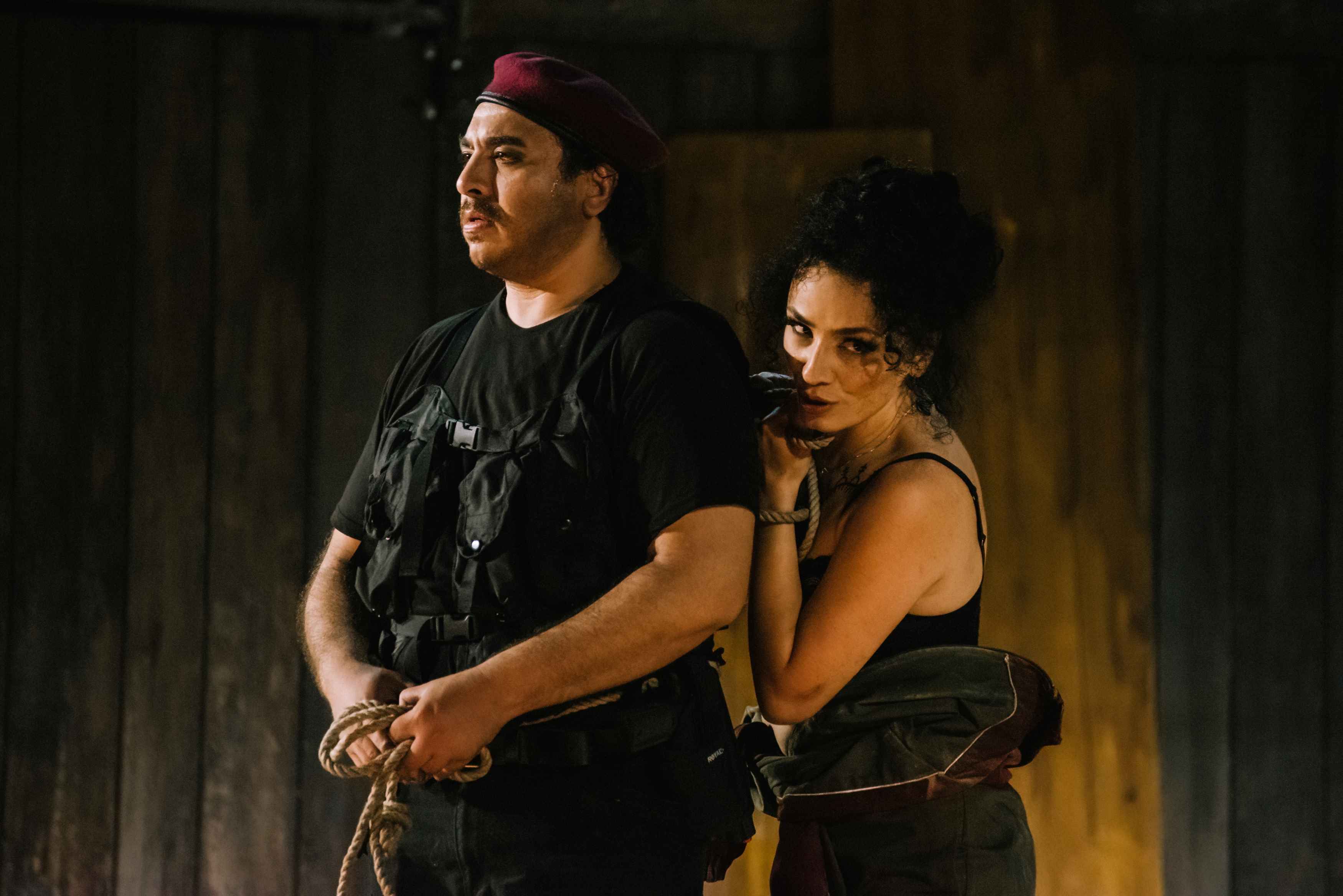
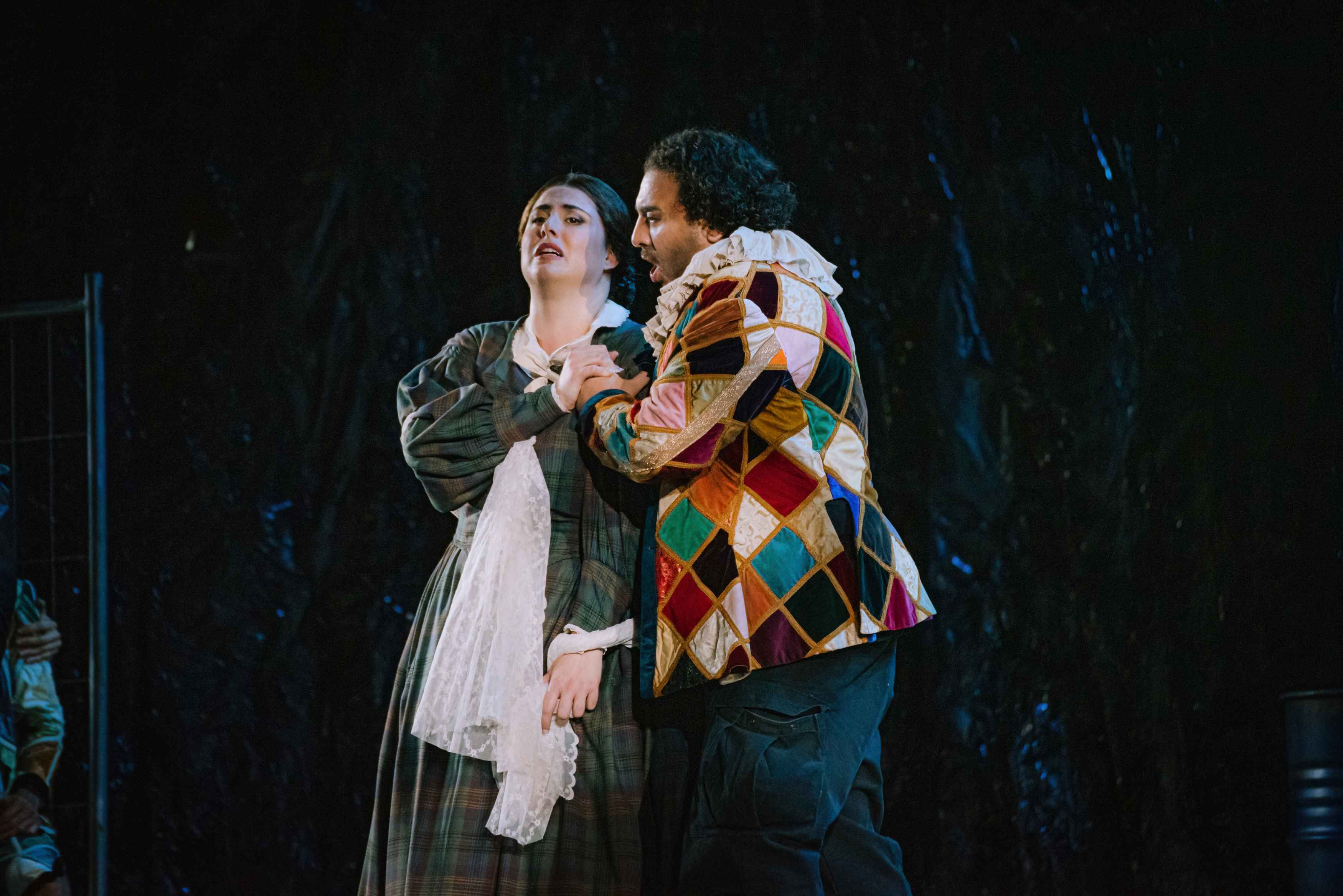
Menghini makes a clear distinction between the world of the gypsies, dressed as harlequins or commedia dell’arte characters, and the soldiers all dressed in black. When José joined the smugglers, he did so by dressing up like them. There was an interesting moment in ‘parle-moi de ma mère’ where, as Micaëla and José sang, a boy in harlequin costume was taken to see a woman, who I presume was his mother, in a prison on the right-hand side of the set. He was then made to change into all black clothes, seemingly conscripted into the military. It’s clear that Menghini wanted to illustrate a brutal militaristic state, but I did find the constant acting of extras a bit de trop, even though the action was extremely well choreographed and approached by all with a clear unanimity of purpose. The start of Act 3, also saw a naked man perambulating to the prelude – clearly inspired by Bieito’s well-travelled staging. Yet, this was not a comparison that did Menghini any favours. The reason why Bieito’s staging has become so iconic is that he strips the work down to its bare minimum, knowing that Bizet’s score tells us all we need to know. Unfortunately, Menghini doesn’t trust the score in the same way, instead giving us a harlequin figure who enumerated loquaciously in the Italian tongue at the start of each act with philosophical thoughts. Frankly, it went on far too long, added nothing in context, and was rather tedious.
This impression was not helped by Donato Renzetti’s stately conducting. His tempi were so slow – although it did start with a zippy overture. That initial Micaëla/José duet seemed to come to a halt, drooping in tension. Indeed, I did start to wonder whether we would still be there this morning. It’s true that Renzetti did phrase the music lovingly and he was rewarded with some elegant horn playing and piquant winds from the resident orchestra. Yet it was clear that the singers wanted him to get a move on – the card scene and ‘chanson bohème’ saw the singers starting to race ahead, although passing dips in stage/pit coordination are not uncommon on a first night. At his entrance, after intermission, Renzetti was greeted by rather tepid applause, to which he responded by trying to encourage the audience to give an ovation. The chorus was admirable, singing with good blend, the tenors and basses in particular, and there were some deliciously tart mezzos. They also sang in comprehensible French. The production team chose the Choudens edition with recitatives. I can’t say it was a particularly felicitous choice and didn’t help with the pacing of the evening.
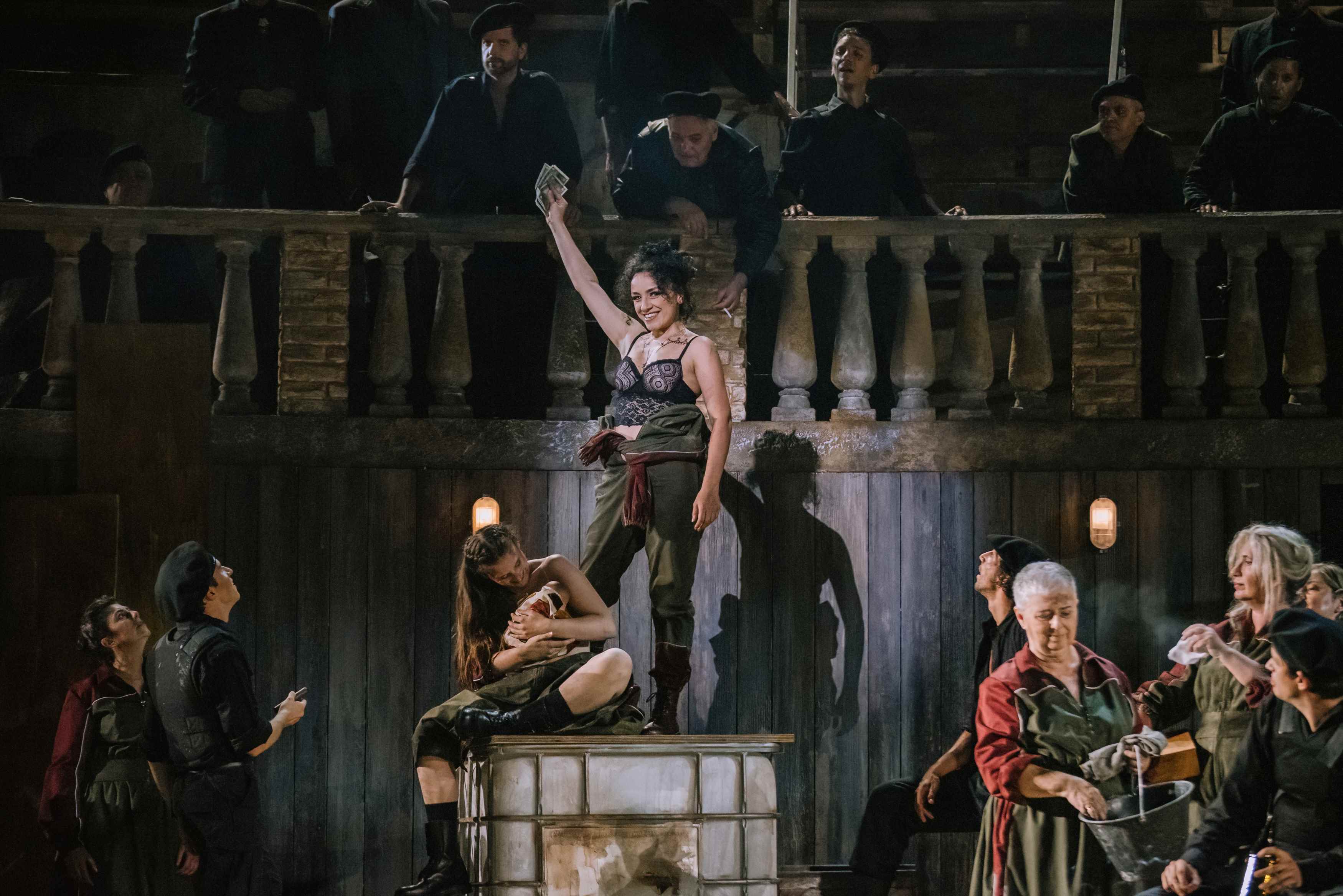
Ketevan Kemoklidze is an experienced exponent of the title role. She certainly has stage presence, strutting around appropriately, and was as one with Menghini’s vision. The voice has two very clear registers and a bit of a hole in the middle. She isn’t afraid to dip into some juicy chestiness, but the middle sounds mature and cloudy. This meant that her seduction of José in Act 2, with the constant crossing of the passaggio wasn’t particularly easy to listen to, highlighting those distinct registers. Her diction was creditable and it was clear that she not only understood what she was singing about, but had a desire to communicate it to the public too. Ragaa Eldin sang José with a bright, focused tenor and an easy top. His French is excellent and clearly enunciated, sung off the text. It did strike me the voice is a bit soft-grained for the role. He most certainly isn’t a bruiser and those desperate cries of ‘je te tiens’ at the end of Act 3 were a bit mild. He did make a genuine attempt to pull back on the high B-flat in the flower song but, perhaps as a result of singing in an outdoor arena, he didn’t quite pull back enough for my taste and I felt he could have gone further and still have been heard. He’s certainly a singer I would be keen to hear again, though.
Roberta Mantegna sang Micaëla in a substantial soprano of genuine beauty of tone. She phrased her aria lovingly, opening up on top with generous vibrations and giving us an impeccable legato. Indeed, she made it sound like she was singing Mimì, a role I would certainly be keen to hear her sing. It was possible, at moments, to ascertain the words she was singing. Fabrizio Beggi coped admirably with Escamillo’s awkward tessitura, even if the voice loses a little colour further up. Still, the firmness of his bass-baritone and the impressive amplitude he produced were notable. He made a genuine attempt to give us the text, although it sounds that he could benefit from some further language coaching to make it optimally idiomatic. The remainder of the cast was efficient. Francesca Benitez sang Frasquita in a scintillating soprano, while Alessandra Della Croce sang Mercédès in a nicely fruity mezzo. Andrea Concetti gave us a gruff, world-weary sounding Zuniga, while Paolo Ingrasciotta sang Moralès in a handsome, firm baritone, although his sung French was somewhat exotic in flavour.
There was much to enjoy in tonight’s Carmen. Certainly, Mantegna’s Micaëla, Eldin’s José, and Beggi’s Escamillo gave pleasure in various aspects, while the orchestral playing and choral singing also gave much to enjoy. Renzetti’s conducting was leisurely. Menghini’s staging had a lot going for it and definitely gave the Sferisterio audience a real show. And yet, while I appreciated his willingness to bring additional insight, I didn’t always find this convincing – though it had clearly been exceptionally rehearsed and the entire cast of singers, chorus, ballet and extras were all as one Menghini’s vision, impressively so given the intricate stage movement. Personenregie was also convincing throughout. The audience responded at the close with warm applause for the four principals and the production team.
 operatraveller.com
[…] was confided to Daniele Menghini. My only other experience of his work was a rather dreadful Carmen in Macerata last summer. Menghini began his staging with an interesting premise. He opened the […]
[…] two left me with less than a universally positive impression. The first I saw by him, was a Carmen in Macerata which included a clown who enumerated loquaciously in the Italian tongue during the […]
[…] My previous encounters with his work have been less than satisfactory. These consisted of a Carmen in Macerata that made this vibrant opera tedious, a Tristan in Palermo that had a naked man […]