Puccini – Madama Butterfly
Cio-cio-san – Elisa Cho
BF Pinkerton – Carlos Cardoso
Suzuki – Cátia Moreso
Sharpless – Stefan Astakhov
Goro – Marco Alves dos Santos
Lo zio Bonzo – Christian Luján
Il Principe Yamadori – Leonel Pinheiro
Kate Pinkerton – Ana Franco
Lo zio Yakusidé – Nuno Dias
Il commissario imperial – Costa Campos
Coro do Teatro Nacional de São Carlos, Orquestra Sinfónica Portuguesa / Antonio Pirolli.
Stage director – Jacopo Spirei.
Teatro Nacional de São Carlos, Lisbon, Portugal. Thursday, October 12th, 2023.
To a twenty-first century audience, Madama Butterfly is a problematic piece. It deals with child sex tourism, the commodification of women, and US imperialism. At the same time, more conservative audience members, unwilling to engage with these deeper issues at the heart of the work, would prefer these to be kept below the surface and simply focus on the story of a woman mourning a lost love. Added to that, the prospect of singers of European descent mimicking Japanese gestures in yellowface, is something that is disturbing to contemporary sensibilities.
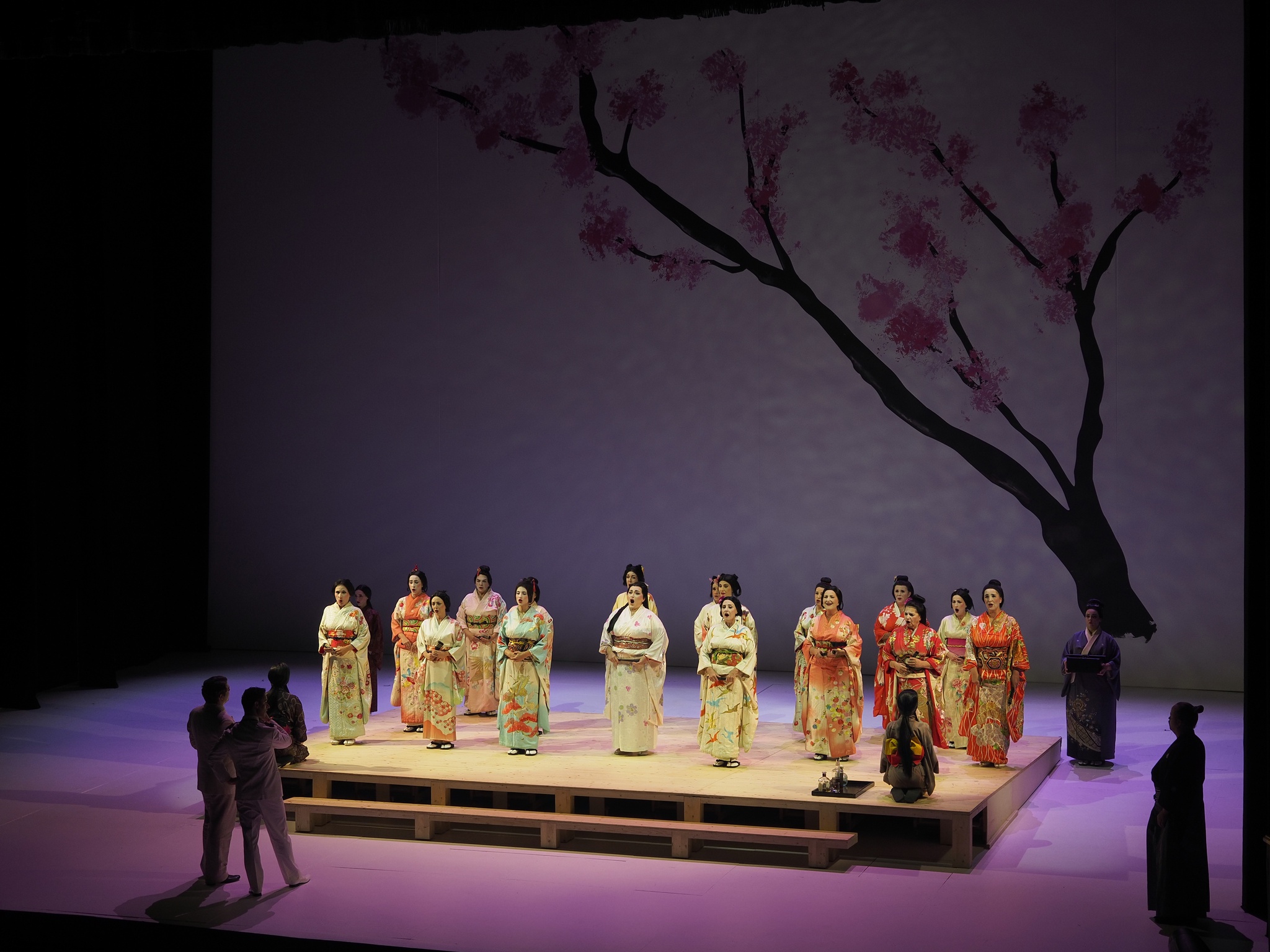
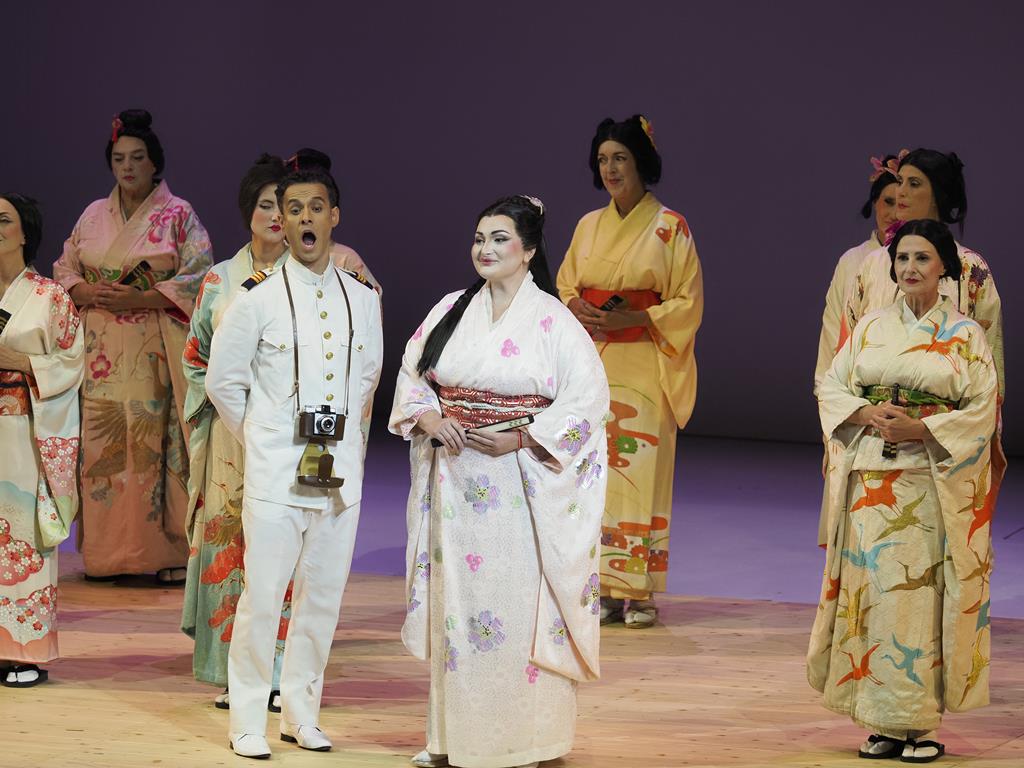
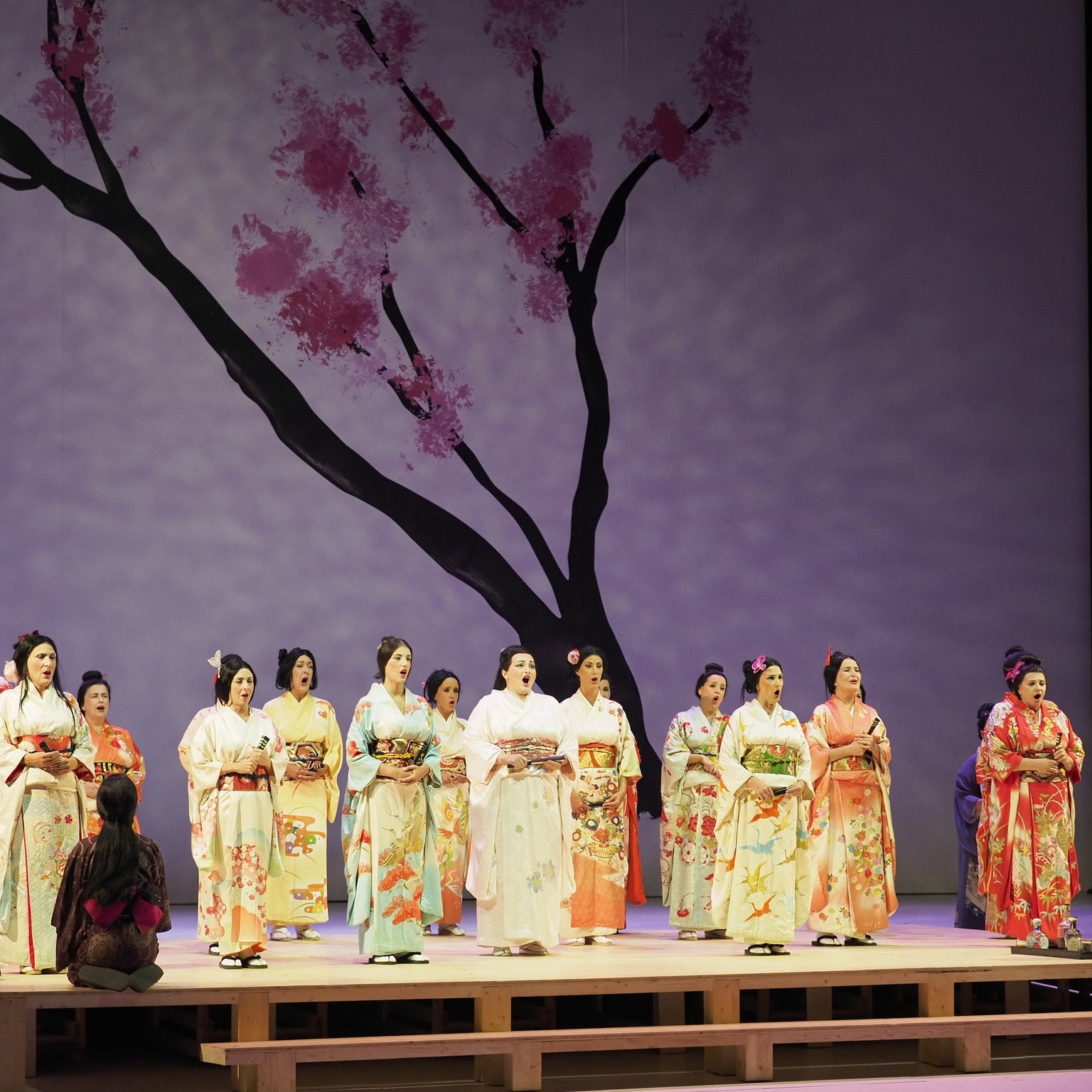
Jacopo Spirei’s new staging for the Teatro Nacional de São Carlos, where it opened the season last week, is an intelligent and sensitive piece of storytelling. While I wish he had opted not to have his cast in stylized Japanese costumes, he certainly gave the more conservative audience members something that met their expectations, and allowed the idea of the meeting of cultures to be brought to the fore. At the same time, Spirei doesn’t shy away from the horror of this story. He directs his cast to create characters so convincing, that one cannot fail to both be moved by Butterfly’s story and confronted with the horror of Pinkerton’s acts, so that when we get to the Act 3, the effect is overwhelming and moved me more than this work has ever done before. The interaction between Stefan Astakhov’s Sharpless and Carlos Cardoso’s Pinkerton in Act 1 was as shocking as it should be. Pinkerton’s glee in ‘marrying’ a fifteen-year old, while Sharpless’ horror in his recognition that this girl should still be enjoying her youth, ‘L’età dei giuochi’, was brought to life in such a realistic way. Similarly, the way Butterfly paraded herself for Pinkerton just before lying down with him at the end of Act 1, was equally horrifying. Spirei, together with Elisa Cho’s Butterfly, made the commodification of her body far too apparent.
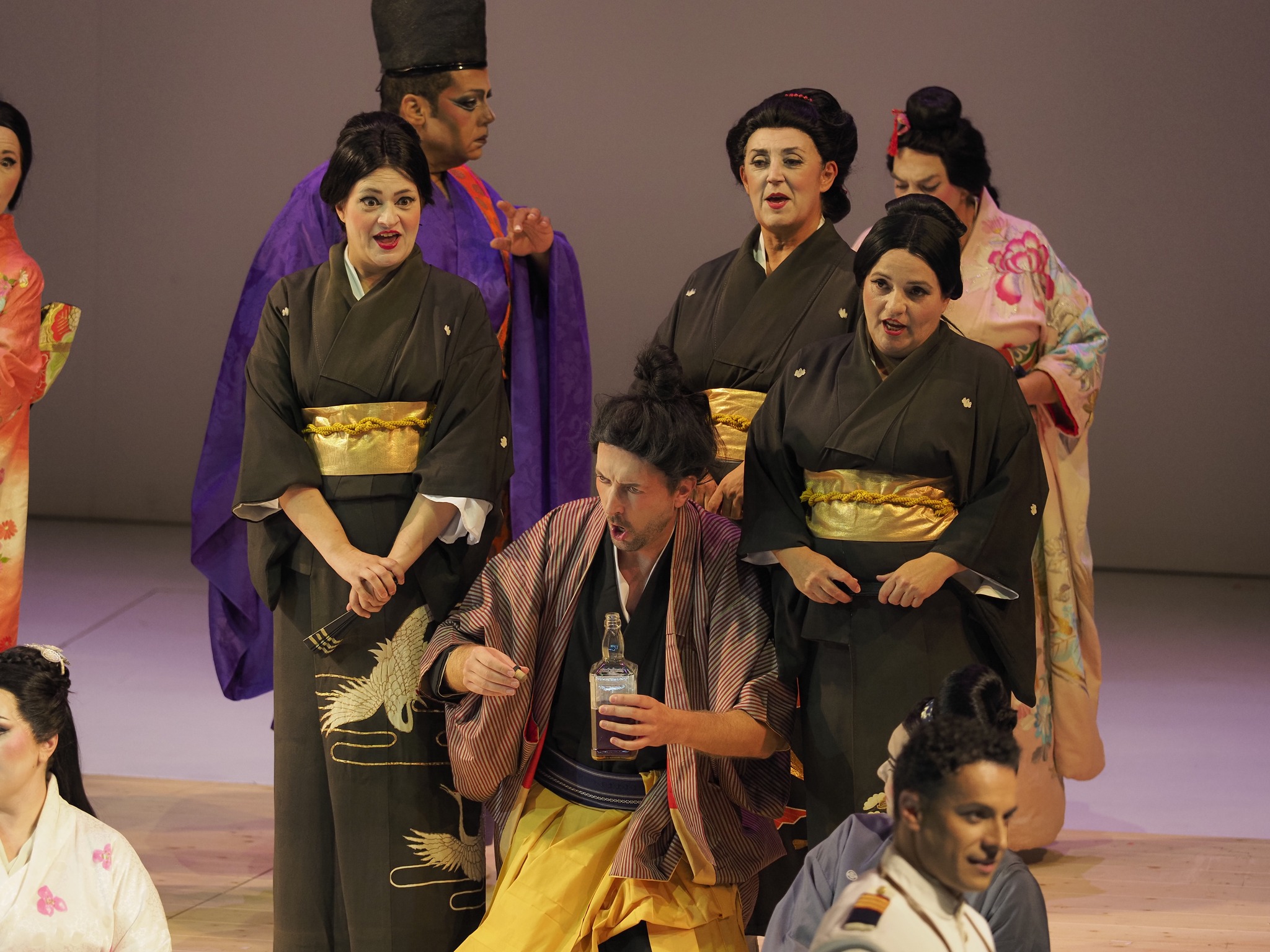
I also appreciated how Spirei showed the influence of the US on Nipponese society as the evening progressed – Act 2 saw Yamadori show up on a motorbike, garish signs now surrounding the former rural idyl, while Butterfly listened to the humming chorus on a radio. In Act 3, we saw a now aged Butterfly watching television at home, reliving those moments in her life where Sorrow was taken away by Kate Pinkerton, for what might have been the millionth time, yet never wanting to let go of a love that deep down she might have thought was futile, but has held on to forever. There was a depth to Spirei’s staging that was not immediately apparent if one took the attractive costumes at face value. Rather, he did make a genuine attempt to engage with those themes of imperialism and cultural appropriation and put front and centre the human, particularly psychological, effects of child sex tourism. The result was an evening that grew in power, due to its humanity and insight.
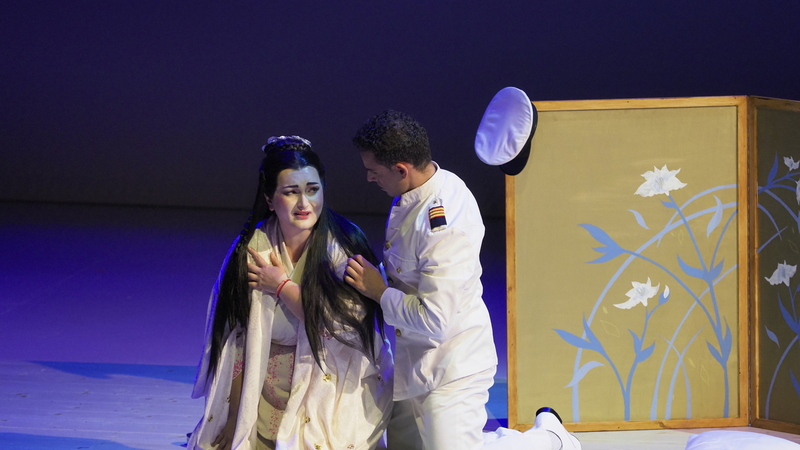
Cho is sharing the run with Zarina Abayeva, pictured. Her soprano is not always easy on the ear – the sound tends to shrillness, with an extremely generous vibrato, and intonation becomes sharp as she puts pressure on the tone. And yet, I found her Butterfly deeply moving. Born in Korea, Cho trained in Italy, and this is apparent not only in the sheer textual acuity she brings to the role, but also in her impeccable musicality and phrasing. She understands the Puccinian style and the need to use the text to find meaning. As the evening progressed, particularly in Act 2, we saw less an interpreter singing a role, and more a woman living it – it was as if she became Butterfly in front of us. The voice soared with freedom and pain, using the tone to create an implicit sense of loss that was unmistakable. At the end, Cho was invited to take a solo curtain call as soon as the lights went up, but it was clear she was completely emotionally spent and she seemed genuinely moved by the massive ovation the São Carlos public awarded her.
The other element of the evening that gave immense pleasure was Atonio Pirolli’s conducting and the playing of his magnificent Orquestra Sinfónica Portuguesa. I don’t think I’ve ever been so aware of the connection between the text and what we heard in the orchestra as I was this evening. Every string tremolo, every harp glissando, seemed to mean something. Pirolli brought out the fragrance of the high violins, luxuriating in their gossamer lightness. His tempi were relatively swift, allowing the drama to unfold, never dragging. Similarly, the moment where Butterfly reveals Sorrow to Sharpless, with a big brassy outburst, was overwhelming – particularly in such an intimate house as this. Pirolli also seemed to be aware, and willing to bring out, the ambivalence in Puccini’s harmonic language: we might be hearing a conventional love duet at the end of Act 1, but Pirolli brought out the contradictions there in the way that Puccini leaves the closing measures open and unresolved. He was rewarded with playing of distinction, including superb brass, while Giampaolo Vessella’s chorus made a positive contribution in their brief interjections.
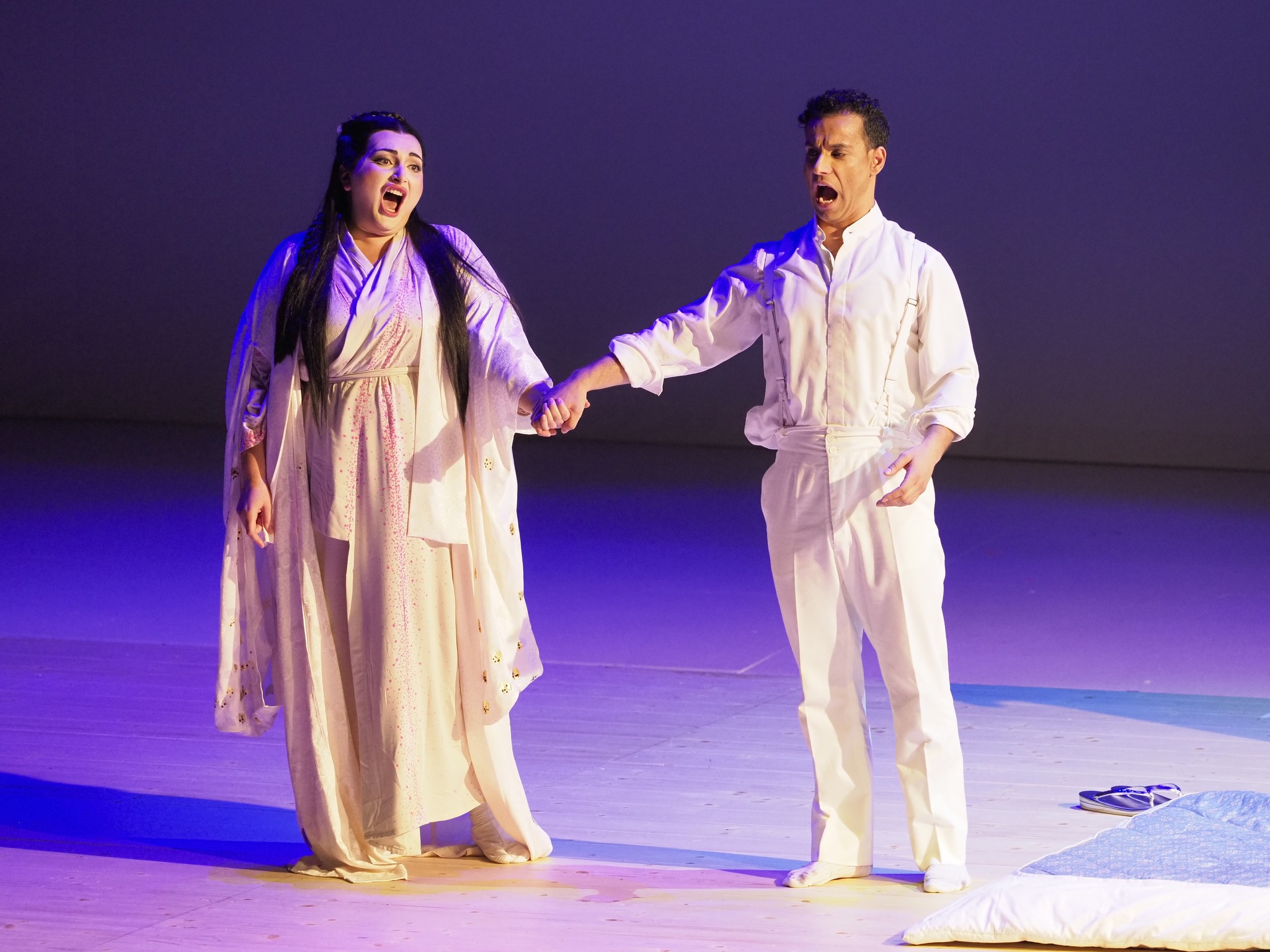
Cardoso is most certainly a find as Pinkerton. His tenor is compact yet sunny in tone, with easy reach. He has a good line, excellent Italian, and certainly incarnated the seediness of Pinkerton’s character convincingly. He found genuine remorse in ‘Addio, fiorito asil’, by putting the text front and centre. There is a tendency for the tone to taper out somewhat at the very top, but I would certainly like to hear Cardoso again in the lyric Italian repertoire. Stefan Astakhov sang Sharpless in a youthful baritone, with a focused column of sound. Throughout the evening, his concern for what was happening was palpable, giving his Sharpless a humanity that isn’t always the case. Cátia Moreso sang Suzuki in her big, vibrant mezzo, the words always forward, bringing a power to her assumption of the role that filled the house. The remaining cast, featuring many of the São Carlos regulars one has come to know, was at the level one expects at this address. It was notable that the house managed to cast all but two roles with Portuguese singers, many of whom trained in the UK – something less likely now thanks to the xenophobic and isolationist government there.
This was a Butterfly that offered us so much. We were given a staging that was willing to confront the difficult issues at the core of the work, yet did so in a way that was thoughtful and full of emotional impact. The evening was anchored around a devastating performance of the title role from Cho, who simply became Cio-cio-san in front our eyes. The orchestra was on glorious form for Pirolli who conducted with genuine insight, making the text live and mirrored in the orchestral lines. The singing was very good across the board. The evening was greeted with a massive ovation from the São Carlos public, with particularly loud cheers for Cho, Moreso, and Cardoso. There’s only one, sold-out, show left in the run. If you can get returns, don’t hesitate.
 operatraveller.com
[…] disparate forces together. Again in Lisbon, Elisa Cho gave us an incredibly moving account of Madama Butterfly, in a staging by Jacopo Spirei that genuinely attempted to engage with the similarly problematic […]
[…] in this glorious city during the closure. Spirei, of course, gave us that incredibly moving Madama Butterfly here last fall, probably the most convincing production I’ve seen of the work, although his Lucie […]
[…] Butterfly I have seen before – and in that I include Jacopo Spirei’s excellent staging at the São Carlos last year, which also sought to face the ugliness of the sexual tourism at the heart of the work. […]