Puccini – Madama Butterfly
Cio-cio-san – Ailyn Pérez
BF Pinkerton – Charles Castronovo
Suzuki – Nino Surguladze
Sharpless – Gerardo Bullón
Goro – Moisés Marin
Lo zio Bonzo – Roman Chabaranok
Il Principe Yamadori – Toni Marsol
Kate Pinkerton – Marta Fontanals-Simmons
Lo zio Yakusidé – Andrés Mundo
Il commissario imperial – Xavier Casademont
Coro Titular del Teatro Real, Orquesta Titular del Teatro Real / Nicola Luisotti.
Stage director – Damiano Michieletto.
Teatro Real, Madrid, Spain. Tuesday, July 16th, 2024.
To end its 2023 – 24 season, the Teatro Real chose to mount Damiano Michieletto’s staging of Madama Butterfly, imported from the Teatro Regio Torino. As is customary here, the house cast the run with multiple singers, including Saioa Hernández, Lianna Haroutounian and Dr Alexandra Kurzak in the title role, with Leonardo Capalbo, Matthew Polenzani and Michael Fabiano as Pinkerton. This evening’s cast featured Ailyn Pérez in the title role, with Charles Castronovo as Pinkerton. The vast majority of the run was conducted by Nicola Luisotti, as indeed it was tonight, with his assistant, Luis Miguel Méndez taking on a handful of performances. The run was also dedicated to the centennial of the birth of Catalonia’s great Butterfly, the late Victoria de los Ángeles.
Michieletto sets the action in our time. Rather than stylized nineteenth-century Japan, we get a seedy and gaudy backstreet, where girls are displayed in a glass room, encouraged to socialize with rich westerners who purchase their services. In so doing, Michieletto immediately highlights the child sexual tourism that sits at the heart of this piece, but that’s so often ignored in productions that prettify what is, in reality, a gruesome story. Yet more than that, he makes us feel. There are so many moments in this staging that just had me in tears. This is a staging of sheer visceral emotional impact. Michieletto makes us even more aware of the fact that Butterfly isn’t marrying Pinkerton for love, but instead through desperation – the way that she recounts the penury she now faced that forced her into prostitution, was made even more potent by the setting. The love duet was absolutely devastating, Butterfly’s sincerity was so tangible, her belief that in marrying Pinkerton she could make a better life for herself so real. Yet Michieletto juxtaposed the duet with a group of girls walking around the glass room below. It was an unbearably moving image, the hope in Butterfly’s music contrasted so effectively with the grim reality of the child sexual tourism of which she was a victim.
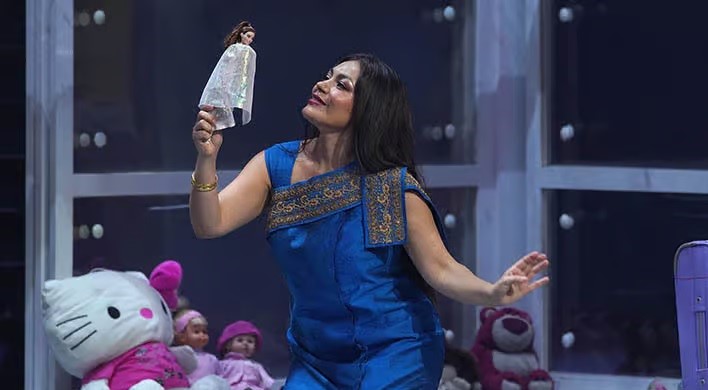
What Michieletto also succeeds in doing is making Pinkerton an even more rounded character than we often see. Yes, he’s clearly what the Italians would call a ‘stronzo’, the way that even before meeting Butterfly he was already socializing and enjoying the company of the other girls, made it clear he had no intention of ever making a long-term commitment to her. Yet there was a genuine sincerity in his singing of the love duet where, for a moment, we could see that he was aware of the sacrifices Butterfly was making in spurning her faith and family. That psychological insight that Michieletto brought into the characters and their motivations was ever-present throughout the evening. As Sharpless read the letter to Butterfly in Act 2, we could see Butterfly’s fantasies of Pinkerton coming to life as he appeared walking on the stage. The moment when Sorrow was introduced to Sharpless was just as devastating as it should be, the innocence of the child returning home from kindergarten with his backpack, tugged at the heartstrings and reinforced the tragedy of both his and his mother’s fate. Particularly as Michieletto had a group of children taunting him later on, bringing out the fact that Sorrow really wasn’t unique in being a child of sexual tourism. The closing tableau of the evening, with Pinkerton snatching Sorrow and throwing him into a car, while Butterfly lay lifeless, quite simply finished me. Michieletto has given us what I have longed to see for so long. A Butterfly that really engages with the horror and tragedy of this story, and does so in a way that makes it impossible for an audience member not to be moved.
Luisotti conducted a house orchestra on excellent form. The sound was big and rich, with some superb brass playing. He also tugged at the heartstrings in the way that he brought out the fragrance of Butterfly’s opening entry, the gossamer lightness of the sound reflecting those Nipponese cherry blossoms. I did, however, find his tempi had a tendency to drag later on in the evening. He revelled in those long Puccinian melodies, but it did feel in the latter pages of Act 2 that there was a distinct drop in tension. The chorus, in their brief contributions, was enthusiastic, although it did take the sopranos a few seconds to find the note in their opening entry and there were a few overprominent vibratos. The strings dug deep to find a deep pile carpet of sound. Luisotti also allowed the band to bloom, although this wasn’t always optimal for balance from my seat, since Pérez’ Butterfly was frequently overwhelmed by the tumult from the pit.
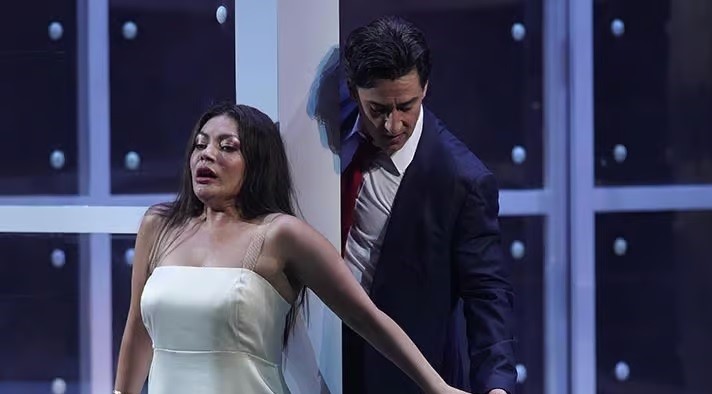
Pérez has one of the most sheerly beautiful sopranos around. The sound has wonderful sheen, with a pulchritudinous velvety core, based on a nice, juicy bottom. She clearly has a very well schooled technique and found a truth in the text that I found to be extremely moving. Hers isn’t the largest voice to have essayed this music and in a theatre of this size, with a conductor willing to allow the orchestra to play out, there were moments where the tone took on a hardness and lack of spin on top, particularly in the climactic closing scene. She sang her ‘un bel dì’ with genuine feeling, finding a beauty of tone and understanding of the text that was deeply affecting. Pérez did, unfortunately, run out of steam in the big climax of that celebrated aria, but one could not be failed to be moved by the vulnerability she brought to the role – a vulnerability that emerged through the tone and her use of text. There was much to enjoy in her assumption and her dedication to Michieletto’s staging.
Castronovo’s Pinkerton was an extremely psychologically complex account of a role that can so often feel one-dimensional. He managed to combine swagger, thorough his gleaming top, with sensitivity in the way that he pulled back on the dynamics in the love duet. As always, his handsome tenor gave much pleasure, as indeed did the clarity of his diction. His phrasing and elegance of line gave his Pinkerton a sophisticated air that made his cowardice in not even being able to face Butterfly in the closing scene even more frustrating. As far as I can recall, Gerardo Bullón is a new name to me and a very welcome discovery. His baritone is firm and warm, with good projection. The top does lose a little in quality, but his is most certainly a name to watch.
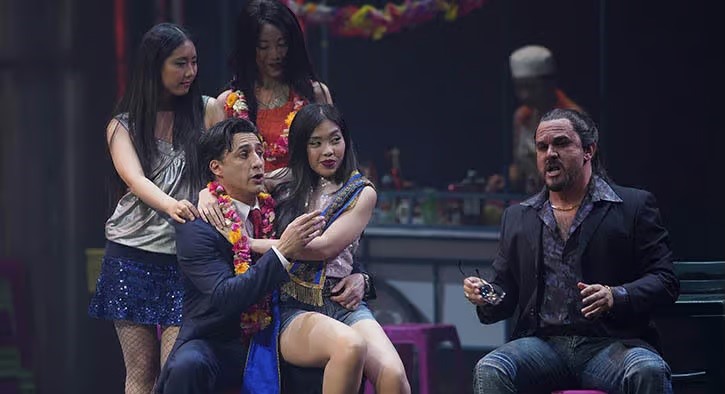
Nino Surguladze sang Suzuki with genuine concern and power. She made use of an agreeably full chestiness, but the registers in her mezzo appear to be starting to part company. Moisés Marin gave us a textually-aware Goro, sung in a focused tenor with easy reach. The remainder of the cast reflected the excellent standards one would expect from this address. Marta Fontanals-Simmons made much of little as Kate Pinkerton, sung in a vibrant mezzo, while Toni Marsol, here costumed as a very old Yamadori, sung in a similarly vibrant baritone.
I am genuinely surprised that this Butterfly has not travelled more widely than Turin and now Madrid. In it, Michieletto faces the horror and tragedy of this story head-on, making it infinitely more moving than any other Butterfly I have seen before – and in that I include Jacopo Spirei’s excellent staging at the São Carlos last year, which also sought to face the ugliness of the sexual tourism at the heart of the work. Michieletto gives us a staging that really makes us feel, to appreciate the unbearable tragedy of Butterfly’s life, a girl who only wanted to make a better future for herself with her American husband. Tonight, he had excellent singing-actors at his disposal. While Pérez was stretched by the final scene, not helped by the roar from the pit, her acting and use of text throughout moved me immensely, while Castronovo made Pinkerton a troublingly complex character. This has to be the definitive staging of Butterfly for our times and deserves to be widely seen and discussed. The audience responded at the close with generous applause for the cast. There are only a few performances left in the run – if you can get to Madrid, don’t miss them. And if you can’t the Real will be streaming Pérez and Castronovo on their Myoperaplayer service from July 21st.
 operatraveller.com
[…] her turn as Butterfly critics raved and said, Perez “sang her ‘un bel dì’ with genuine feeling, finding a beauty of […]
[…] singing was hampered by the acoustic. Castronovo also sang Pinkerton in Damiano Michieletto’s Madama Butterfly in Madrid, which he did with the utmost musicality and handsomeness of tone. Michieletto’s […]
[…] with a more sensitive director. Indeed, if Turin or Madrid could revive Damiano Michieletto’s staging with Buratto, I would be incredibly grateful. For Munich, it might be time to invest in a new […]