Orff – Trionfi
Catulli carmina
Lesbia – Nicole Chevalier
Catallus – Oleksiy Palchykov
Trionfo di Afrodite
Sposa / Solo 1 – Nicole Chevalier
Sposo – Oleksiy Palchykov
Solo 2 – Jake Arditti
Basso corifeo / Basso solo – Cody Quattlebaum
Carmina Burana
Soprano – Sandra Hamaoui
Countertenor – Jake Arditti
Baritone – Cody Quattlebaum
Hamburger Knabenchor, Alsterspatzen – Kinder- und Jugendchor der Hamburgischen Staatsoper, Chorus of the Liatoshynskyi Capella of Kyiv, Chor der Hamburgischen Staatsoper, Philharmonisches Staatsorchester Hamburg / Kent Nagano.
Stage director – Calixto Bieito.
Staatsoper, Hamburg, Germany. Saturday, September 21st, 2024.
This new production of Orff’s Trionfi, by Calixto Bieito and premiered tonight, marks the start of the 2024 -25 season at the Staatsoper Hamburg. While Carmina Burana is one of the most performed choral/orchestral works in the repertoire, the remaining two parts of the Trionfi trilogy, Catulli carmina and Trionfo di Afrodite are seen much more infrequently. There are several reasons for this: the first is that they are both significantly more challenging for the chorus, requiring a discipline of tuning and rhythm that only the most exceptional choruses possess. The other is that while Catulli carmina is tightly structured, Afrodite seems to amble along aimlessly until it concludes with a huge scream. The trilogy, then, places a heavy burden on a stage director and cast to actually make the latter engaging.
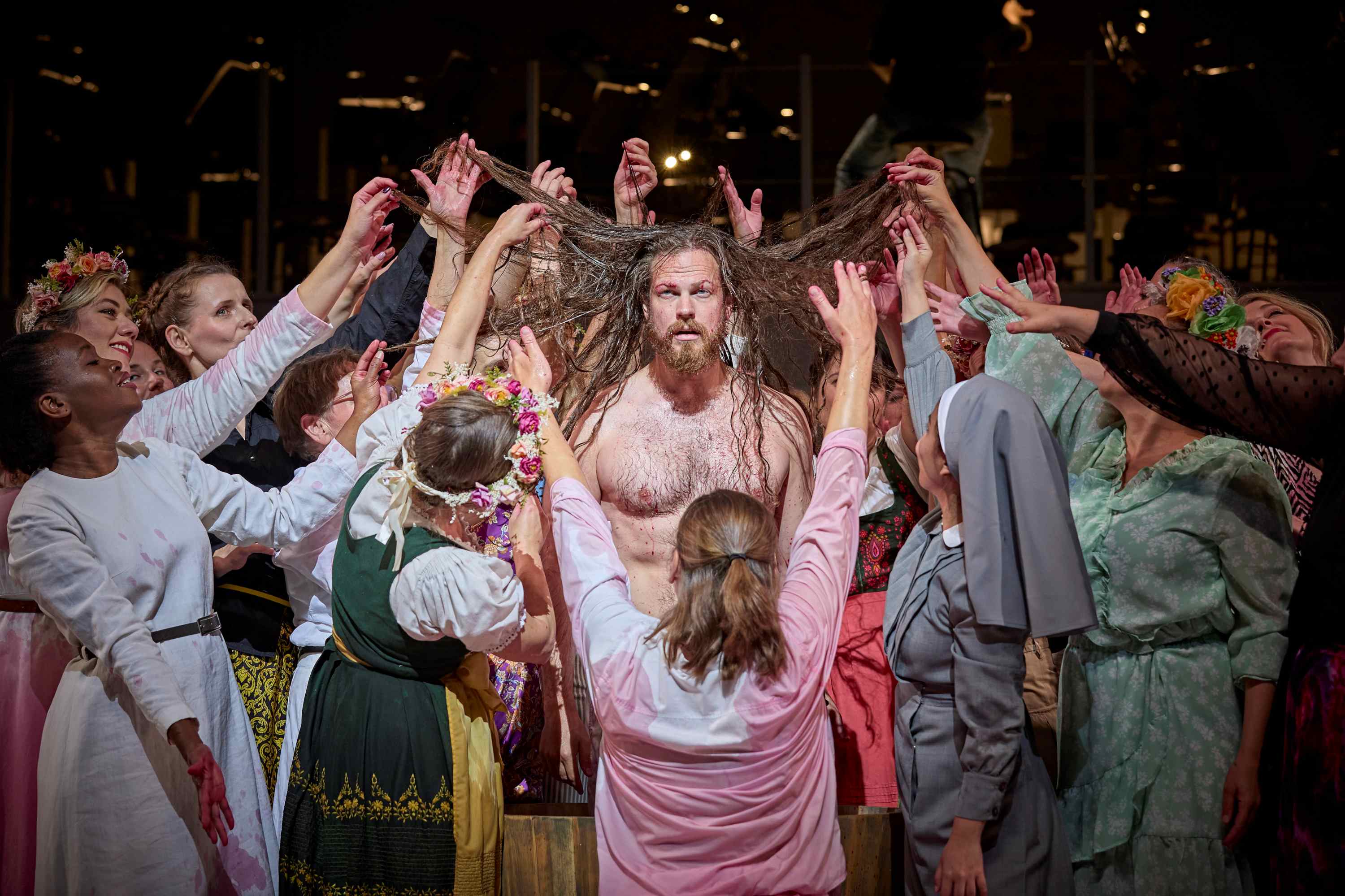
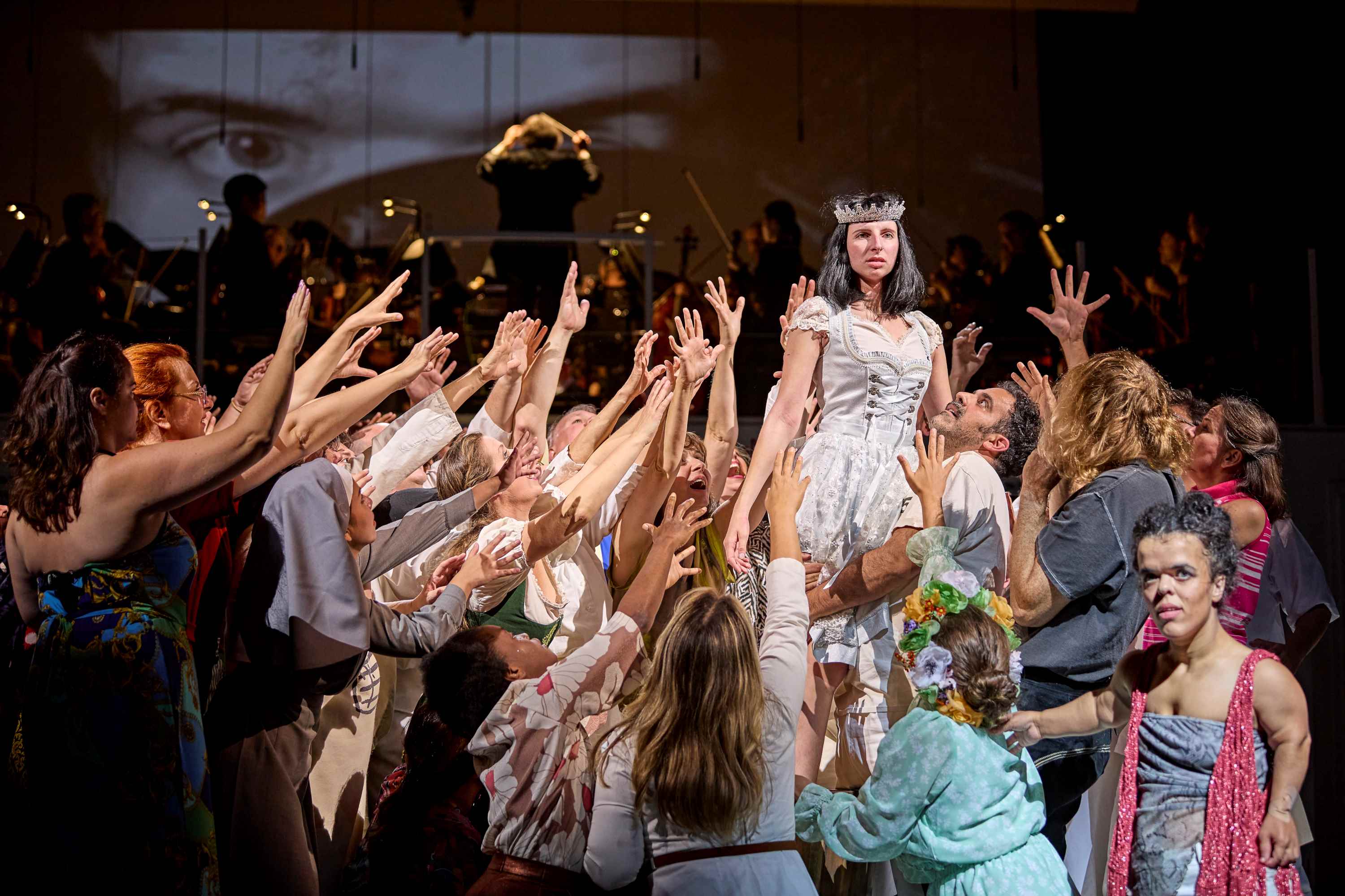
This was very much an evening of two halves, with Catulli and Afrodite before the intermission and Carmina Burana afterwards. The personnel was also different, with the Chorus of the Liatoshynskyi Capella of Kyiv, prepared by Bogdan Plish, providing the chorus in the first half of the evening, with the Staatsoper’s own chorus, prepared by Eberhard Friedrich and Christian Günther, taking over for the second. Working with one of his regular collaborators and set designers, Rebecca Ringst, Bieito placed the orchestral forces on a set of raised platforms at the rear of the stage, while the chorus and principals performed at the front. In so doing, Bieito created in Catulli and Afrodite an atmosphere redolent of ancient Hellenic theatre, all while in modern dress, with a chorus moving in formation, making hieratic gestures, commenting on the action. He also set up a dichotomy between the relatively passive formation of the chorus, with the passionate incarnations of Oleksiy Palchikov as Catallus and the Sposo, and Nicole Chevalier as Lesbia and the Sposa. A group of extras, in various states of undress, engage with the pair.
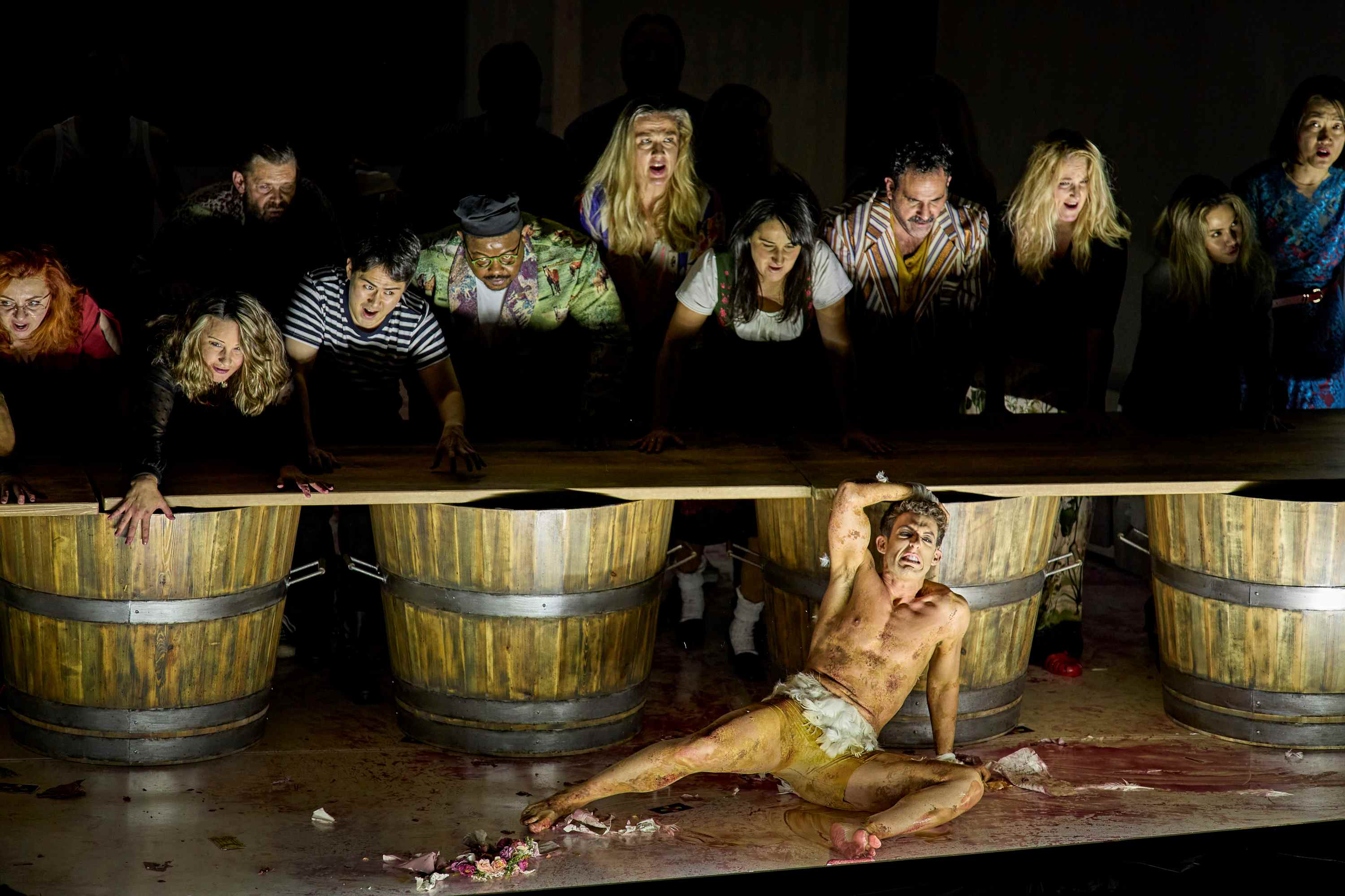
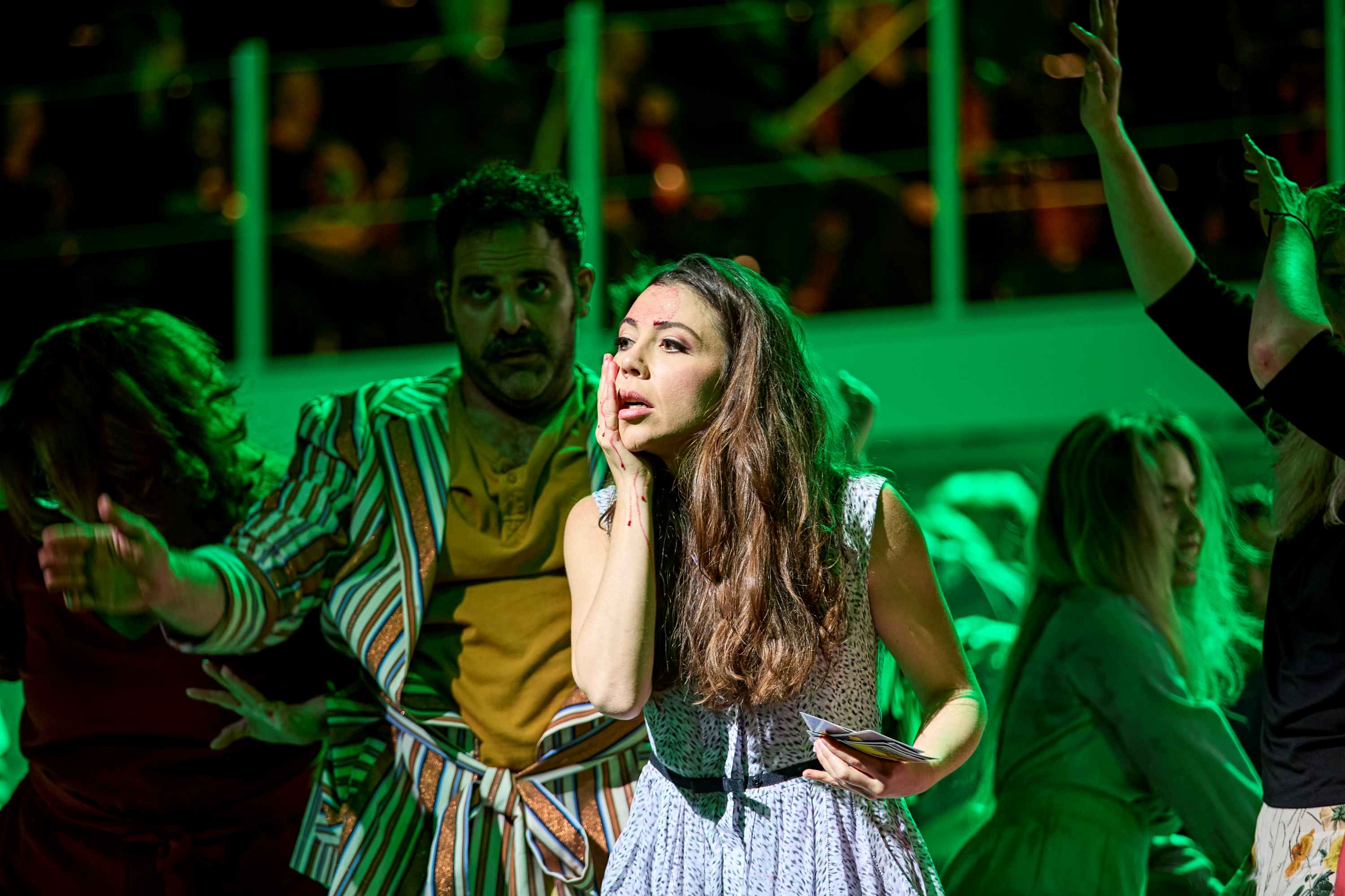
It seems to me that Bieito sees a clear distinction between love as a cerebral concept, and sex as very much a physical one. He asks a lot of his singing-actors, with Chevalier’s Lesbia initially appearing from inside a piano which Palchikov drags on stage. In so doing, he adds a third dimension: music, with music as much a part of this trinity as language and physicality. What we see is a piece of pure music theatre, bringing these three aspects together – the music pushing the performers to ever more extreme rhythmic and declamatory aspects; the text brought out clearly; and the physical expressed through the body in its purest form, naked, and in the almost violent interactions that an abandonment to sex leads us to, particularly in the way that Lesbia submits herself to a multi-gender group of people, while Catullus can only conceive of interacting with one woman. The effect is both cerebral, in that it forces us to put together the pieces of what we see, but also physical, in those insistent repetitions of ‘eis aiona’, and our personal reactions to the near-violence of sexual abandon.
Carmina Burana is very different. If the first half of the evening felt starkly esoteric, the second half is riotous in its bacchanalian abandon. The first image we see with that famous outburst of ‘O fortuna’, is a group of people who could be celebrating Oktoberfest – indeed I saw a few of them on the way to the opera this evening – including some ladies in dirndls with a couple of nuns for good measure. I don’t know if this was Bieito’s intention, but having the choristers stamp in time, as if a procession of jackboots, to that opening chorus felt like a reminder that this is a work from the era of Nazism. The next hour, however is a riot of colour and high spirits, including the cast throwing wine over each other, after Bacchus showed up to taste it; while the ladies, including the nuns, flirted with and felt up Cody Quattlebaum’s baritone soloist.
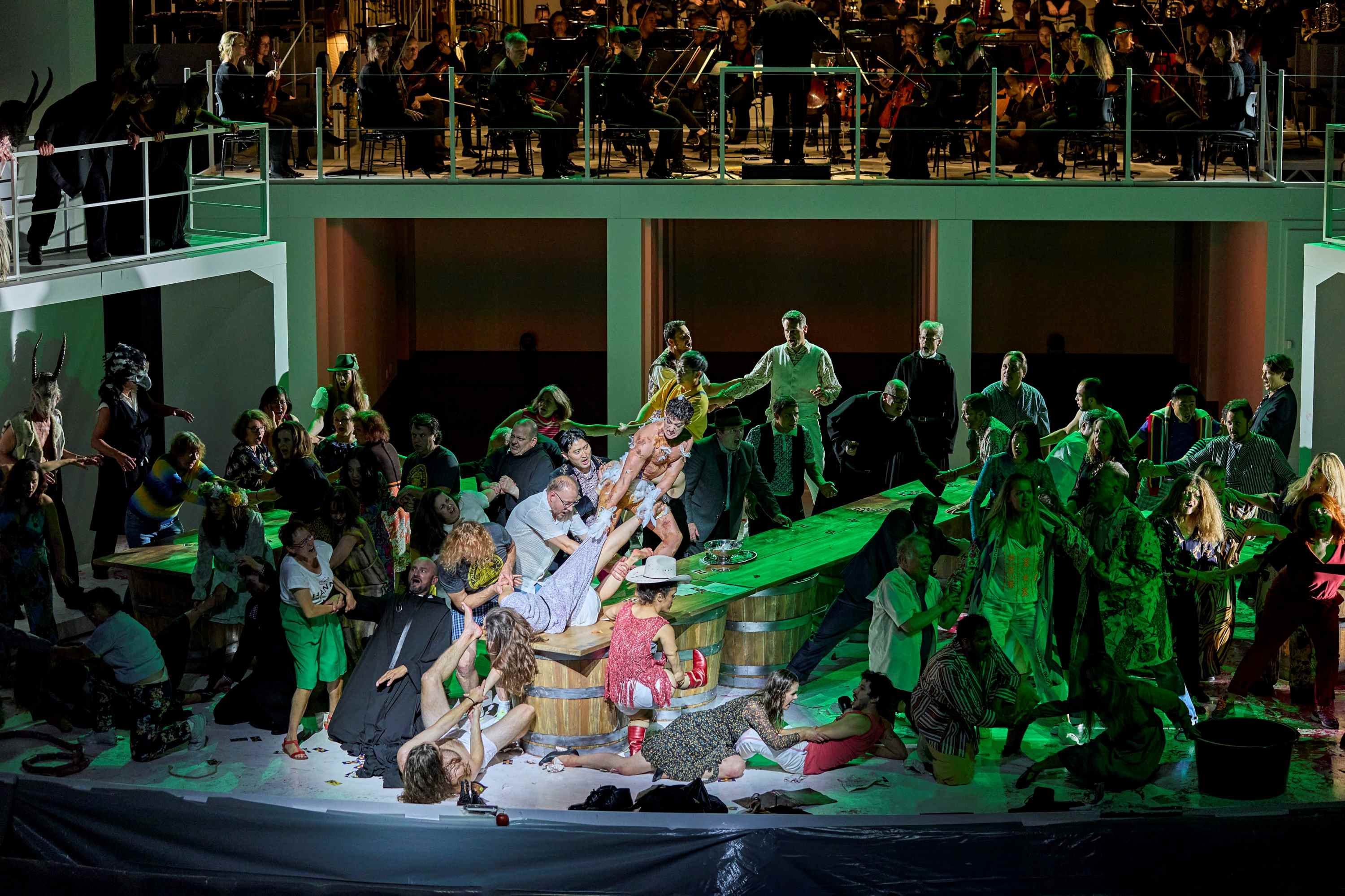
There was a terrifically vivid humour to Bieito’s reading that seemed to capture the audience’s imagination and had them reacting to it with audible glee. Not least Jake Arditti’s swan being hauled in and placed on a metal plate, while the chorus pulled parts of his roasted flesh off to taste it. Moreover, it seemed the choristers were having the time of their lives – the acting was so vivid, every single person incarnating a very different and clear personality. The direction of choruses is one of the elements of stage direction that Bieito excels at, and this was most certainly the case tonight. He gives us, in Carmina Burana, an orgy of decadence and vibrancy, yet without allowing us to forget the origins of this famous score.
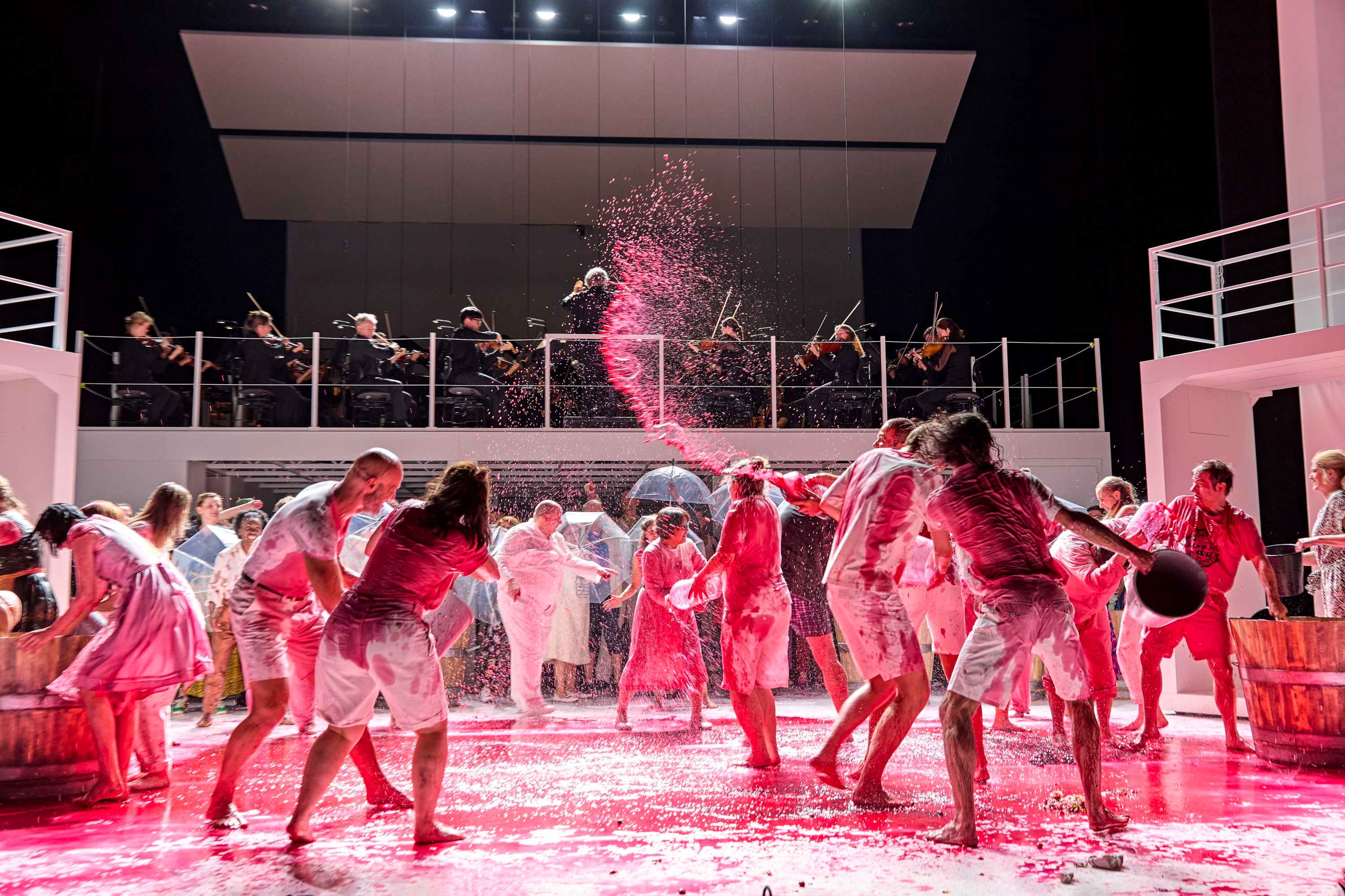
It was certainly visually striking to have the four pianos lined up at the back of the stage, high above the action, with the orchestra just below them. To conduct three such rhythmically intense works while behind the singers is a major challenge, and to keep things together, Nagano was supported by three assistant conductors located around the auditorium. The singing of the Liatoshynskyi Capella was staggering in its accuracy in the first half of the evening, both in tuning, even in the a cappella sections, and in rhythm. From my seat towards the rear of the Parkett, I can’t say the same was true in Carmina Burana, as the chorus there had a tendency to be slightly ahead of the beat, for instance in ‘Veni, veni, veni, venias’. Despite the acoustical and logistical challenges, Nagano led a reading that was striking in its rhythmic impetus, even making frequent uses of rubato in Carmina Burana, making the tempi nicely elastic. If tension had a tendency to sag in Afrodite, this is more down to the work rather than Nagano’s interpretation. The quality of the playing of the Staatsorchester was excellent: hazy, high string harmonics, eloquent flute playing, precise brass, and driving percussion – all were definitely present. If the singing of the Staatsopernchor didn’t quite have the discipline of tuning that the Liatoshynskyi had, they more than compensated in volume and sheer lustiness. The children, prepared by Luiz de Godoy, sang confidently with warm tone.
Palchykov was a confident presence in his roles. His tenor is bright and ringing on high, capable of dispatching the high, declamatory writing with assurance. There was a slight tendency for him to lose the core at lower dynamics at the start of the evening, but once warmed up, he found real freedom in his singing. Chevalier also sang with assurance, making use of vibrato to vary the tone, executing Orff’s long, melismatic lines with ease and dispatching the large angular leaps as if they were the most natural thing in the world. She also blended most beautifully with Arditti in their duet. Arditti brought his cultured countertenor sound to his music, the words always nicely forward, his closing ‘video’ terrifying, while the voice rang out into the auditorium with ease.

I do wonder whether Quattlebaum had an unannounced indisposition or whether he was instead over-parted. His baritone has a warm, nutty core, but the overall tone is rather dry and lacking in heft. He’s a physically audacious actor, willing to let it all hang out and also allowing the women to play with his magnificent mane. Yet vocally, Carmina Burana sounded a stretch too far for his current vocal resources, betrayed by that dryness of tone and a lack of genuine legato. Sandra Hamaoui was a very welcome discovery for me as the soprano. Her instrument is focused in tone, with a diamond edge, able to soar to her high D with ease. She found genuine introspection in her ‘in trutina’, shading the tone with real pulchritude. Undoubtedly a name to watch.
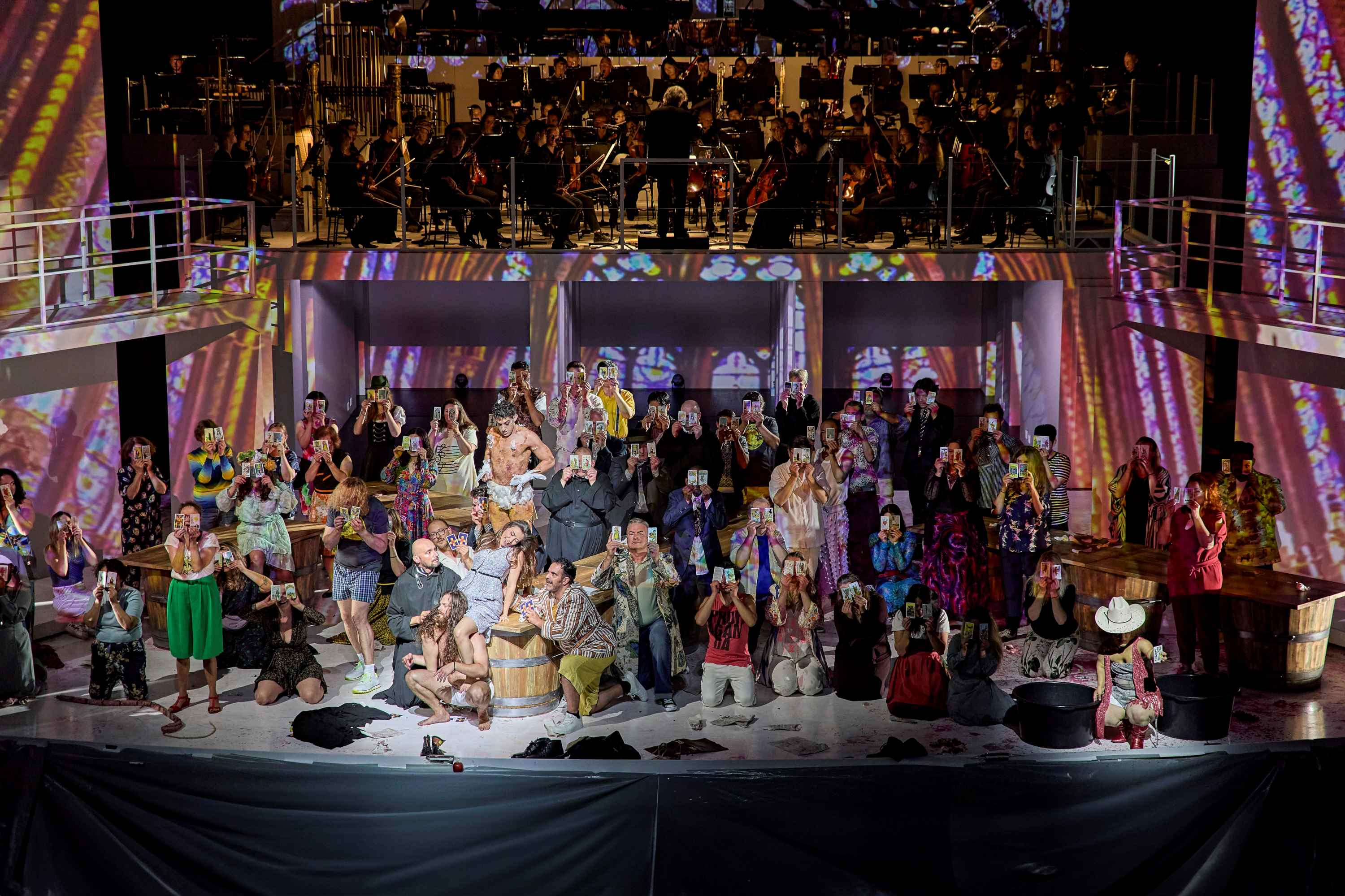
The Staatsoper deserves our gratitude for giving us the opportunity to experience Trionfi live in a staged production. This is something we’re unlikely to have again any time soon. Bieito has given us an evening of two halves – one, an homage to ancient Hellenic theatre, the other a bawdy romp, full of humour that had the audience completely engaged. He manages to inspire performances from his cast that take them to their vocal and theatrical limits. Musically, the evening was distinguished by superlative choral singing from the Ukrainians, while the Hamburgers gave us some terrifically enthusiastic and lusty singing. Nagano’s conducting was assured, although inevitably there were some coordination issues, not helped by the fact that this was the opening night of the run. The audience responded at the close with huge, enthusiastic cheers, a couple of boors booing were easily drowned out.
 operatraveller.com
[…] particular, was marched on and off – the kind of detailed direction that we saw in last week’s Trionfi in Hamburg was absent here. The main reason for the placement of the singers on stage was the […]