Wagner – Der fliegende Holländer
Holländer – Nicholas Brownlee
Senta – Elisabet Strid
Erik – Stanislas de Barbeyrac
Daland – Franz-Josef Selig
Steuermann – Moisés Marín
Mary – Eva Kroon
Coro de la Comunidad de Madrid, Cor de la Generalitat Valenciana, Orquestra de la Comunitat Valenciana / James Gaffigan.
Stage director – Willy Decker.
Palau de les Arts, València. Saturday, March 8th, 2025.
With this run of Der fliegende Holländer, James Gaffigan marks his final production as Music Director of the Palau de les Arts in València. He leaves an orchestra that is among the three finest opera orchestras in the world – with a deeply appreciative audience. I was perhaps less than overjoyed to see that the house has appointed Mark Elder to be his successor, a conductor who managed to suck the life out of Elektra in Naples last year, and whose performances have rarely, if ever, filled me with excitement. It’s a shame because there really are some fantastic, younger opera conductors around currently, without a permanent appointment, who, in my humble opinion as a back seat driver, would likely have made a more satisfying choice at the head of this outstanding orchestra. For Gaffigan’s final production, the house imported Willy Decker’s staging from the Teatro Regio Torino, where it was in turn imported from the Opéra de Paris, France, and featured an international cast mainly of the new generation of singers in this repertoire.
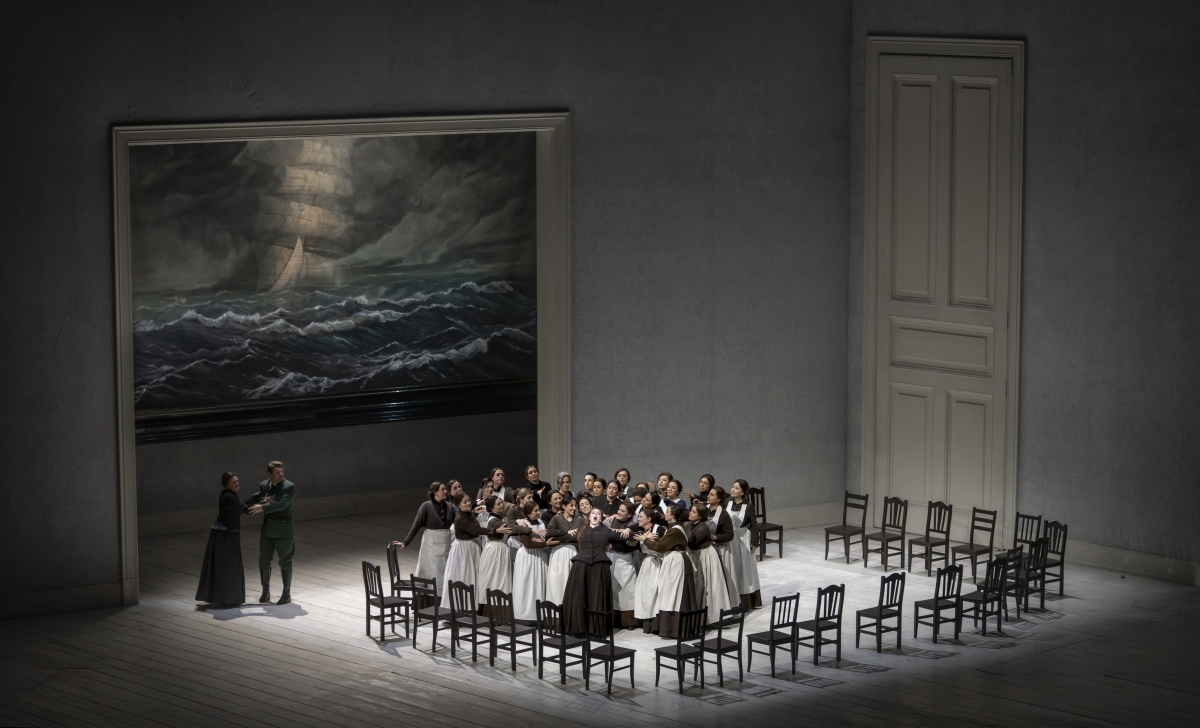
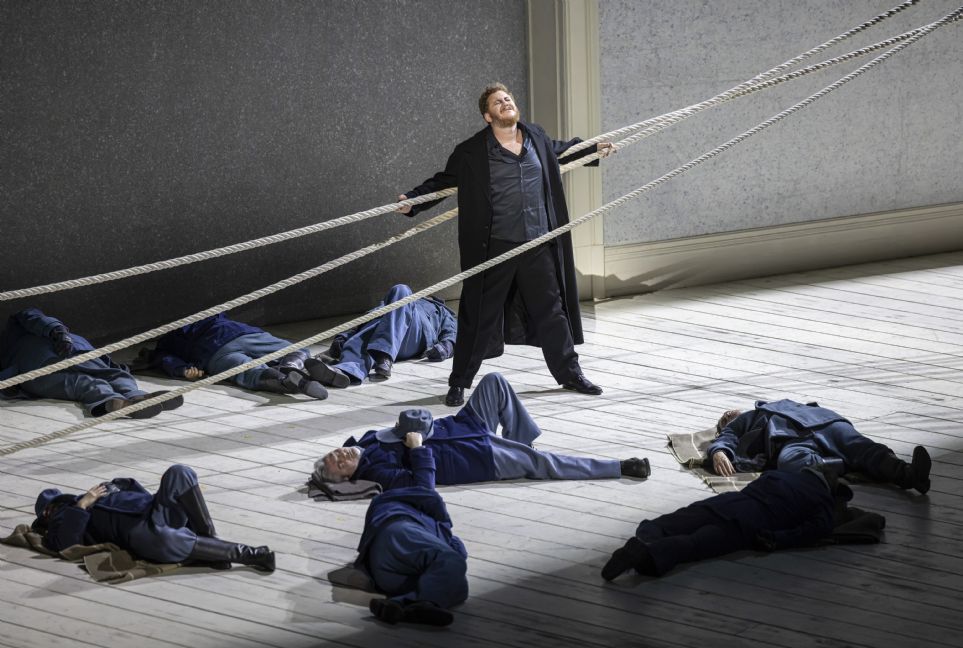
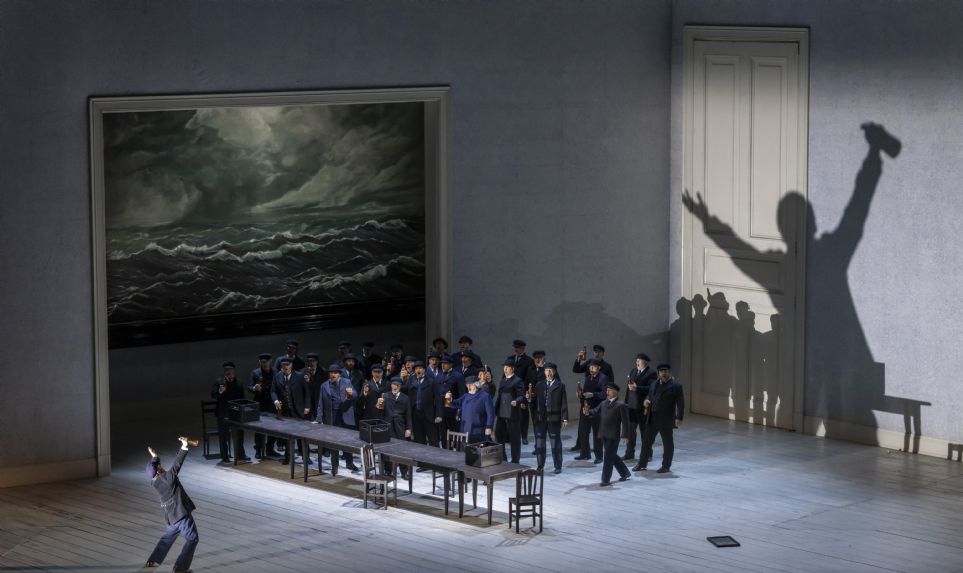
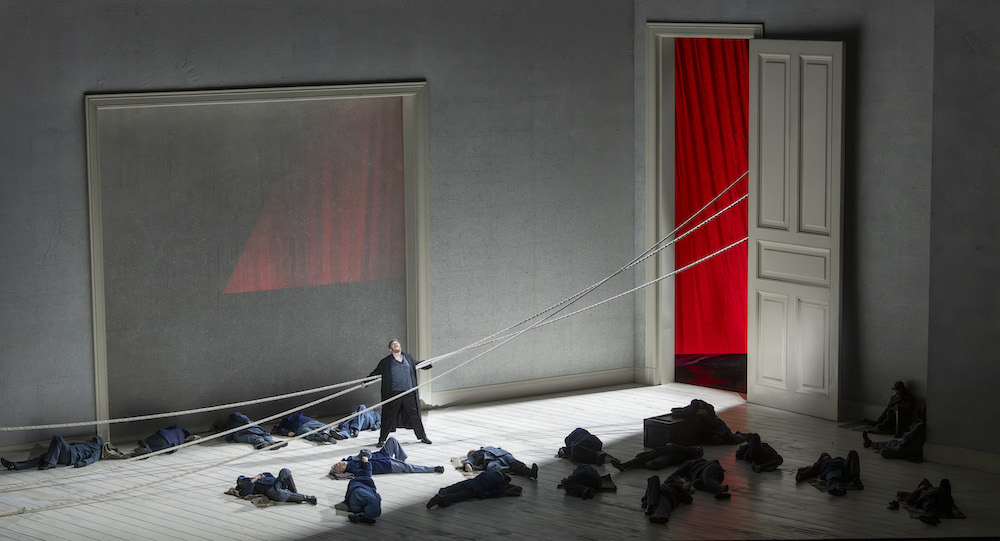
Decker’s staging, tonight revived by Stefan Heinrichs, posits an interesting question. To what extent do these fantastical legends, such as that of the Holländer, represent the delusions of a psychotic mind? Yet he doesn’t start out with that question; instead, he threads it through the evening until the final scene forces us to ask it and confront the reality of those tales that have been told over generations. Decker places the action in a large room, with a large painting showing the sea in the centre, and an oversize door on the side, through which waves are visible when it opens. In so doing, he creates a claustrophobic atmosphere that seems to take us deep into Senta’s psyche. The way in which the large painting appears, almost surreptitiously, to morph into a painting of the Holländer’s ship in a way that only Senta could see, was incredibly disturbing, as indeed was the sight of the red sails that appeared through the painting at the Holländer’s first entrance. Similarly, Decker uses the door opening to show us the shadow of the Holländer standing outside, as if wanting to prove his realness through something that also feels intangible. The evening constantly seems to progress through both real and imagined – as the choruses sang to the Holländer’s sailors on his ship, the men of Daland’s ship collapsed to the ground, leaving us with an uneasy sense of the two crews morphing into one. When the Holländer finally revealed his true nature, the fact that Senta mouthed his words along with him, forced us to reflect on whether this was all, in fact, a figment of her imagination. What Decker has given us is a staging full of ambiguity, one where we are taken into the mind of someone suffering from mental illness, yet in doing so are left wondering what is actually real in what we see.
The evening had clearly been fluently revived by Heinrichs, with personenregie that was logical and showed characters clearly engaging with each other. His direction of the large chorus was also confident, with the choristers moved around the stage logically. It struck me also that Decker’s building up of tension in his staging throughout the evening was also mirrored in Gaffigan’s conducting. At the start of the evening, it all felt rather restrained. The overture was full of the salty sea air, just like the air one could experience outside on entering the house, yet the textures felt transparent, with strings playing with a welcome use of minimal vibrato to colour the tone. Throughout the evening, Gaffigan’s tempi were relatively swift, with the exception of the Holländer/Senta duet in Act 2, which did feel like it dropped the tension somewhat. The entire evening came in around 2 hours and 12 minutes. Gaffigan also found a similarly welcome swing to the spinning chorus, which took shape quite delightfully. What struck me, however, was that Gaffigan was very much playing the long game, so that when Act 3 arrived, that was the moment he let his orchestra fully off the leash, with the off-stage chorus interacting with the on-stage tenors and basses and making a tremendous noise. Throughout the evening, Gaffigan was a highly considerate accompanist to his singers, always letting the voices through. He was rewarded with superlative orchestral playing from his musicians – the quality of the all-important brass playing was exceptional, not a split note from them all night. The wind playing also had a genuine personality, not least the eloquent cor anglais solo, while the strings were both athletically lean and silky in approach. The quality of their performance tonight is testament to the outstanding work Gaffigan has done with them, to maintain the quality that Valencians have become accustomed to from their orchestra.
I had the pleasure of seeing Nicholas Brownlee as Wotan in Das Rheingold in Munich last year and was keen to hear him again. His Holländer tonight brought many of the same qualities that one experienced then – an admirable firmness of tone, impeccable diction, and a voice able to carry over the tumult in the pit. This is a role that sits well in his bass-baritone, there was never any sense of him being stretched by the tessitura. That said, it did sound to my ears that the support isn’t completely lined up. This is a very hard feeling to describe, but in a voice like his, one would like to hear a column of sound that stretches from the feet right up and over the head. From what I heard of Brownlee tonight, it sounded that the way the sound was produced was tense and muscular. As I always write, mine are only one pair of ears and others will hear things differently, but this was very much a sense I had throughout the evening. His is a very rare talent and an exceptionally exciting one, and I very much hope that Brownlee has good people around him advising him.
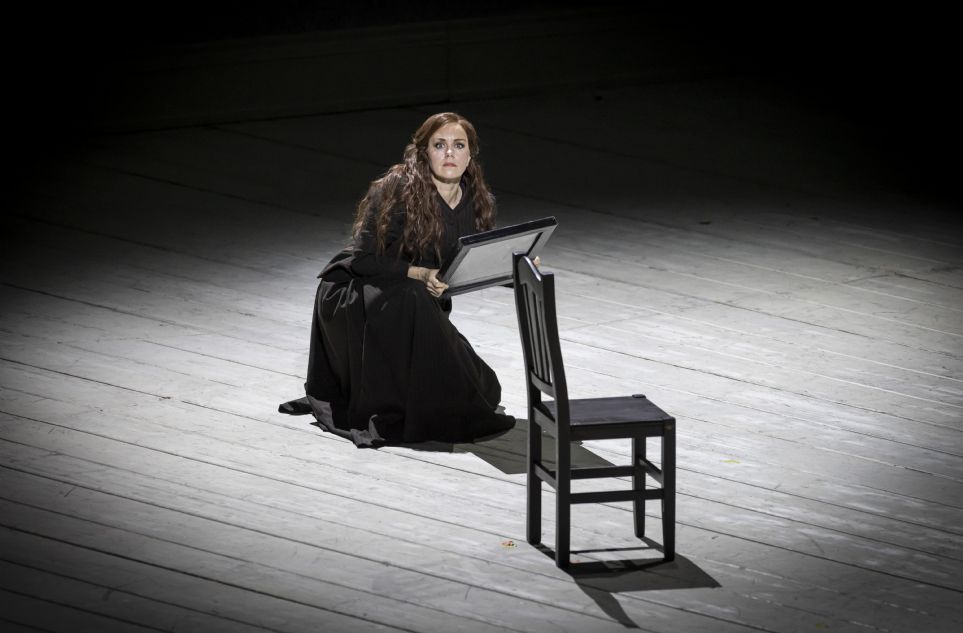
Elisabet Strid sang Senta with a well-schooled technique. Indeed, it struck me that she sang this music as if it were bel canto, phrasing those long florid lines with an impeccable legato. This was also apparent in the ballad, in which she crossed the registers with both intelligence and ease, as well as the utmost musicality. Strid’s soprano is quite soft-grained in sound, but certainly does not lack in amplitude. Senta is also a role that sits quite high and there were a few passages where Strid’s soprano threatened to succumb to the forces of gravity and her tuning went awry. That said, hers was a lyrical, intelligent, and compelling account of the role. Stanislas de Barbeyrac continues to explore the Wagnerian repertoire, with this assumption of Erik. It’s a role that sits well for his bright tenor, with focused tone. He sang his music in excellent German and a grateful legato. Again, it did sound to my ears that he’s still working the role into the voice, the top wasn’t quite as connected as one might have expected it to be, tightening somewhat up there where it should ideally bloom. This really is a role that is an ideal match for his tenor and I look forward to hearing him grow even more into it through the coming seasons.
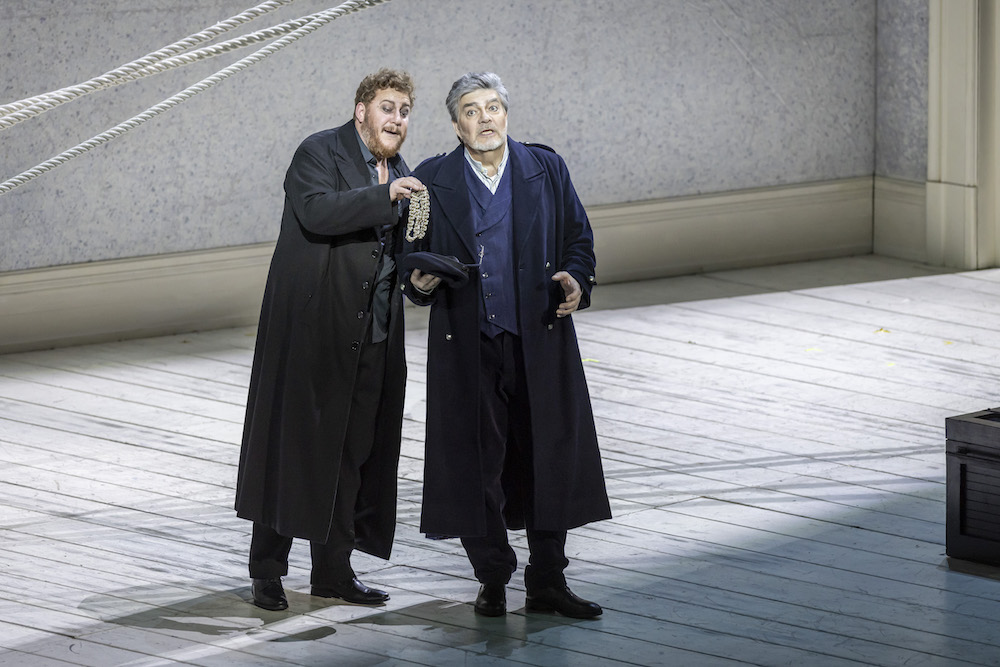
Franz-Josef Selig’s bass appears to be transcending the passage of time as Daland. Yes, it does sound that he needs to make a little more of an effort to sustain those longer, legato lines than previously, but his bass is still very full in tone and in amplitude. Moisés Marín was an extrovert Steuermann, while Eva Kroon sang Mary in a fruity contralto. The Cor de la Generalitat Valenciana, usually one of the finest opera choruses out there, was not on its best form tonight. Now prepared by its new director, Jordi Blanch Tordera, the tuning in the sopranos and mezzos was not at the level I would expect here, with a couple of over-prominent vibratos dominating the blend and drooping the pitch. They did sing with an impressive unanimity of approach and ensemble, however. The tenors and basses were excellent, singing with tremendous volume, the tenors shining out with silvery tone into the house. They were joined by the tenors and basses of the Coro de la Comunidad de Madrid, prepared by Javier Carmena, for the off-stage portions in Act 3.
There was so much to enjoy in this evening’s Holländer. The singing of the principals represented the new generation of Wagnerians assuming this repertoire today. Decker’s staging was a work of intelligence and insight, forcing us to reflect on the real and the imagined. The house orchestra was on glorious form for their outgoing chief, who gave us a reading that built up gradually, culminating in a thrilling conclusion in its final act. The audience response was exceptionally generous, with particularly loud applause for Strid, Brownlee, and Gaffigan and his orchestra.
 operatraveller.com