Filidei – Il nome della rosa
Adso da Melk – Kate Lindsey
Guglielmo da Baskerville – Lucas Meachem
La Ragazza del Villaggio / Statua della Vergine – Katrina Galka
Jorge da Burgos – Gianluca Buratto
Bernardo Gui – Daniela Barcellona
Abbone da Fossanova – Fabrizio Beggi
Salvatore – Roberto Frontali
Remigio da Varagine – Giorgio Berrugi
Malachia – Owen Willetts
Severino da Sant’Emmerano – Paolo Antognetti
Berengario da Arundel / Adelmo da Otranto – Carlo Vistoli
Venanzio / Giovanni Dalbena – Leonardo Cortellazzi
Girolamo Vescovo di Caffa / Cuciniere – Adrien Mathonat
Ubertino da Casale – Cecilia Bernini
Michele da Cesena – Flavio D’Ambra
Cardinal Bertrando – Ramtin Ghazavi
Jean d’Anneaux – Alessandro Senes
Coro di Voci Bianche dell’Accademia Teatro alla Scala, Coro del Teatro alla Scala, Orchestra del Teatro alla Scala / Ingo Metzmacher.
Stage director – Damiano Michieletto.
Teatro alla Scala, Milan, Italy. Saturday, May 3rd, 2025.
There’s something incredibly gratifying to see that all performances of the world-premiere run of an opera are completely sold out. The interest in Francesco Filidei’s latest stage work, an adaptation of Umberto Eco’s celebrated novel Il nome della rosa, has been enormous and it was wonderful to see the legendary Teatro alla Scala so full this evening, with an attentive audience hanging off every word and sound emerging from the stage and pit – with no mass exodus at intermission either. The opera is a co-commission between the Scala, the Carlo Felice in Genoa, and the Opéra de Paris, with a libretto by Filidei himself with Stefano Busellato.

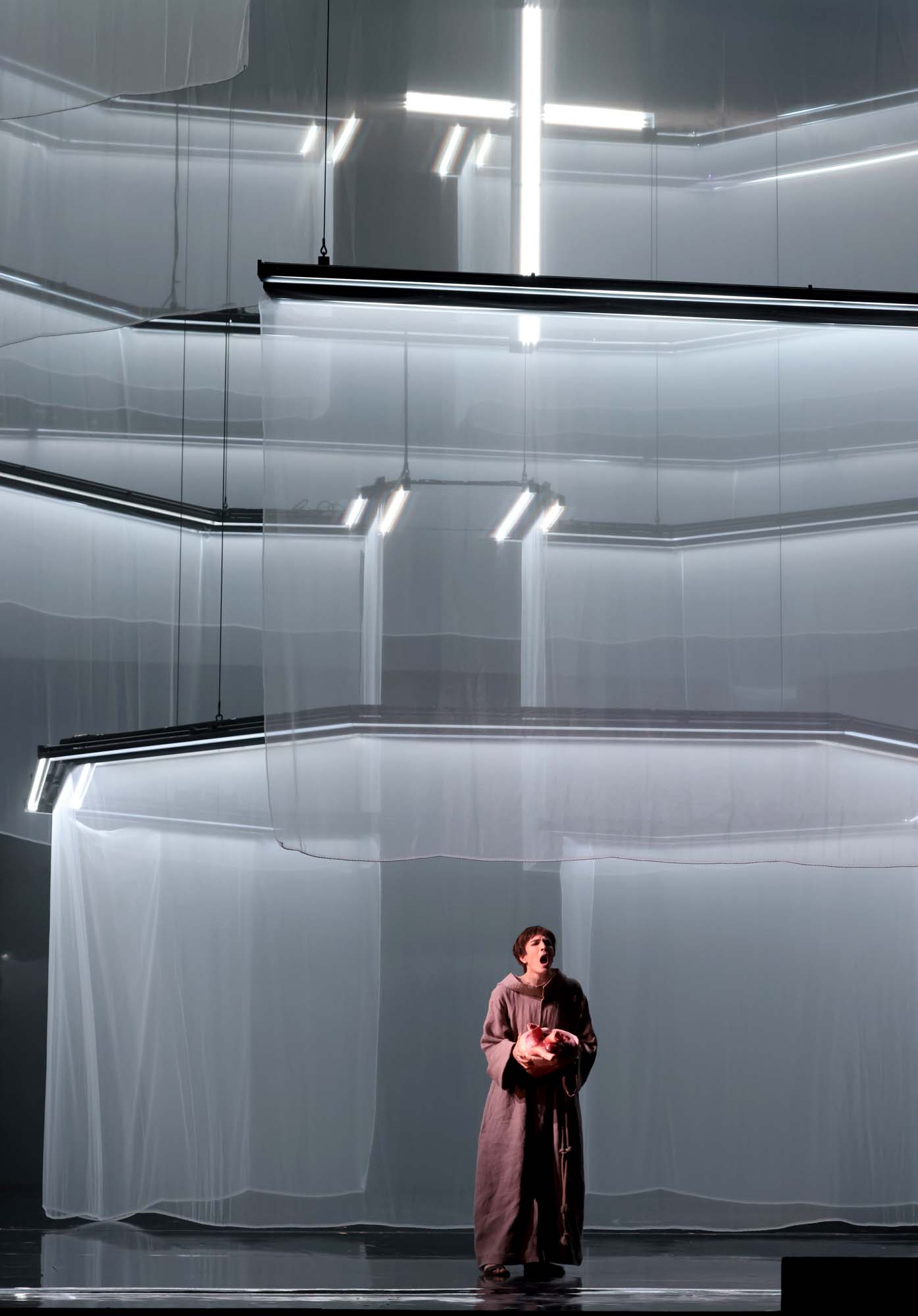
The stage direction has been confided to Damiano Michieletto who sets the action in a single set, by long-term collaborator Paolo Fantin, where the chorus is ranged in rows above, looking down, while the action takes place within a central circular space, into which objects are wheeled on and off accordingly. The visuals are austere, generally, but there’s a contrast between the historic aspects of the monks’ costumes and the more modern visuals of an illuminated lectern in the library, or hospital-style trolleys for the victims. Having the chorus seated above also gives the impression of a group of monks in rows reading, but also offers a more practical element, allowing them to sing from scores – essential given the complexity of Filidei’s choral writing.
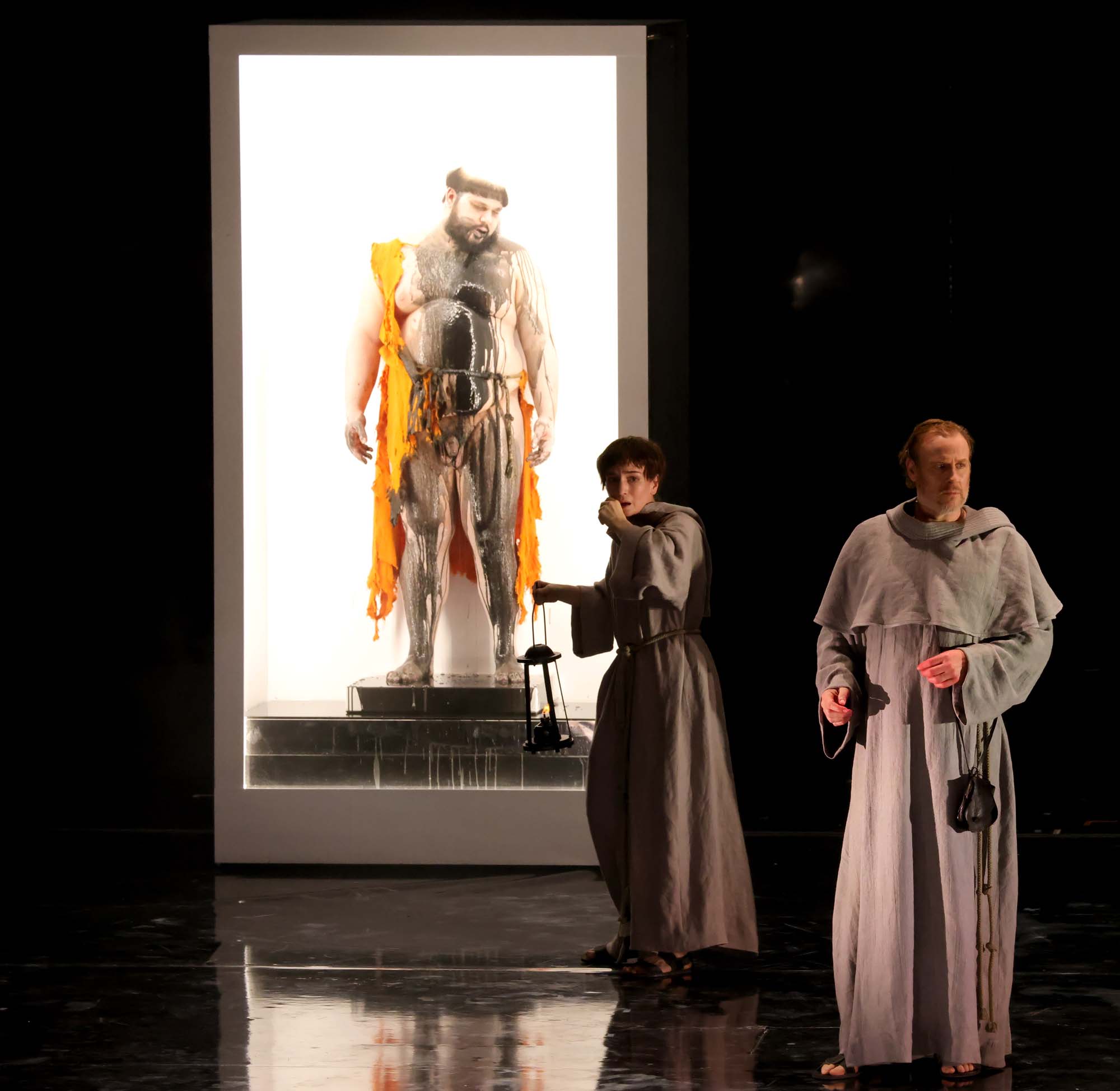
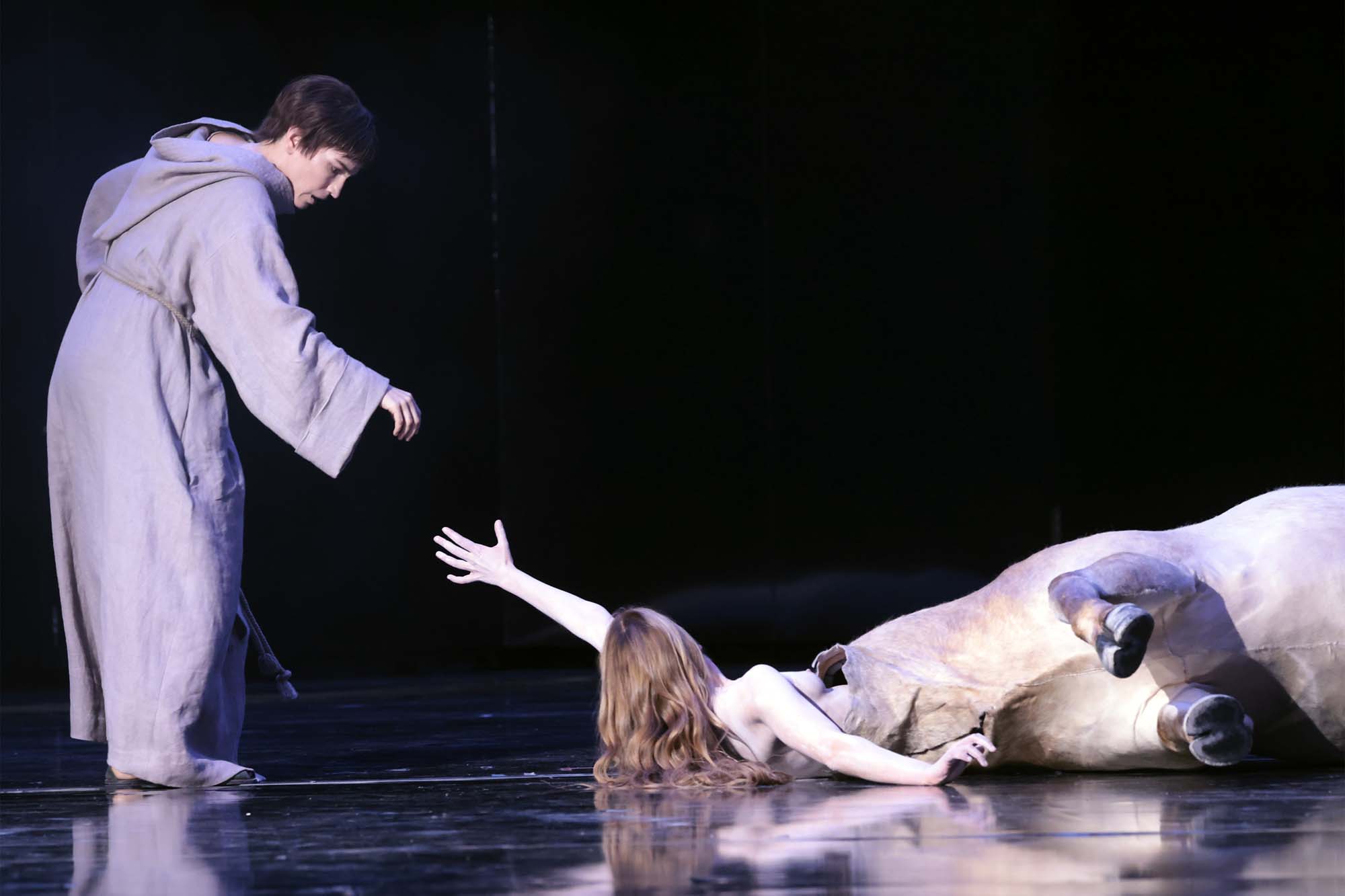
One of the qualities I associate most with Michieletto’s work as a director is the sheer emotional impact he brings to his work. He’s a director who can’t help but make us feel so profoundly. I have to admit that the sheer heart on sleeve emotion that marks his work was an aspect that was absent tonight. His staging felt esoteric, austere almost, in keeping with the monastic setting granted, but also with realities that felt intimated rather than felt. For instance, the central part of the stage was dominated by a rose-like structure composed of translucent drapes that hung from the flies. These would descend down to the stage to illustrate Baskerville walking through his mental processes, as he attempted to make sense of the murders, or, in the closing moments, they dropped to the ground to suggest the destruction of the monastery during the blaze. Similarly, Michieletto also brought some considerable visual interest to his staging – whether in a fresco coming to life, Malachia being tortured by scorpions, or strange figures with animal heads perambulating the stage. In doing so, it felt that he was very much bringing a medieval illustrated book to life. And yet, I can’t escape the nagging feeling that we were observing the emotions of the work from without, rather than the sheer emotional impact that Michieletto so often brings to his work.

In a work set in a monastery there’s always a danger of it being hard to tell characters apart, given the similarities of their costumes and voice types. Filidei transcends this by both giving each of the twenty named characters in the libretto their own musical personalities, and also in using countertenor, contralto and soprano voices for the monks. This gives his writing, both instrumental and vocal, a seemingly limitless palette of tone colours. Furthermore, I found his vocal writing to be immensely singable. Yes, he made the most of each singer’s vocal registers, but there were no wide leaps around the range and there was nothing predictable about the direction of the vocal lines, in a way that many contemporary opera composers seem to operate in. He uses his vast orchestral forces with great confidence, with a large string section, triple winds, and five percussionists playing an enormous variety of instruments. Eco’s novel abounds with references to past writers and Filidei’s score does so musically. Often these references are hidden in the vocal line: the writing for Remigio seems redolent of Calaf in Turandot, for instance. Elsewhere, they’re more explicit, such as in a quote from Rosenkavalier when Adso recounts his assignation with the village girl to Baskerville, or the introductory measures to the fugue from Falstaff at the start of the theological dispute. In this respect, I found Filidei’s score to be both a true homage to Eco’s novel, but also a score that belongs and takes its place in the history of this storied house.

The choral writing is exceptionally demanding, with the choruses, adults and children, divided into what sounded like a considerable number of parts. Filidei not only has them sing, but also asks them to make percussive noises that reflect and amplify the percussiveness from the pit. To illustrate the aged Adso’s voice, Filidei has the chorus intone the text in sprechgesang, with the different voice sections not quite in sync. The voices also add a halo to the sound through being asked to sing softly in their highest registers. The Scala chorus, prepared by Alberto Malazzi and Giorgio Martano, rose to the challenge through a disciplined and focused approach that belied the difficulty of the music. The children, prepared by Bruno Casoni, also sang with total dedication. I do wonder if Filidei’s writing requires an even bigger chorus for maximum impact, given the sheer number of parts the chorus appears to be divided into. The Scala orchestra also played with prodigious sureness for Ingo Metzmacher, who kept the disparate forces together with airtight concentration. The strings used a wide variety of playing techniques, whether col legno or high harmonics that added an eery atmosphere to the sound. The most memorable part of the score, at least for me, came at the end of Act 1, during Adso’s conjugation with the village girl. Here, Filidei created hazy close, choral harmonies to envelop the sound, with tenderness emerging from the pit. This was undoubtedly an enormous challenge for the house forces and they most certainly rose to the occasion.
In the huge cast it would be impossible to discuss every single performance in depth. However, I will highlight here a number of them. Kate Lindsey brought her claret-toned mezzo to the role of Adso, the voice even throughout the range. Lucas Meachem was an authoritative actor as Baskerville, his firm baritone a serviceable vocal presence. Daniela Barcellona was unrecognizable in her ecclesiastical garb as Bernardo Gui. The role sits around the passaggio for her, and while she tastefully dispatched the chestiness, I longed for her to let go a bit. She was, however, never less than professional. Owen Willets sang confidently as Malachia, his countertenor able to fill the house with ease. Similarly, Carlo Vistoli gave us a passionately-sung Berengario, his countertenor full of beauty of tone, even in the highest reaches. As Burgos, Gianluca Buratto dispatched the complex rhythmic pronouncements with poise, in a role that sits quite low. Fabrizzio Beggi sang the Abbone’s music with focused resonance in the lower reaches of the part. Giorgio Berrugi sang Remigio’s music with warm, full tone and an elegant line. Roberto Frontali brought his familiar comic timing and robust baritone to the role of Salvatore, while Katrina Galka sang the village girl in a crystalline soprano with elegant staccati. The remaining roles were all extremely well taken and displayed an admirable dedication of preparation.
Filidei’s score shows enormous ambition and the technical means to achieve it. Michieletto’s staging offers visuals that amplify the work, bringing its fantasy to life. I did feel, however, that we were very much on the outside looking in, rather than being made to feel. Nevertheless, this is a work that deserves to be seen, heard, and discussed. It feels very much a product, as well as a part, of the great Italian operatic tradition. The audience response at the close was very warm, particularly so when Filidei appeared at the final curtain. To hear a capacity audience, at this most fabled of venues, respond so enthusiastically to a new opera gives an enormous sense of hope for the future of this great artform.
 operatraveller.com
[…] OPERATRAVELLER: Crítica, Investigaciones monásticas: Il nome della rosa en el Teatro alla Scala […]
[…] was some new music this year. Francesco Filidei’s Il nome della rosa premiered at the Scala to a sold-out run. Based on the novel by Umberto Eco, it’s a work of […]