Verdi – Otello
Otello – Brian Jagde
Jago – Gabriele Viviani
Cassio – Airam Hernández
Roderigo – Albert Casals
Lodovico – Sim Insung
Montano/Un araldo – Fernando Radó
Desdemona – Asmik Grigorian
Emilia – Enkelejda Shkoza
Pequeños Cantores de la ORCAM, Coro Titular del Teatro Real, Orquesta Titular del Teatro Real / Nicola Luisotti.
Stage directors – David Alden.
Teatro Real, Madrid, Spain. Sunday, September 28th, 2025.
With this revival of David Alden’s production of Otello, the Teatro Real is opening its 2025 – 26 season. I saw Alden’s production when it was new at English National Opera, around a decade ago, and my memories of it were not particularly distinguished. I was keen to see whether it had improved with the years. The casting for this revival was also a compelling reason to attend, with Brian Jagde making his debut run in the title role, Asmik Grigorian as Desdemona, and Gabriele Viviani as Jago. When you have singers of the calibre of Airam Hernández as Cassio, one can assume that it would be an evening where the singing is front and centre.
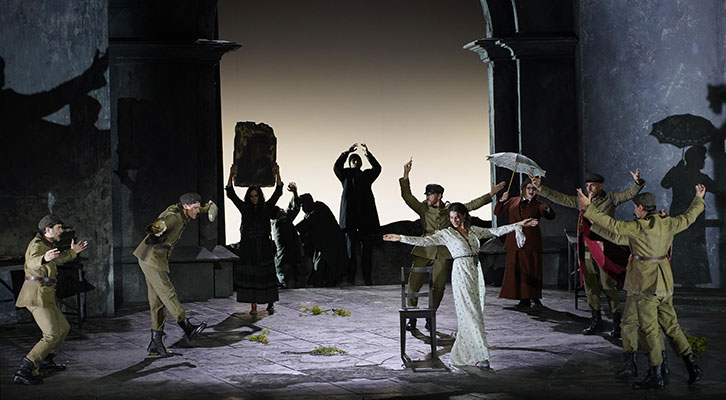
Which is a good thing, because I do admit that Alden’s staging has certainly not improved with age. I don’t know if Alden intended for the opening scene to be risible, but that was certainly the effect. He moves the chorus around as a block, asking them to indulge in movement, by Maxime Braham, that seems to have them swaying around as if they had enjoyed a little too much of the local brandy. That, combined with the wild-maned danseuse who randomly gyrated around the stage giving us frequent views of her panties, did not promise a particularly serious start to an evening of potent drama. Fortunately, thanks to the excellent singing-actors at his disposal, the evening did settle down, but it felt that this was more due to the individual performances of the singers, rather than a sense of insightful personenregie.
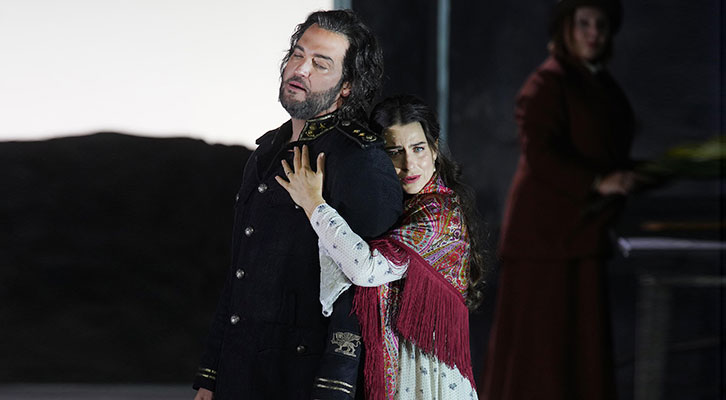
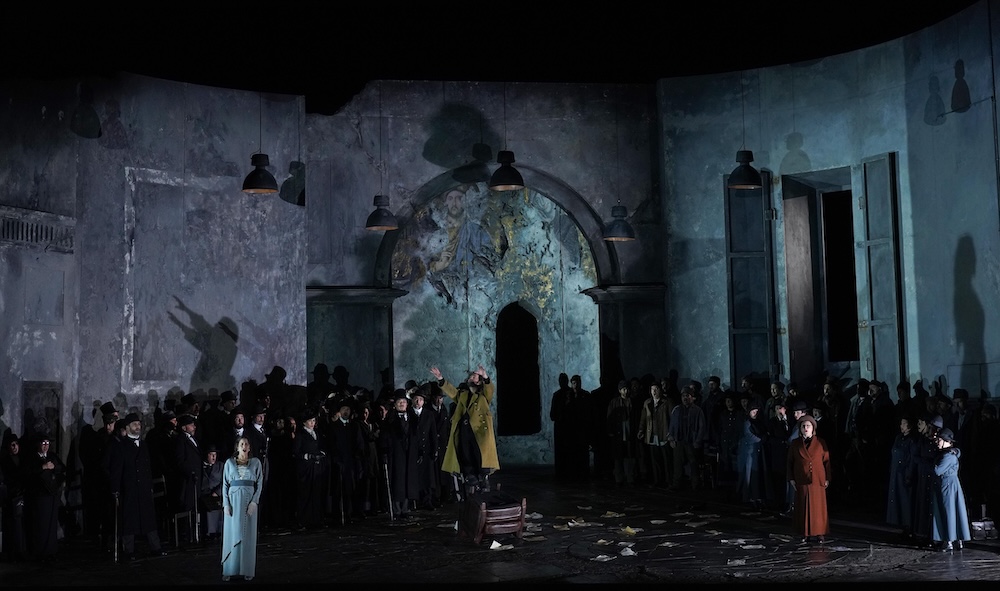
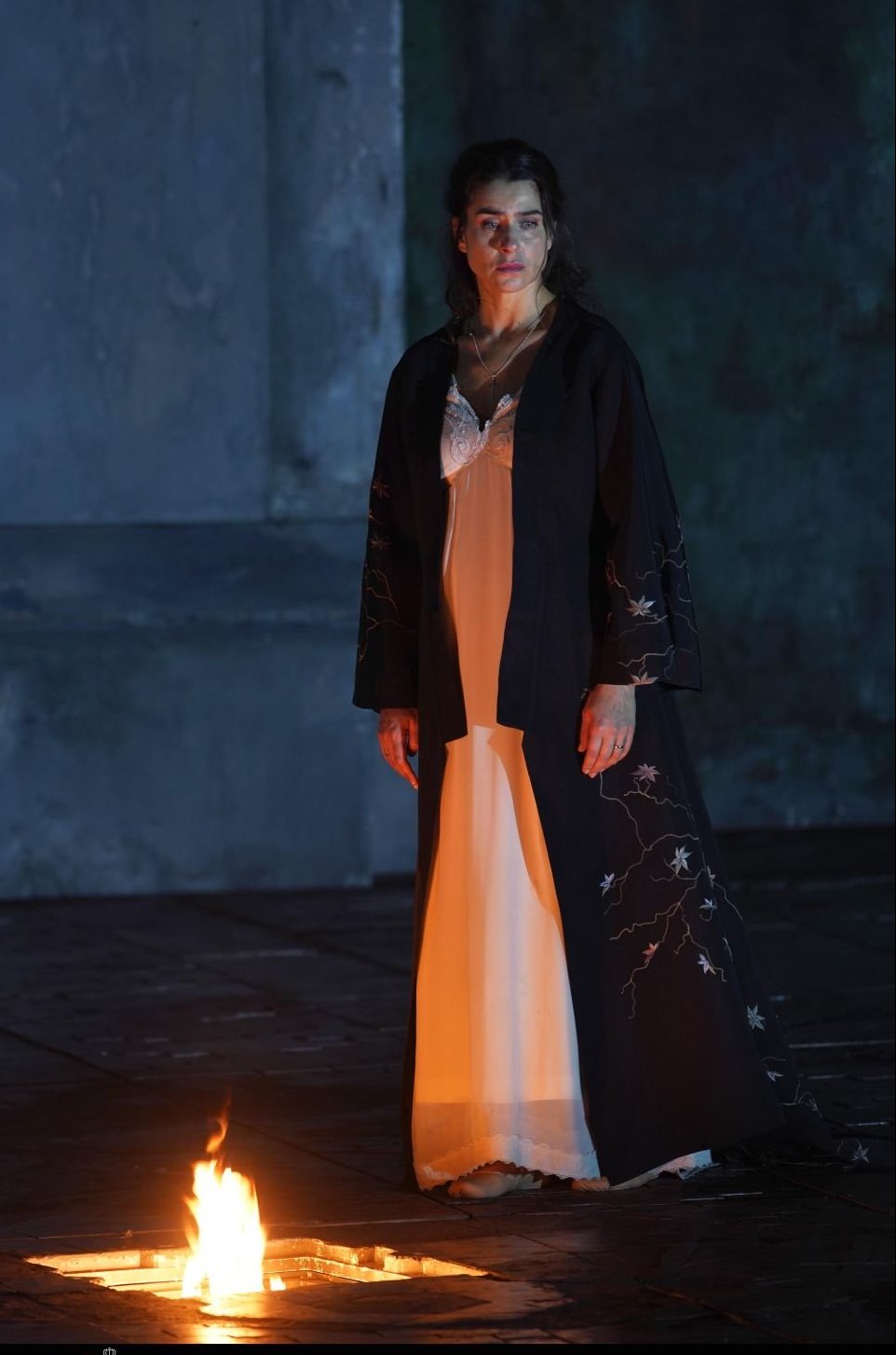
Indeed, far too often characters were simply asked to gesticulate to the front, arms outstretched. I also don’t quite understand why, in the Act 1 love duet, that Otello and Desdemona chose to copulate on the dusty floor rather than find a more comfortable spot. The most successful aspect of Alden’s staging was the lighting, by Adam Silverman. He made frequent use of shadow within the semi-circular set to provide some striking images of characters standing over each other – reinforcing the power relationships inherent in the piece, whether Jago over Otello, or Otello over Desdemona. Otherwise, this was a staging that was very much dependent on strong individual performances to drive the drama forward.
In his debut run of this iconic role, Jagde gave notice that he could become a truly great Otello. He’s not there yet, but there’s some serious promise that makes me very excited to see him grow in the part over the next few years. His opening ‘esultate’ was thrilling, his dark, masculine tenor opened up gloriously on the top, the high B and A staggering in their amplitude and ease. Despite the generous size of the voice, he was able to pull back on the tone in the love duet, shading it with delicacy. Vocally, Jagde gave us a most impressive piece of singing. What I do hope he will focus on for future assumptions, is the relationship between text and note. I longed for him to make more use of the language, to use the vowels to project emotion while spitting out the consonants. For instance, those repeated cries of ‘sangue’ at the end of Act 2 needed more blood in the tone by exploiting the vowels. That isn’t to say that his ravings to Desdemona in the Act 3 duet weren’t impressive, they very much were, I just felt that the impact was blunted by a relative lack of colouring of the text. Make no mistake, however, with this debut run, Jagde has very much arrived in the role.
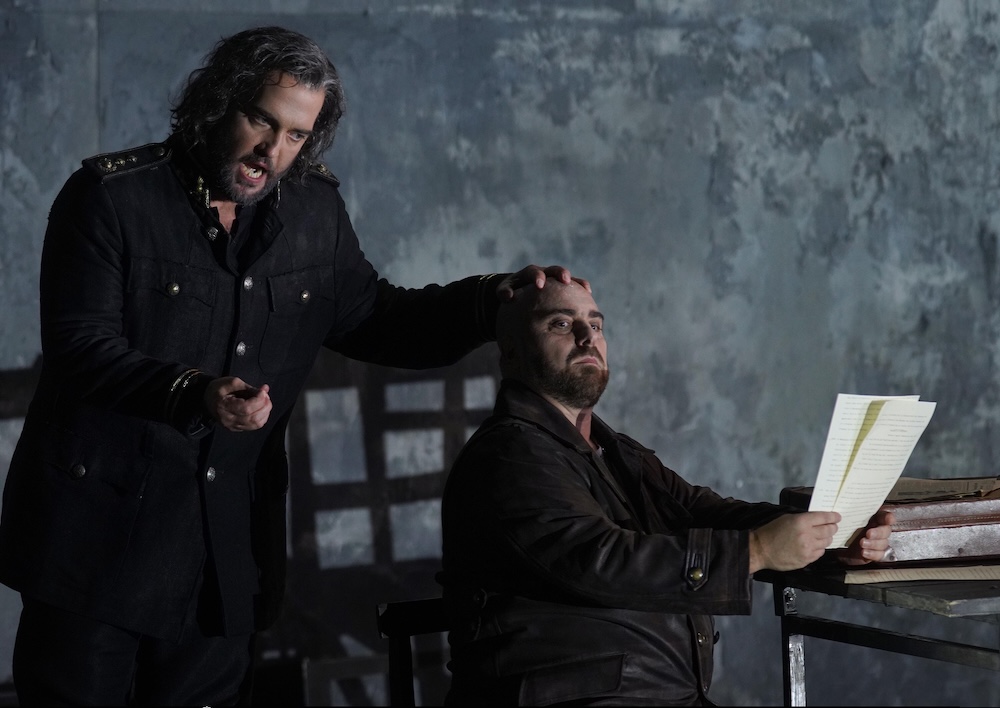
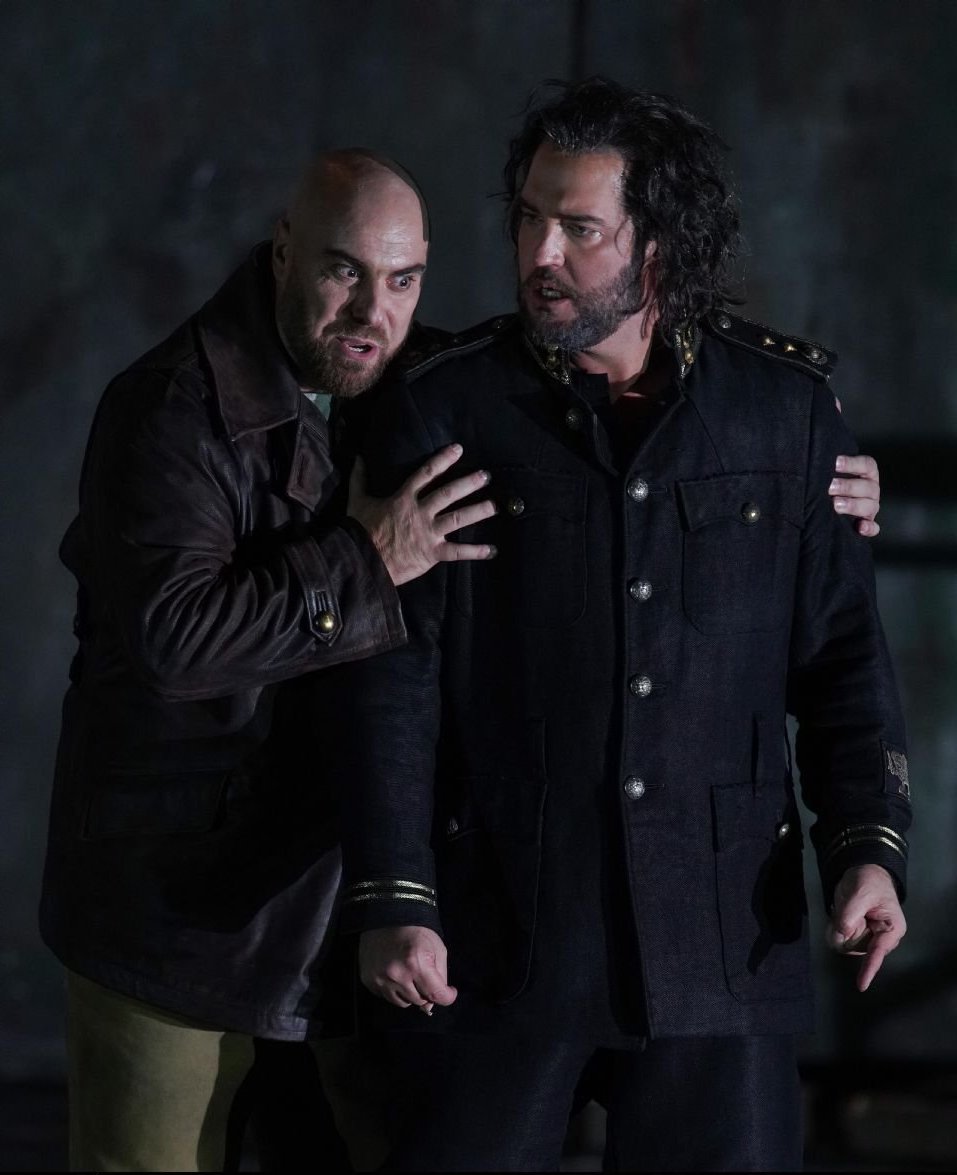
Viviani gave us a fabulously demonic Jago. Indeed, he gave us a masterclass in how to use text, sound and physicality to give us an incredibly complex portrayal. Viviani illustrated Jago’s journey from wounded pride to sheer psychopathy, refusing to accept his responsibility in the final scene. The way that he brought a smile to the tone while witnessing Otello’s disintegration was seriously disturbing. Similarly, he sang his ‘credo’ with firm tone, even vibrations, and registers fully integrated. Viviani also made full use of the dynamics, pulling us into his conspiracy, while also repelling us with his evil. Needless to say, his diction was crystal clear all night, exploiting the language, including those wide open ‘A’ sounds, for even more impact. His was a multifaceted, disturbing, and compelling reading of this gift of a part.

Grigorian gave us a luminous Desdemona. She has the kind of profound understanding of how this music should go that simply cannot be taught. Her reading of the role abounded in eloquent Verdian phraseology, founded in a generous chestiness that opened up to a wonderful top, capping the ensembles radiantly. I did find that Grigorian took a little while to settle, she took a few extra breaths before floating on high in the love duet, but once past this, she phrased in long, eloquent lines, bringing an honesty to her singing that was full of Desdemona’s innocence. Her big Act 4 scena saw her searching for truth in her singing, the repeated cries of ‘salce’ varied in tone and feeling, and her ‘Ave Maria’ was sung with elegant beauty, the closing ascent to the high A-flat floated on a cushion of sound.
The remaining cast was of the highest level. Hernández’ Cassio was sung in a bright, forwardly-placed and ringing tenor. Enkelejda Shkoza sang Emilia with deep feeling, in a fruity mezzo, singing her passionate lines of truth in Act 4 with extroversion. Sim Insung sang Lodovico in a stentorian, slightly woolly bass, with plenty of resonance. In the brief role of the Araldo, I was impressed by Fernando Radó’s big, resonant bass – one I’d like to hear more of. The chorus, prepared by José Luis Basso, rose to the occasion. This is a big assignment for them and they rewarded us with a massive noise that filled the house thrillingly. The sopranos gave us a staggering sustained high C in Act 3, while the tuning in the unaccompanied passage after the passing of the storm in Act 1 was absolutely spot-on. Moreover, the rhythmic accuracy they brought to Verdi’s challenging syncopated writing was seriously impressive. There was a focus to the tone that I found gratifying to listen to, no war of vibratos here, just a wall of sound that blew me out of my seat. It was a great night for them. The children’s chorus had been equally well prepared by Ana González.
The house orchestra was similarly on top form for Nicola Luisotti, rewarding him with playing of the very highest quality, whether in the glowing brightness of the high strings and strumming harp in the love duet, or the darkness of the lower strings and brass portending doom in the closing act. I did find Luisotti’s reading to be somewhat routine, however. I longed for him to point the surging rhythms in the Jago/Otello duet at the end of Act 2, to drive it forward much more than just responding to the stage. Similarly, the surging strings in response to Jagde’s electrifying ‘esultate’ also felt somewhat anticlimactic. To his credit, Luisotti did keep his large forces together, with ensemble watertight throughout. It’s just that I longed for him to pull out the rhythmic force of the work, to drive and enhance the strength of the feeling emerging from the singing. It was undoubtedly a competent reading, but I did long for more.
Tonight’s Otello was a splendid opening to the new operatic year in Madrid. Yes, Alden’s staging is unintentionally risible and not as insightful as one might hope, but tonight was very much about the singing – and what singing we were treated to. We witnessed superb singing across the board. Jagde’s Otello promises so much for the future. It was thrillingly sung and one can only hope that with time he will find even more depth to his characterization. Grigorian gave us a radiant Desdemona, with Viviani finding so much depth and complexity in his portrayal of Jago. The audience responded at the close with thunderous ovations for the cast – justifiably so.
 operatraveller.com
[…] recently made his role debut at the Teatro Real de Madrid, where critics hailed his interpretation, stating, ” Jagde gave notice that he could become a truly great Otello” and “Vocally, […]
[…] insight, but also significant dryness in the tone. Brian Jagde gave us a thrilling debut as Otello in Madrid, while Asmik Grigorian brought dramatic charge to Desdemona. Gabriele Viviani made […]