Rimsky-Korsakov – The Night Before Christmas (очь перед Рождеством)
Tsaritsa – Violeta Urmana
Village Head – Sergei Leiferkus
Chub – Dmitry Ulyanov
Oksana – Elena Tsallagova
Solokha – Ekaterina Semenchuk
Vakula – Sergey Skorokhodov
Panas – Milan Siljanov
Deacon Osip Nikiforovich – Vsevolod Grivnov
Patsyuk – Matti Turunen
Devil – Tansel Akzeybek
Woman with violet-blue nose – Alexandra Durseneva
Woman with ordinary nose – Laura Aikin
Bayerischer Staatsopernchor, Bayerisches Staatsorchester / Vladimir Jurowski.
Stage director – Barrie Kosky.
Bayerische Staatsoper, Nationaltheater, Munich, Germany. Sunday, December 7th, 2026.
Rimsky-Korsakov’s The Night Before Christmas or Christmas Eve as it’s also known in the Anglophone world, is a work that’s barely known in the West. It’s a shame because it has some terrific music, greatly inspired by Ukrainian folk music, as a detailed note in tonight’s program book reveals. Barrie Kosky’s new staging for the Bayerische Staatsoper opened last month, and with it, the Staatsoper has given us a holiday treat, under the direction of house Music Director, Vladimir Jurowski.
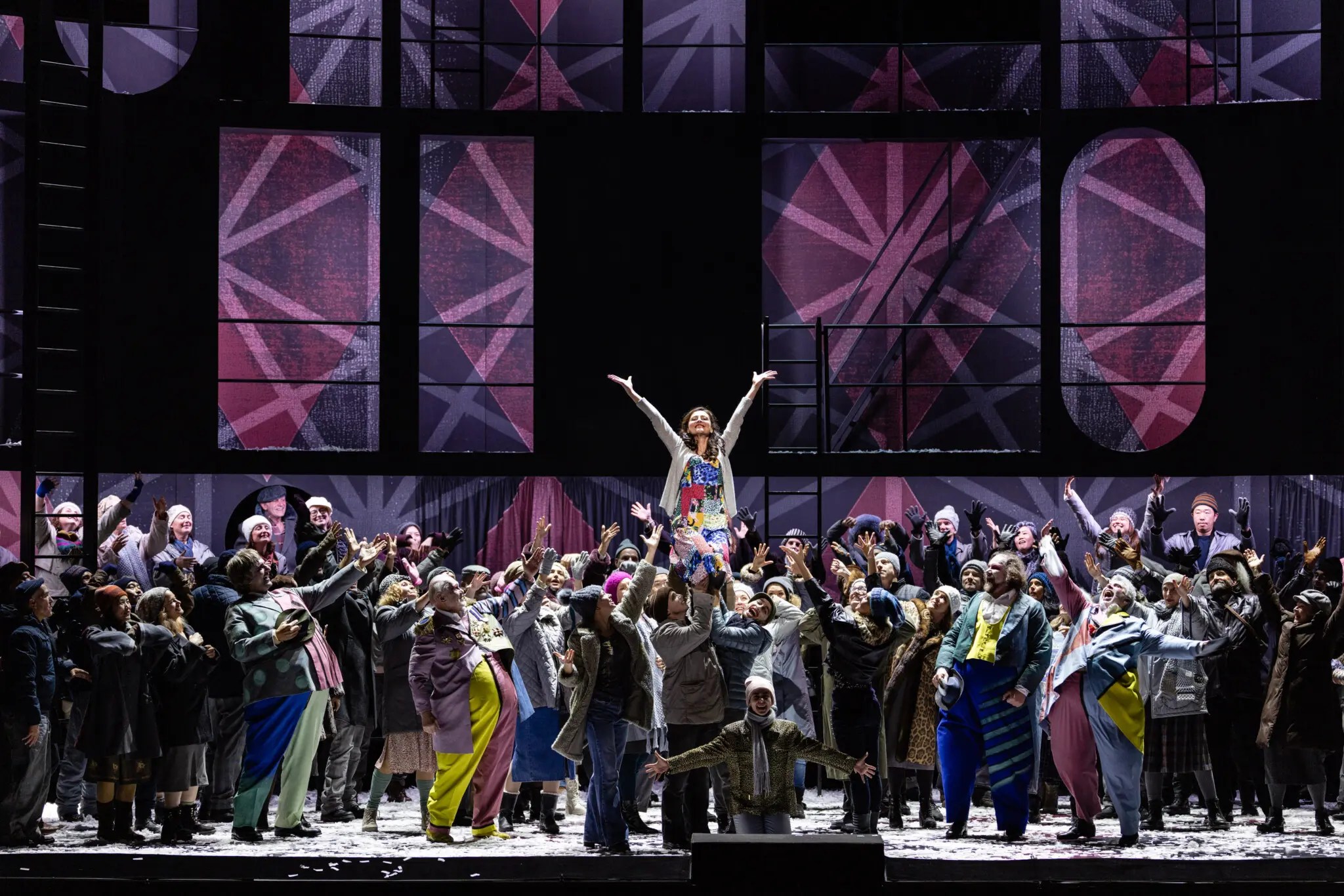
This is a work of sheer fantasy, based in village life, with the Devil working in tandem with the sorceress Solokha, while her son, Vakula, is taken with the lovely Oksana, to the extent that he flies on the Devil’s back to St Petersburg to ask the Tsarina for her shoes – since this is what Oksana wanted. Kosky’s staging has many of his familiar trademarks: the mass dancing for the chorus, the glitzy danseurs, and the fantastical visual environment. Moreover, I didn’t know how much I needed to see the great Violeta Urmana as the Tsarina descending from the flies on a silver throne, and being handed a cigarette and some vodka by her attendants, but this has to be the most fabulous stage picture I’ve seen all year. Kosky sets the action in a single set, by Klaus Grünberg, with ladders scattered around that the principals and acrobats climb. The evening opened with the chorus seated around the set, applauding Jurowski as he entered. At first, it made me wonder if we were watching a village performance of the events in the plot. In fact, the stage crowded with people made it very hard to focus on any one element – whether the principals, ballet, or indeed the crowd. As the evening developed, however, the crowd disappeared and the action unfolded in front of us with the principals, ballet, and acrobats as the core focus. Perhaps, by starting with the crowd on stage, this was Kosky’s way of pulling us in, of making us the audience rather than the crowd on stage. Perhaps also, I’m simply overthinking this, and having the crowd on stage at first, watching and engaging, was just a way to start the evening off.

Still, it’s an extremely visual show and the cast entered into it with great spirit and seemed to be having a wonderful time. Rather than having Vakula fly on the Devil’s back, Kosky instead had some acrobats hanging from ropes high up on stage. It was seriously impressive, if not more than slightly anxiety-inducing to watch. Similarly, the introduction to the Tsarina’s palace had a group of danseurs of all genders, dressed in scarlet ballgowns and turbans, with choreography by Otto Pichler. The oversized costumes, by Klaus Bruns, with Ekaterina Semenchuk’s Solokha given impressively generous bustiness, seemed redolent of cartoons. There was an undoubted joyfulness to Kosky’s staging that one could not help but be won over by, that sense of fantasy that simply brought the audience along for the ride, with personenregie so vivid and engaging that he had clearly inspired the principals and the chorus.

Musically, it reflected the extremely high standards one would expect at this address. This is a score full of changing moods, of constant tempo fluctuations and a wealth of colour. Jurowski led this excellent orchestra with a sure hand, bringing out a seemingly limitless palette of orchestral tints from his musicians. The fanfares at the entrance of the Tsarina were vibrantly ringing, the horn playing throughout was impeccable and there was a lyricism to the phrasing that pulled one in just as much as the staging did. There was a poetry to the playing of the solo violin, sadly not credited in the program book, and the clarinets and flutes played with wonderful mellifluousness. The chorus, prepared by Christoph Heil, sang with impressive blend and tuning, and made a huge noise in the big choral scenes. They also entered fully into the spirit of Kosky’s staging, executing the complex stage moves with aplomb.

Elena Tsallagova gave us a delightful Oksana. In her opening aria she also busted some seriously impressive dance moves, while never compromising the beauty or integrity of the sound. Her pearly soprano is focused in tone, with easy agility in the florid writing, all dispatched in an elegant line. She also knows how to use the language to colour the sound, the words always nice and forward. Sergey Skorokhodov sang Vakula in a muscular tenor. At the start of the evening, it did sound that the voice needed a bit of heavy lifting to get up to the top during his initial romance to Oksana. As the evening progressed, however, he warmed up nicely, the top emerging with more freedom, filling the room impressively. Semenchuk has quite the repertoire these days, her roles ranging from Marfa to Abigaille and Turandot. She’s a fine singer and a terrifically watchable actress, but I regret to say that to my ears, the contralto role of Solokha sits on the low side for her, lacking the ultimate in organ-pedal low notes that a true contralto would bring, and not always managing to fully reach beyond the footlights. Of course, Semenchuk was never less than completely engaging and entered fully into the character and Kosky’s conception of her.

Tansel Akzeybek sang the Devil in his focused tenor, easily-produced, with the text always forward. He was extremely brave in the way he negotiated climbing the ladders on stage. Dmitry Ulyanov brought his big, resonant bass to the role of Chub, Oksana’s father. It was a pleasure to see the venerable Sergei Leiferkus again on this stage. Even at age 79, the voice is instantly recognizable, still so firm and healthy in tone. There are baritones half his age who would kill for an instrument as vigorous as his. Milan Siljanov brought his handsome, burnished bass to the role of Panas, while Vsevolod Grivnov brought his big, vibrant tenor to the role of the Deacon, the voice pinging into the house with focused amplitude. Matti Turunen gave us a luxury cameo as Patsyuk, his bass absolutely huge, booming out imposingly. In her brief, but important, scene as the Tsarina, Urmana gave us a masterclass in holding the stage, through her clarity of diction, focus of tone, and vocal amplitude. Even in the smallest of roles, we had singers of the calibre of Alexandra Durseneva and Laura Aikin, dispatching their roles with sheer wit.

This was an uplifting evening in the theatre. Kosky has given us quite the show, full of visual fantasy, and has clearly inspired his cast to engage fully with his staging. Musically, it was in safe hands under Jurowski’s direction. He clearly loves this score deeply, eliciting playing of distinction from his musicians. There was so much to enjoy in the singing of the principals, particularly in Tsallagova’s beguiling Oksana. The audience responded at the close with generous ovations for the entire cast.
 operatraveller.com
[…] even if Laurent Pelly’s staging didn’t quite cohere. In Munich, Barrie Kosky directed Christmas Eve, with a terrific ensemble cast, conducted with real insight by Vladimir Jurowski, the highlight of […]