Tchaikovsky – Yevgeny Onegin (Евгений Онегин)
Tatyana – Corinne Winters
Olga – Ksenia Dudnikova
Larina – Alison Kettlewell
Filippyevna – Margarita Nekrasova
Lensky – Dmitry Korchak
Yevgeny Onegin – Mattia Olivieri
Triquet – Mark Milhofer
Zaretski – Agshin Khudaverdiyev
Prince Gremin – Giorgi Manoshvili
Cor de la Generalitat Valenciana, Orquestra de la Comunitat Valenciana / Timur Zangiev.
Stage director – Laurent Pelly.
Palau de les Arts, València. Sunday, February 1st, 2026.
For its latest opera in the 2025-26 season, the Palau de les Arts in València has imported Laurent Pelly’s production of Yevgeny Onegin, which I saw in Brussels a few years ago. It was interesting to reacquaint myself with it. At De Munt, my seat was towards the front, and I was very much looking up at the action. Here, my seat was further back and elevated, towards the middle of the Platea, which meant that I had a very different perspective on the action.
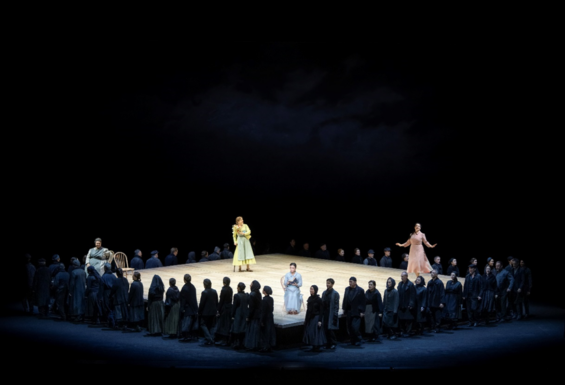
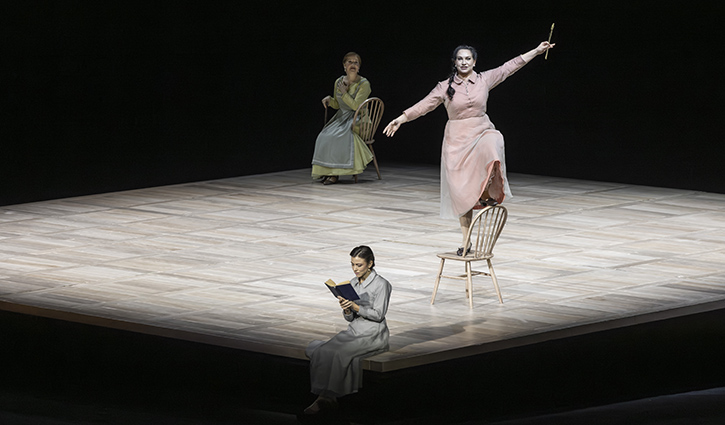
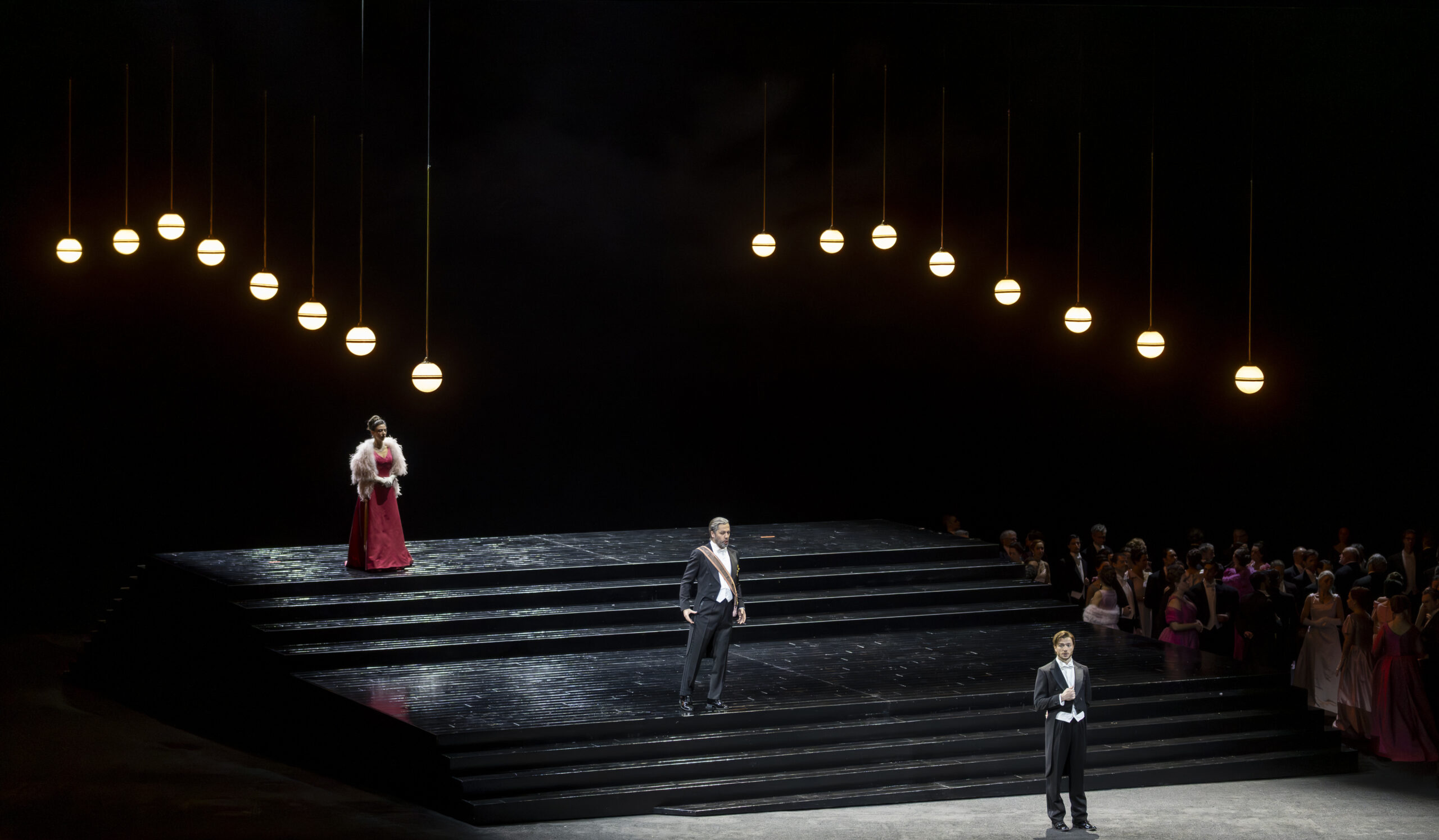
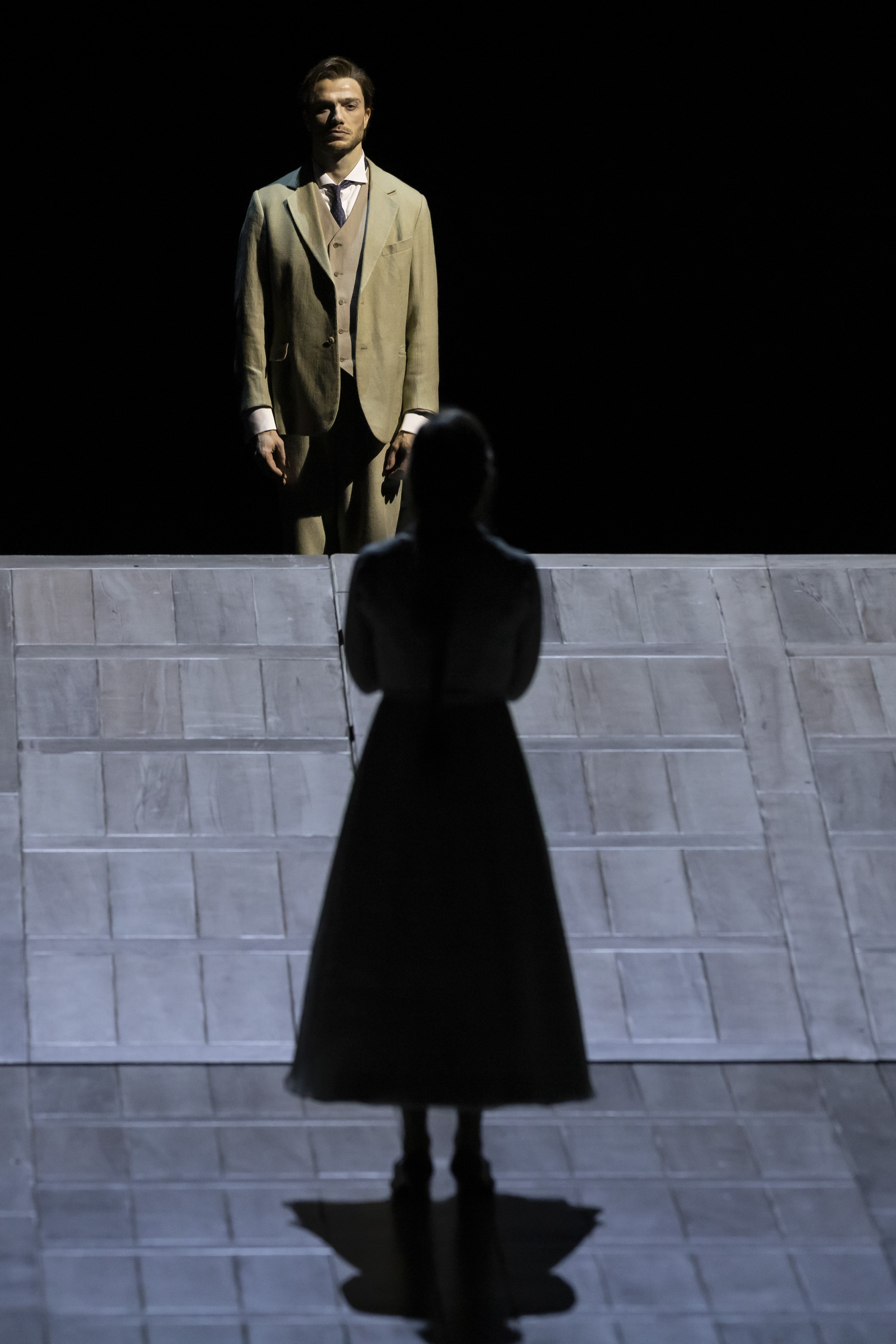
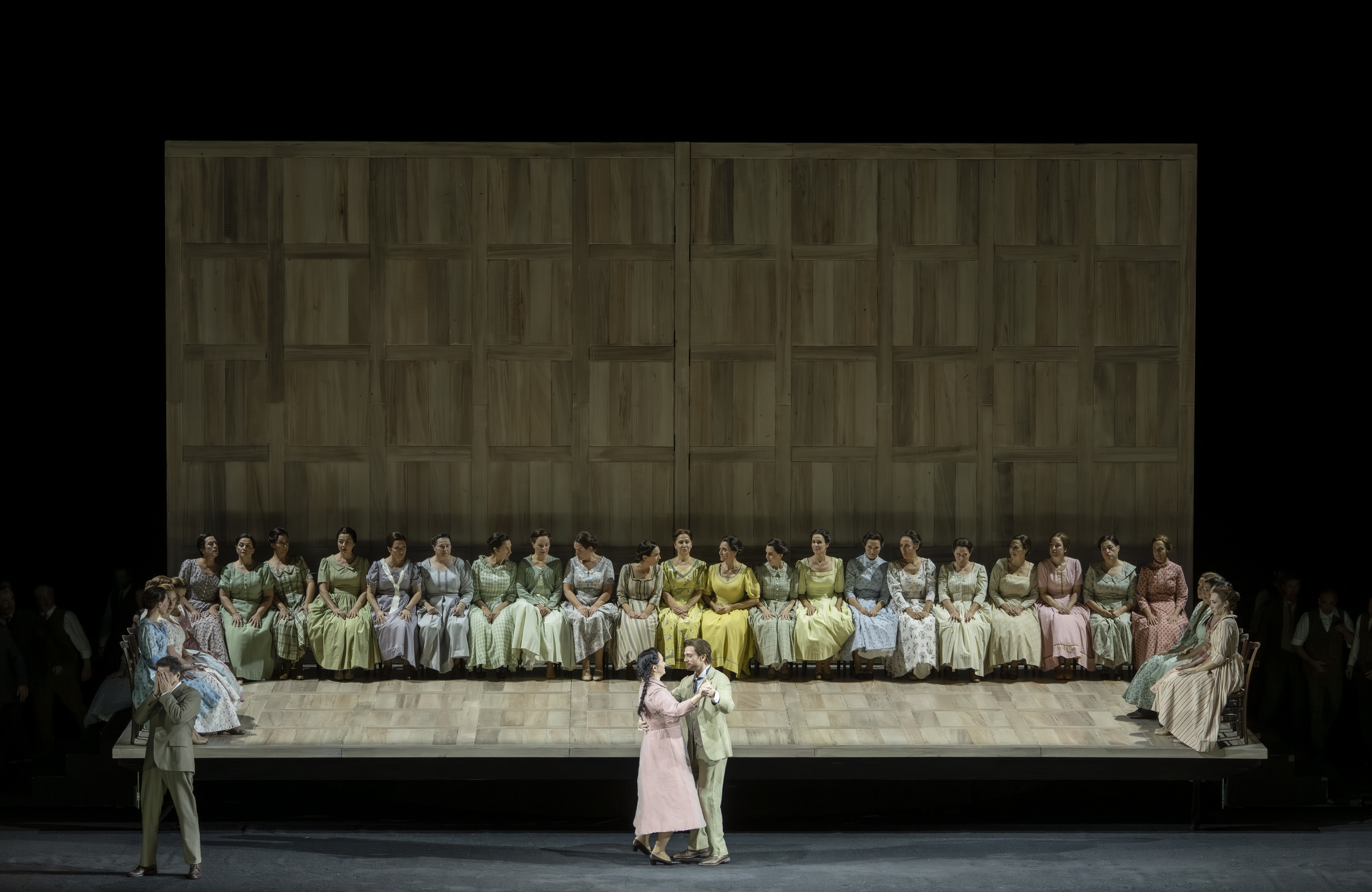
Pelly sets the action within a minimalist set, by Massimo Troncanetti. This is much sparer and far from the countryside or urban settings of other productions, yet what it does is focus our attention on the interactions between the characters. The set consists of a large wooden stage-within-a-stage, on which the action takes place. It makes for an arresting opening, having Tatyana, Olga, Larina and Filipyevna alone on stage, with nothing else around them. It brought out not only Tatyana’s loneliness but also the solitude of the countryside, in which Tatyana takes refuge in books, and all Olga wants to do is have a good time. Similarly, the staging for the letter scene is particularly striking, with the rear of the stage elevated up to encase Tatyana, as if within one of the books that she’s so passionate about. St Petersburg is staged on a large imposing set of rising and escalating stairs, perhaps illustrating Tatyana’s rise through society, surrounded by elegant costumes, completely different to her country upbringing.
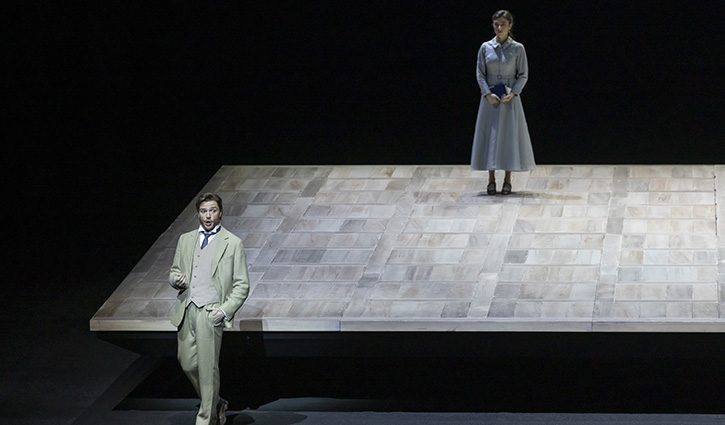
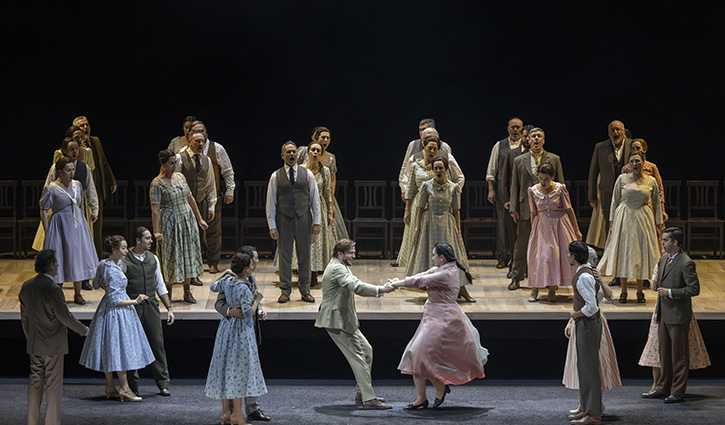
In such a concentrated setting, the focus has to be on the personenregie to create the characters and this is an aspect that works particularly successfully in this revival. The final scene was gripping. There was a physicality to Mattia Olivieri’s Onegin in his physical handling of the new Princess Gremina, passionately attempting to kiss her and viscerally, physically rejected by her. It was in such marked contrast to his demeanour earlier in the evening when he rejected her. The sheer physicality that Corinne Winters injected into her letter scene showed immense dedication. Not everything worked, however. While we did have the chorus at the front for the name day waltz, bathing us in a wall of glorious sound, having them perambulate around the block for the opening peasants chorus was less agreeable in terms of dynamics. I also found there to be a lack of that sexual tension between Onegin and Lensky that is a hallmark of Warlikowski’s Munich production, for example. Still, what Pelly has given us is a concentrated burst of dramatic energy, lit with striking beauty by Marco Giusti. Credit is also due to the singers of the Cor de la Generalitat Valenciana, who dispatched their dance moves in the name day party and in the ball scene, with tremendous vigour and accuracy, with choreography by Lionel Hoche.
The musical direction was confided to Timur Zangiev, who I saw conducting this score at the Scala last year. That was a less than fully satisfying evening, so it gives me great pleasure to report that this year’s Onegin gave significantly more pleasure. Of course, it helped that he had the exceptional Orquestra de la Comunitat Valenciana at his disposal. This band is one of the top three opera orchestras in the world by my estimation. The difference in his interpretation from last year’s was striking. The sheer wealth of sound he achieved from his musicians was staggering. Indeed, I left the house wishing for him to do a Tchaikovsky cycle with them. The full and generous beauty of the strings, the oboe full of sheer poetry in the letter scene, or lyricism of the horn playing, this was orchestral playing of the very highest distinction. Moreover, there was a remarkable depth and bloom to the sound, with the lower brass and double basses given a satisfying foundation to the textures. His tempi were on the slower side, but didn’t drag tonight. He also made frequent use of rubato, pulling us in, using those tempo manipulations to emotional effect all while keeping his singers and musicians with him. Most impressive.
This run marked Olivieri’s debut in the title role and he’s already a splendid Onegin. His baritone is utterly healthy in tone, focused and firm throughout. His diction was impeccable, using the language to truly colour the tone. He sang his arioso of rejection to Tatyana with incredibly handsome tone, so much that he probably traumatized her even more. He rose to a final scene of sheer emotional power, bringing out Onegin’s desperation through his pointing of the words, yet never submitting to the urge to hector. Olivieri’s Onegin is one of the finest I’ve had the pleasure of hearing in a long time.
Winters sang Tatyana in a large dusky, soprano with a dark edge. Hers is an interesting instrument. She sings with the utmost generosity, always allowing the voice to open up and flow freely. At the same time, the voice seems to permanently sit around the note and never quite on it – at times flat, others sharp. That Winters is an exceptionally committed singing-actress is never in doubt. And yes, she did generally sing those tricky descending motifs in the letter scene in tune, something that’s defeated many other sopranos. Winters also used the language to bring out vocal colour, using those Russian diphthongs to make the emotions register. It was an interesting assumption of the role.
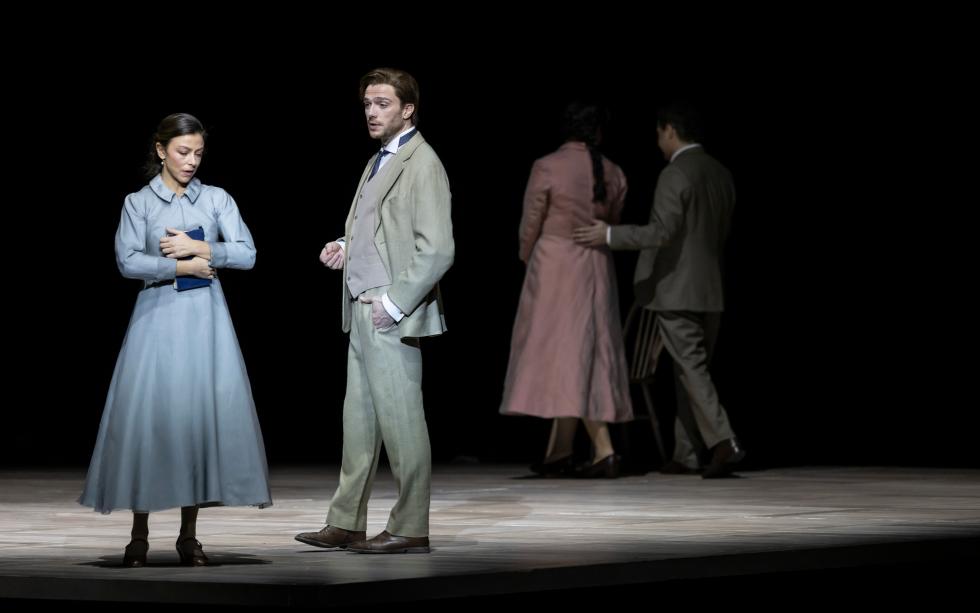
Dmitry Korchak’s tenor seems to have grown significantly since I last heard him. The voice is focused, with easy ping, and fills the theatre in a silvery burst of sound. That said, I did long for him to pull back on the volume a bit, since it was a little overwhelming at first. Then, when he got to his ‘Kuda? Kuda?’ something happened. Korchak shaded the tone with delicacy, pulling back, using the dynamics to allow the wistfulness to register. A notable artist with a lot to offer. Ksenia Dudnikova brought a deliciously dark mezzo to Olga’s music. It fills the house with generosity, and as with Winters, those distinctive Russian diphthongs were very present, filling her singing with authenticity.
Margarita Nekrasova sang Filippyevna in a large, rounded contralto. The registers may have parted company, but the warmth of her character was not in doubt. Alison Kettlewell sang Larina in a big, freely vibrating mezzo. Mark Milhofer gave us an elegant Triquet, singing his couplets with charm and affection. Giorgi Manoshvili sang Gremin’s aria in a wall of sound, big and rich, with the bottom opening up to seemingly unlimited depths. I was also impressed by Agshin Khudaverdiyev’s Zaretski, sung in a healthy, firm baritone – I’m eager to hear him take on the title role. The chorus, prepared by Jordi Blanch Tordera, was on tremendous form tonight, singing with focused amplitude and successfully managing the seemingly impossible feat of executing those complex dance moves and maintaining striking unanimity of ensemble.
This was a deeply satisfying Onegin. Pelly has given us a staging that focuses on the personal, bringing the action right down to the bare minimum, allowing the emotions to tell the story. He was well served by a dedicated cast who injected the evening with passion and commitment. Zangiev’s conducting was significantly more convincing than the last time I heard him, while the orchestral playing was simply magnificent. The audience responded at the close with generous cheers for the entire cast.
 operatraveller.com