Dean – Of One Blood
Elizabeth Tudor, Queen of England – Johanni van Oostrum
Mary Stuart, Queen of Scots – Vera-Lotte Boecker
Female Consort I – Lee Seonwoo
Female Consort II – Mirjam Mesak
Female Consort III – Lotte Betts-Dean
Female Consort IV – Meg Brilleslyper
Female Consort V / Jane Kennedy – Freya Apffelstaedt
Male Consort I / Lord Darnley – Michael Butler
Male Consort II – Joel Williams
Male Consort III / Rizzio – Andrew Hamilton
Male Consort IV / Scottish Lord I – Armand Rabot
Male Consort V / Scottish Lord II / Executioner – Paweł Horodyski
Harpsichord Solo – Mahan Esfahani
Bayerischer Staatsopernchor, Bayerisches Staatsorchester / Vladimir Jurowski.
Stage director – Claus Guth.
Bayerische Staatsoper, Nationaltheater, Munich, Germany. Saturday, June 27th, 2026.
Following his international success with his operatic version of Hamlet, Brett Dean’s new opera, Of One Blood, was premiered here, at the Bayerische Staatsoper, last month. The stories of Elizabeth Tudor and Mary Stuart have, of course, provided fertile material for operatic treatment over the years and here, together with his librettist Heather Betts, Dean has reimagined the intertwined histories of these two notable historical figures. Although the two queens never apparently met in real life, Betts takes as her starting point the letters written between the two of them, and combined these with historical sources to provide a solid basis for the musical lines to take shape on.

The stage direction was confided to Claus Guth. What Guth does, is nothing short of miraculous. Although this is a brand-new opera, his staging genuinely amplifies and reflects the shape and textures of the music. He gives us a masterclass in how to bring a score to life, while also within it creating clear, identifiable personalities and their stories. Guth sets the action within a single set by Étienne Pluss, consisting of an imposing white room, around which a group of extras in futuristic garb, by Ursula Kudrna, operate as if conducting a forensic investigation around what precisely happened between these two women. Indeed, Elizabeth makes reference to ‘curing the past’ in the libretto, and this is a theme that runs throughout both Guth’s staging and the work itself. That idea of understanding the relationships and the events, even if it can’t change the past, and allowing these women to tell their story, is one I find most intriguing. Not quite everything Guth does fully works, at least for me. He did have a group of extras randomly make movements around the queens, which seemed to add little and distracted more. And yet, the sum of Guth’s staging, the way that the set in the second act disintegrates in both the same way that the lives of the women disintegrate and reflects the shape and texture of the music, this reflects the work of a master director and technician.

By setting the lead roles for two sopranos, Dean clearly imagines these to be two personalities with as much in common as divides them. The writing for Mary Stuart is more angular, higher-lying, with leaps that from the very start seem to reflect a woman with a faltering grasp of her own sanity. The writing for Elizabeth Tudor, is more grounded, lower-lying, constantly crossing the passaggio, but also more lyrical. Indeed, there’s a big scene for Elizabeth in the second act that culminates in a reflective moment of peachy beauty, where she laments their regal status and wishes they were milkmaids. This could make for a very nice concert piece for enterprising sopranos. The vocal lines are challenging, particularly those for Mary, but they are generally singable. However, the writing for the off-stage chorus, reflecting English Tudor choral writing, must have required nerves of steel and discipline in tuning. Dean’s writing for the orchestra is extremely rhythmic. He superimposes electronic sounds on the orchestral textures, reflecting the sound of the quill on paper of Elizabeth and Mary writing to each other, with complex rhythmic writing, particularly for the brass. In some respects, it can feel too insistent – the opening scene of Mary in her court, with constantly pulsating rhythms, felt breathless and disorienting. Dean’s language contains references to Ravel and Stravinsky, but also Tudor writing, with star harpsichordist Mahan Esfahani giving us a cameo on stage as he accompanied Elizabeth. Indeed, his music seemed to switch between Tudor simplicity and modern-day complexity. Dean, and Betts, give their characters plenty of space in which to tell their stories, and yet I did find the work to be at least a half-hour too long. I found a lack of dramatic momentum, particularly in act 2, where the score ruminated at length, when it could have been tightened up and pulled towards its inevitable conclusion. Part of this perceived lack of momentum was due to the fact that the work is focused on two main characters, with the remainder of the ensemble made up of a consort of male and female singers, from which individuals emerge in certain scenes to provide key characters.

Vladimir Jurowski led the house orchestra on virtuosic form. The sheer clarity of the rhythm he obtained from them, the integrity of their tuning and unanimity of ensemble, all were seriously impressive. He brought out the hazy transparency of the strings in the few moments of repose and obtained an impressive range of orchestral colour from his musicians. Jurowski’s tempi felt just right and if, as mentioned above, there was a sense of the second act dragging, this was more due to the stasis of the work itself rather than the lead from the pit. The chorus, prepared by Christoph Heil, sang with superb discipline. Their tuning in the off-stage passages, with the Tudor-inspired melodies superimposed on orchestral textures of futuristic harmonies, was seriously impressive. There was an integrity to the tone, a purity, that I had not previously associated with them.

It must be quite demanding, yet most rewarding for two singers to be the first to sing their roles, and Vera-Lotte Boecker and Johanni van Oostrum, both rose to the challenge as Mary and Elizabeth, respectively. Boecker was on fabulous form as Mary. The role really takes a soprano to her limits, yet her instrument is so free and easily-produced, the voice soaring with seemingly unlimited freedom on top, the higher volumes never resulting in any loss of integrity of tone. She sang in generally crisp English, though the slightly rhotic R and a few exotic diphthongs were passing and did not distract. Boecker had clearly internalized both the role and the text. It’s been a while since I’ve had the pleasure of hearing her, but she really did today give notice of an artist of the highest distinction.
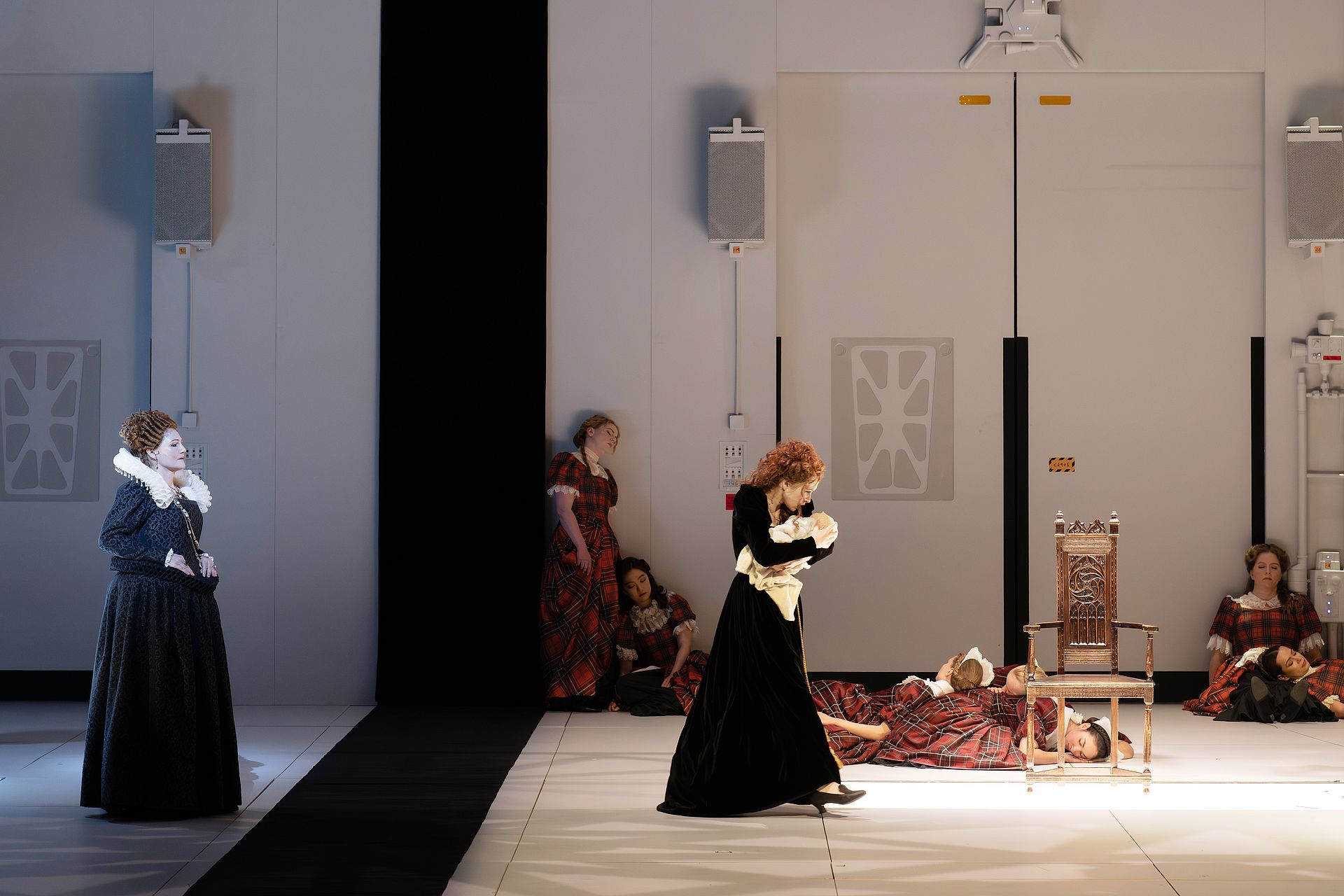
I first heard Van Oostrum over a decade ago as a glorious Marschallin in Berlin. She has gone on to have a flourishing career. The voice has a wonderful strawberries and cream tone and she is clearly a master technician, the constant crossing of the lower passaggio integrated fully. Van Oostrum sang her reflective music with radiant beauty, the long, higher-lying passages dispatched with an impeccable legato and smoothness of line. I’m not sure if the South African soprano is a native English speaker, but she sang her role with genuine textual acuity, using the words to colour the line with great intelligence and clarity.

The remainder of the cast reflected the excellent standards of this, one of the world’s greatest lyric theatres. The consort of men and women, all distinguished members of the house ensemble, sang with luminous tone and precision of tuning together. Freya Apffelstaedt, another South African reflecting the exceptional talent to have emerged from the rainbow nation over the past decade, sang with a warm, sunny mezzo in her solo assignment as Jane Kennedy. Michael Butler had a thankless role as Mary’s husband Lord Darnley, with an extremely dislikable, misogynistic character and extrovert, high-lying tenor lines. He dispatched his music with extrovert stage presence and a precise, focused tenor. Andrew Hamilton sang with excellent clarity of diction as Rizzio, his bass warm and healthy. As indeed was Paweł Horodyski’s full and resonant bass in his roles.

This made for a stimulating evening in the theatre. Guth’s staging is a major achievement, simply because he manages to amplify the music in the stage action, bringing it to life in the most convincing way. The musical standards were, as one would expect, absolutely outstanding, from the orchestral playing of staggering precision, to Boecker and Van Oostrum who gave so fully of themselves for us. I do have some reservations about the pacing of the work, that it was slightly too meandering for full dramatic cogency, but it is undoubtedly well constructed and conceived. While there were a very few early departures at intermission, the audience response at the close was positive, with generous acclaim for Boecker and Van Oostrum.
 operatraveller.com