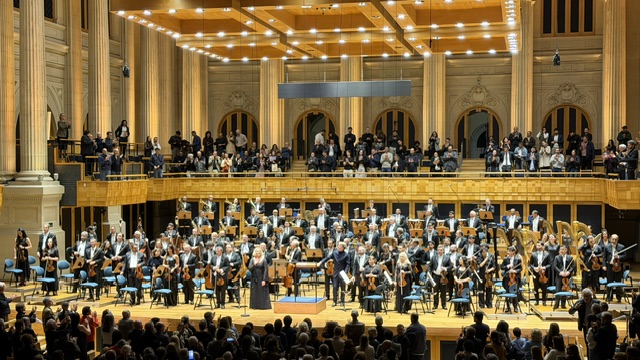
Wagner – Lohengrin: Vorspiel
Wagner – Die Meistersinger von Nürnberg: Ouvertüre
Wagner – Tannhäuser: Ouvertüre und Bacchanal
Wagner – Götterdämmerung: Selection
Brünnhilde – Aile Asszonyi
Orquestra Sinfônica do Estado de São Paulo / Marc Albrecht.
Concert performance.
Sala São Paulo, São Paulo, Brazil. Friday, May 29th, 2026.
The city of São Paulo is exceptionally fortunate to be home to the phenomenal Sala São Paulo. Opened in 1999, the hall is located in the former station hall of the Júlio Prestes Station in the downtown of the largest city in the Americas. Seating 1500, the main hall is set in a shoebox shape, with a wonderfully spacious acoustic, one which allows the orchestral sound to open up and bloom fully. While the acoustic is indeed exceptional, it does mean that one hears absolutely everything, including dropped program books, shuffling in the row behind, and audience members whispering. It’s an exceptionally handsome venue and a privilege to visit, a symbol of the transformational power of culture to bring an old, disused building to life. Due to its location, there are naturally some safety concerns when visiting, but the hall very much facilitates visitors’ access by posting security guards at the entrance, providing a direct access to the neighbouring Luz metro station avoiding the street, and facilitating direct taxi access from a secure parking lot.
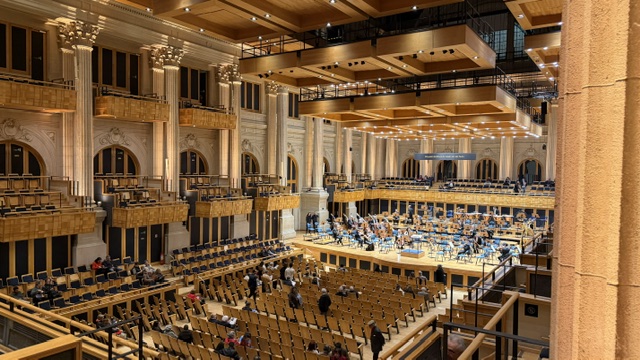
Tonight marked my fourth visit to this remarkable hall, but this is the first time that I’ve had the opportunity to review an evening there. The hall is home to the Orquestra Sinfônica do Estado de São Paulo (OSESP) and its choruses. Note, that in the Brazilian variant of the Portuguese language, the word ‘Sinfónica’ is spelled as ‘Sinfônica’. The OSESP, with a history stretching back to 1953, is widely recognized as one of the finest symphonic formations in South America, and its performances are made widely available to a larger audience through its channel on the YouTube, as indeed will this concert of music by Wagner. On this occasion, the orchestra invited German maestro Marc Albrecht, a noted Wagnerian, to conduct this program consisting of three overtures plus a selection from Götterdämmerung. At around sixty-five minutes of music, this concert did feel like rather short measure, however. They could certainly have added more music from the Ring or a few other overtures.
It was rather daring of Albrecht to open the evening with the Lohengrin Vorspiel, starting as it does on a thread of sound. He encouraged the OSESP strings to start from the softest pianissimo. This was moderately successful, with the string tone initially rather brittle, though as the dynamics opened up, the string sound revealed a tone of luminous sheen. Albrecht phrased the music in big, vertical blocks of sound, focusing on granite-like sonorities, rather than melodic beauty. It was an interesting approach, much more Teutonic than Latin. One of the most glorious musical experiences I had last year was hearing São Paulo’s other symphony orchestra, that of the Teatro Municipal, playing Mahler 3, where they made the music sound utterly Brazilian in its warmth and generosity. I was very much hoping for a similar approach tonight. After all, one of the most wonderful aspects of hearing music all over the world is being able to experience how orchestras bring different national traditions to their playing. The OSESP is obviously a superb band, able to blend in with the style demanded by the conductor, and this was certainly the case here. The Meistersinger overture was given a big-boned, romantic, perhaps even bombastic, approach. There were big, thick-pile long string phrases and gleaming brass, yet the quicker sections also felt more serious than playful, again more Germanic than Latin, undoubtedly following Albrecht’s approach.
This approach was also perceptible in the Tannhäuser overture and bacchanale. That driving, pushing and pulling of the bacchanale, the kind of music that should sound indecently filthy, here felt a bit straight-laced and lacking in personality. Technically, it was excellent, apart from a very small number of brass accidents, those silky strings making the echoes of the invitation to the grotto ideally pulchritudinous. And yet, I longed for Albrecht to allow this fabulous orchestra to show its personality more, to let them off the leash and really make the bacchanale as racy and exciting as it should be.
Following the intermission, the orchestra, augmented by six harps and significant numbers of brass, returned to give us the selection from Götterdämmerung, consisting of Siegfried’s Rheinfahrt, the Trauermarsch, and the Schlussgesang, joined by Aile Asszonyi. Readers may recall that I last saw Asszonyi in the absolute travesty that was Konwitschny’s production of Die Frau ohne Schatten in Bonn. These extracts again demonstrated Albrecht’s approach. It was efficient and confident, yet those insistent stabs in the Trauermarsch felt powerful, but failed to strike the sheer pain they needed to. It was extremely well played, though lacking in emotion. It must have been difficult for Asszonyi to come out and sing her fifteen minutes from nowhere – what a missed opportunity it was not to ask her to sing the Liebestod also, perhaps to conclude the first half. She sang her music in a bulky, slightly grainy soprano. The voice is large, but the size is produced by slightly distorting some of the vowel sounds in her vocal production. Asszonyi’s intonation was frequently accurate, but the higher reaches were aimed at, rather than hit straight on, the voice sounding as if it needed some heavy lifting to get up there – though the elevator stopped a few floors short.
That said, something happened in the closing moments. Maybe it was the fact that the finish line was in sight, but the orchestra seemingly gained a myriad of instrumental colours; those echoes of the Rhinemaidens took on a cantabile beauty that was hitherto missing, the glinting flames of Valhalla gleamed in bright orchestral tints, and the redemption through love motive soared and glowed. It felt that the orchestra was finally giving us its true personality as if released from its Teutonic shackles.
It was a treat to be able to hear this music in this magnificent acoustic, even if I did leave with a less than unanimously positive impression of Albrecht’s conducting. The program itself also felt rather short and it was a bit decadent to bring Asszonyi over for one item, when she could certainly have offered more as part of the evening. Still, there was, despite some reservations, much to enjoy in the evening and the audience response at the close was exceptionally generous. Tomorrow’s performance will be broadcast live on the YouTube and made available for on demand viewing in due course.