Nono – Intolleranza 1960
Un emigrante – Giovanni Tristacci
La sua compagna – Gabriela Geluda
Una donna – Marly Montoni
Un algerino – Isaque Oliveira
Un torturato – Anderson Barbosa
Solo soprano – Laryssa Alvarazi
Coro Lirico Municipal, Orquestra Sinfônica Municipal / Priscila Bomfim.
Stage directors – Nuno Ramos & Eduardo Climachauska.
Theatro Municipal, São Paulo, Brazil. Tuesday, June 3rd, 2026.
The Theatro Municipal (a house which uses the antique spelling of the Portuguese word for theatre) is certainly offering its audience an audacious 2026 season. In addition to a concert performance of Mahler 8 last month, July sees a new Tristan und Isolde with an international cast, and a Don Carlo in September with a similarly starry lineup. Last weekend, the house offered the first-ever performances in South America of Nono’s Intolleranza 1960. It’s a work few operagoers have ever had the opportunity to see live – it was certainly my first occasion seeing it – and the house has double-cast the run, with mainly local singers. It’s a huge undertaking, a piece that’s exceptionally challenging for the chorus and the orchestra, and this new production is most definitely a statement of intent.
Intolleranza is a rarely-heard work. There are several reasons for that. The music is exceptionally difficult for the singers. The choral writing requires a discipline of tuning and pitching that would challenge even the most proficient of choruses. The solo writing is extremely poorly written for the voices, requiring wide leaps across the registers, sustained high writing for the tenor and soprano, and big brass outbursts that are exceptionally taxing in their continuous length. This is isn’t a conventional opera, with a clear narrative that has a start and end point. Rather, it’s a series of interlinked scenes, that track a migrant’s journey from Southern Italy to an undefined land, where he’s confronted with police brutality, and muses on the nature of freedom. Along the way, he meets various people, including a woman he conjugates with, an Algerian refugee, and a figure called ‘La compagna’ who randomly comes along for the ride. The writing is consistently loud, the effect of the seventy-five minutes resembles something like being continually bludgeoned by a sonic hammer. It’s certainly noble in its ambition, to cry out against oppression and fascism, written as it was in the shadow of the Shoah. And yet, there’s a lack of light and shade. More importantly, the characters are barely drawn so we don’t really get to know or care for them, simply because the vocal writing is so unstintingly brutal to them – and indeed to us as listeners.
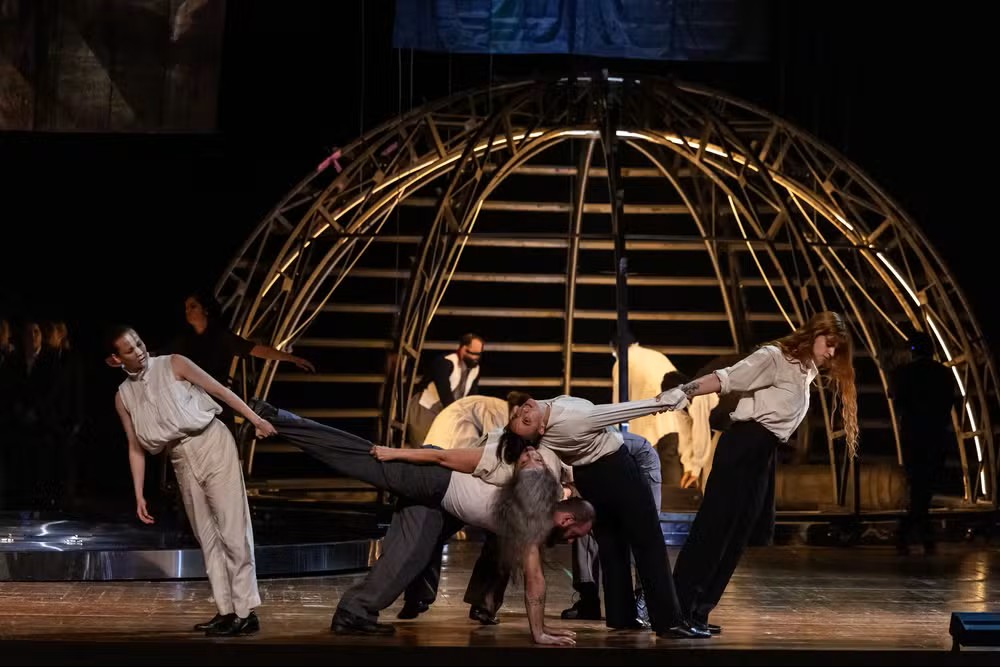
The stage direction was confided to the duo of Nuno Ramos and Eduardo Climachuaksa, both well-known artists in Brazil, whose work cuts across the boundaries of art installations, film, and music. This production marks their first foray into opera and it must be admitted that right from the opening moments, it was clear that this was the work of operatic novices. The very best opera productions are those that amplify the impact of the music, rather than drowning it in symbolism. Rather than giving us, as audience members, the space to think and absorb what we saw, Ramos and Climachauska instead drown the score under layers of visual ‘noise’ that mean that the work loses any impact it may have, reinforcing that impression of being bludgeoned for an hour and half. There were signs at the very start of what laid in store. The opening chorus, was accompanied by a succession of random words projected on to the curtain. While I was attempting to tune into the words being sung, or read the surtitles, the random text served to completely distract from what we heard. As the evening developed, Ramos and Climachauska made use of extras to populate the stage. These indulged in random yoga poses, or movements that seemed redolent of capoeira. They also frequently fell to the stage noisily, something that my seat neighbours found hysterically funny the fourth time around. I’m still wondering what the figure who spent most of the evening turning around in circles was doing. I really hope he didn’t end up hurling all over the stage as a result.
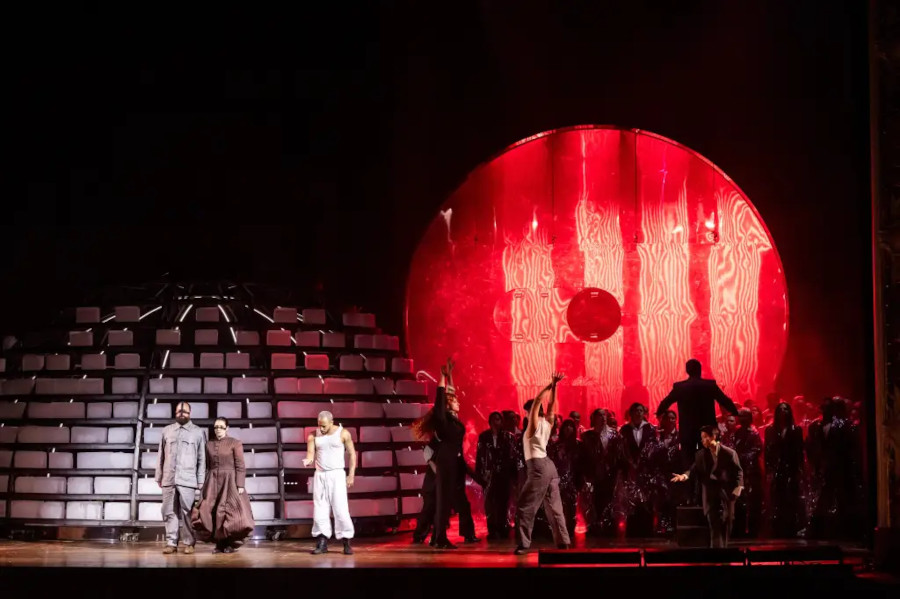
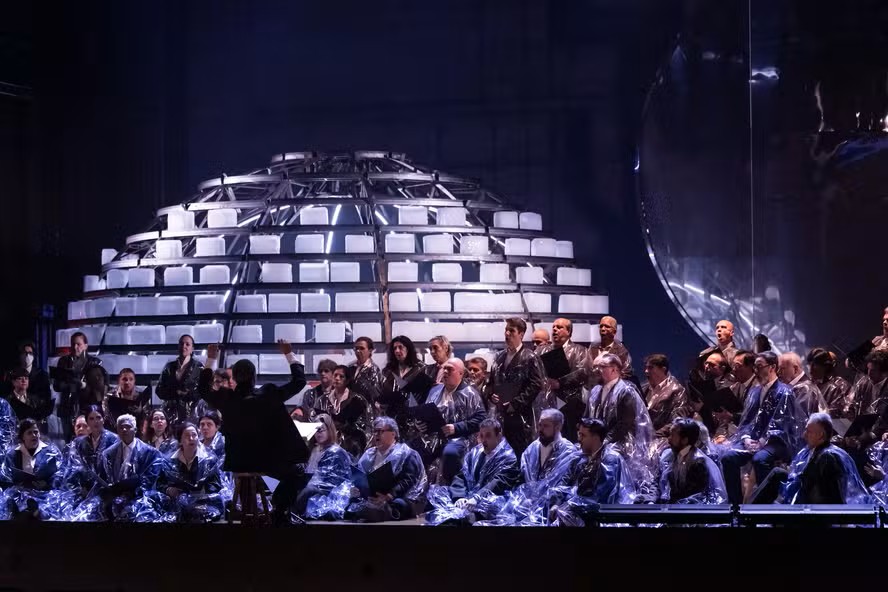
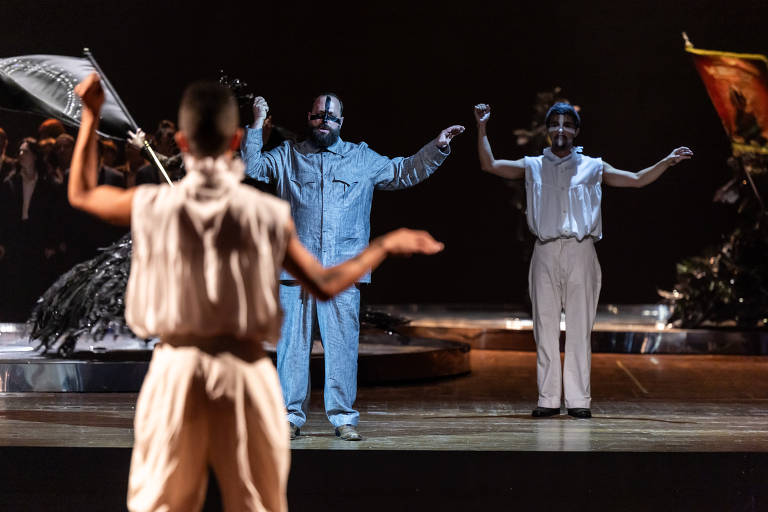
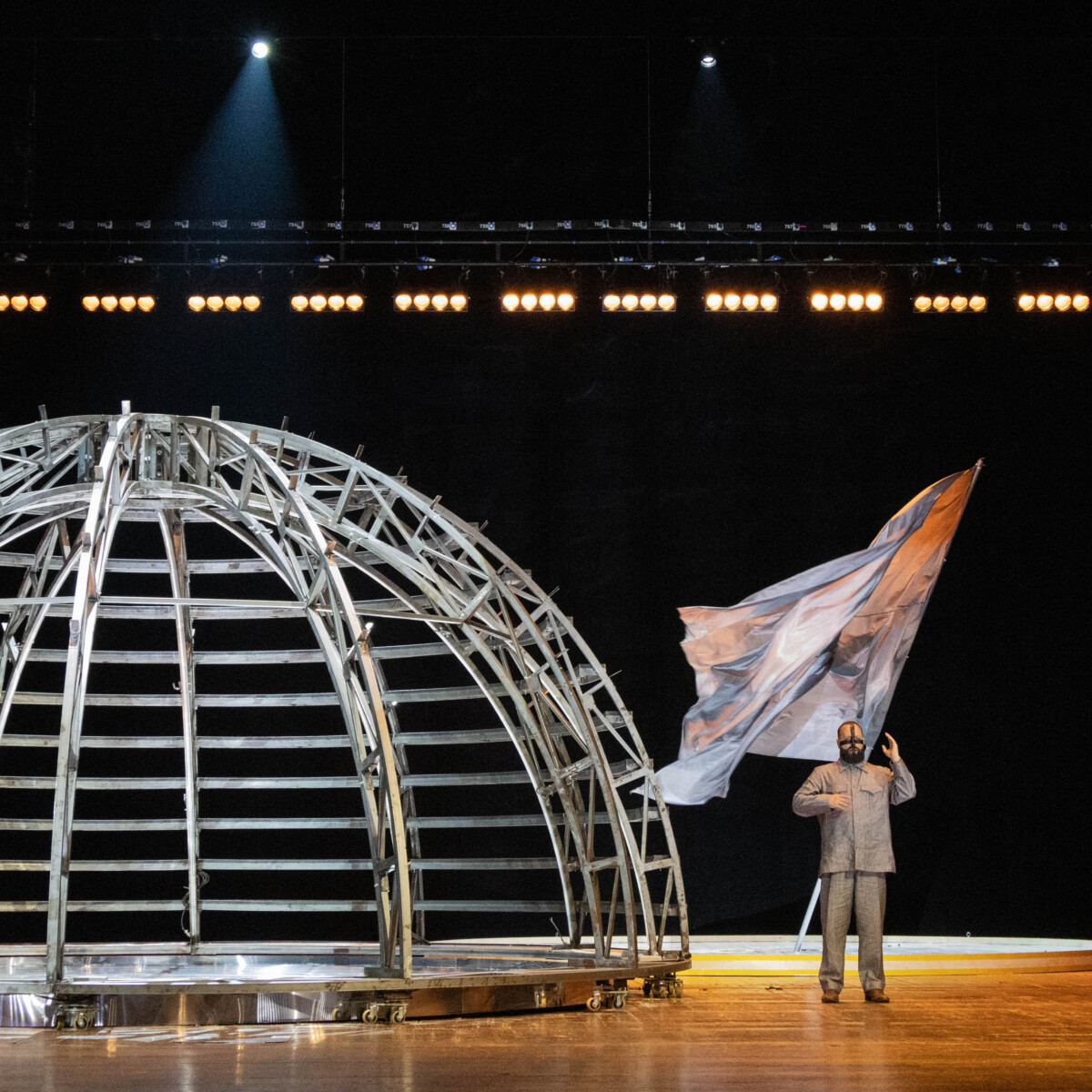
It was clear Ramos and Climachauska also didn’t trust their principals to tell a story. Or, perhaps the less charitable interpretation is they were unable to direct them. Instead, they had two actors per principal mimic their movements, both at the front of the Plateia behind the conductor, blocking sightlines for those of us sitting there, and on stage. The set, by Renan Marcondes and Marcus Garcia, has a structure that has echoes of the Genbaku Dome in Hiroshima, one of the few structures standing in the Japanese city after its bombing, within which the actors construct a cannon on wheels. In an entr’acte linking the first and second half of the evening, the structure is dismantled and moved to the front, while one of the extras violently plays a wind machine, only for the structure to be reconstructed and filled with white blocks as to suggest an igloo being built. I left the theatre asking myself two questions: what did the imagery actually mean and did it accentuate the music? While the Hiroshima reference was obvious, the igloo was less so, and the set and the movement of the extras served to accentuate how under-directed the principals and large chorus were, with the latter simply parked at the front or at the sides as required. Intolleranza is a work that focuses on the struggle of the individual against an oppressive state and in taking the focus of the production away from the principals, what Ramos and Climachauska have done is precisely what the work seeks to confront: they have taken the attention away from the individuals to be able to tell their story and, instead, reinforced the system of stage decorations and extras. It felt very much like a missed opportunity.
A shame because the musical side was more than decent. Bomfim had been assisting Roberto Minczuk on the musical preparation, but when the latter became unwell and unable to lead the run, Bomfim stepped up to ensure the musical direction for the production. She was ably supported by chorus master, Hernán Sánchez Arteaga, who conducted his singers on the stage. Bomfim secured superb playing from the Orquestra Sinfônica Municipal (note that in the local variant of the Portuguese language, ‘Sinfónica’ is written as ‘Sinfônica’). The brass playing was particularly distinguished, playing with strength and not a split note all night. There was a precision to the orchestral playing tonight that reflected the long hours of preparation that had clearly been well spent. The Coro Lirico Municipal, around one hundred strong, made a mighty noise. The accuracy of their tuning was also spectacularly good. The choral writing is just as brutal as the solo writing, with several passages of extremely loud, focused writing. The chorus rose to the occasion, pouring out focused tone into the house, their commitment simply awe-inspiring.
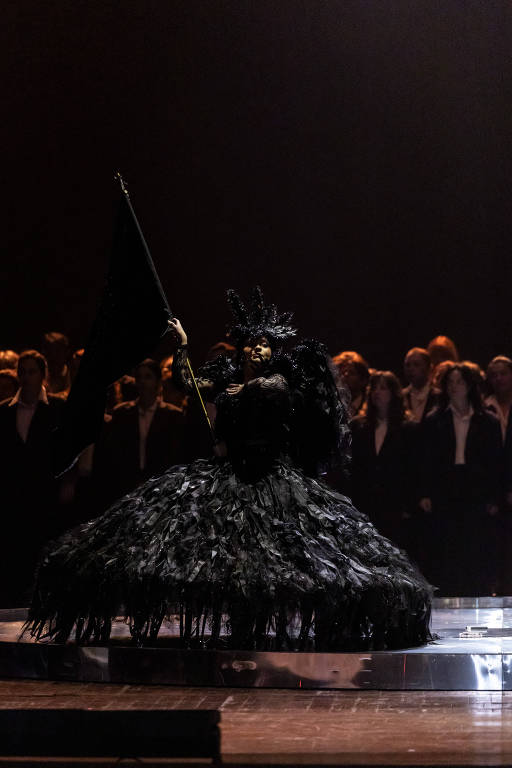
For this run, three of the principal roles have been double-cast, and I saw the second of the two. The Emigrante was taken by Giovanni Tristacci. The Brazilian tenor trained in Catalonia and in Belgium, and he’s the owner of a bright, focused Italianate instrument. He coped exceptionally well with the high-lying tessitura of his role, pouring out streams of rich, golden tone without a hint of strain. Gabriela Geluda sang La compagna. This is a horrific role for the singer, requiring long, sustained and loud singing high up in the voice. Geluda was unafraid to make some ugly sounds up there, leading one to be worried about the health of her instrument. Her commitment was not in doubt, however, and she was utterly valiant in her approach. Marly Montoni sang La donna in a rich contralto, the wide leaps dispatched with aplomb. Isaque Olivieira sang the Algerino in an exceptionally handsome baritone, the voice seemingly able to defy gravity with easy reach on top. Anderson Barbosa sang the Torturato with confidence, as indeed did Laryssa Alvarazi in the brief soprano solo.
One must indeed be grateful to the Municipal for the opportunity to hear this work, even if it now comes across as dated and poorly written for the voices. The house forces had clearly given the work their very best. The quality of what we heard from the orchestra and chorus reflected the very highest standards, ones that any theatre in the world would be proud to produce. Ramos and Climachauska’s staging was sadly extremely problematic, failing in the simple task of allowing the work to tell its own story. A pleasure, however, to see the house completely full for the performance, with an incredibly diverse audience, who greeted the final curtain call with generous applause – and indeed, greeted the cast with a huge ovation in the lobby at the close.

